E4.8 - Chords and tangents
Circle symmetry controls lengths as well as angles. You will use perpendicular distances to equal chords, locate the centre using chord bisectors, and set equal the two tangent segments drawn from one external point.
Equal chords and distance from the centre
Two equal chords lie on opposite sides of a circle's centre. If the gap between these parallel chords is , how far is each from the centre? The important measurement is not a sloping line to an endpoint: that endpoint is already one radius away.
Distance from a point to a line
The distance from a point to a line is the length of the perpendicular segment from the point to the line. For a chord, measure perpendicularly from the centre to the line containing the chord.
Draw and , with the centre and the feet on chords respectively. The distances are and , not and . Those latter lengths are radii, whether or not the chords are equal.
Equal chords and equal distances
Equal chords in the same circle are equidistant from the centre:
where lies on , lies on , and . The chords need not be parallel for this equality.
Not given in the List of formulas: learn this circle property.
A chord of a fixed length can be turned around the centre without changing how deeply it lies in the circle. Symmetric positions on either side of the centre therefore have the same perpendicular distance. The same-circle condition matters: equal chords in circles of different radii need not have equal distances from their centres. A diameter has distance zero.
[DIAGRAM: asset_name: Equal chords use perpendicular distances; asset_slug: equal_chord_distances; caption: The marked right angles identify the distances from the centre.; description: Three exact circles have equal parallel chords AB and CD on opposite sides of centre O, with perpendicular feet M and N. In the first the equal chords are each 12 centimetres and OM is 3.5 centimetres while ON is x. In the second the full separation MN is 7 centimetres and both individual distances are unknown. In the third MN is 9.2 centimetres. The equality AB=CD is written above each circle, and right angles are marked at both feet.]
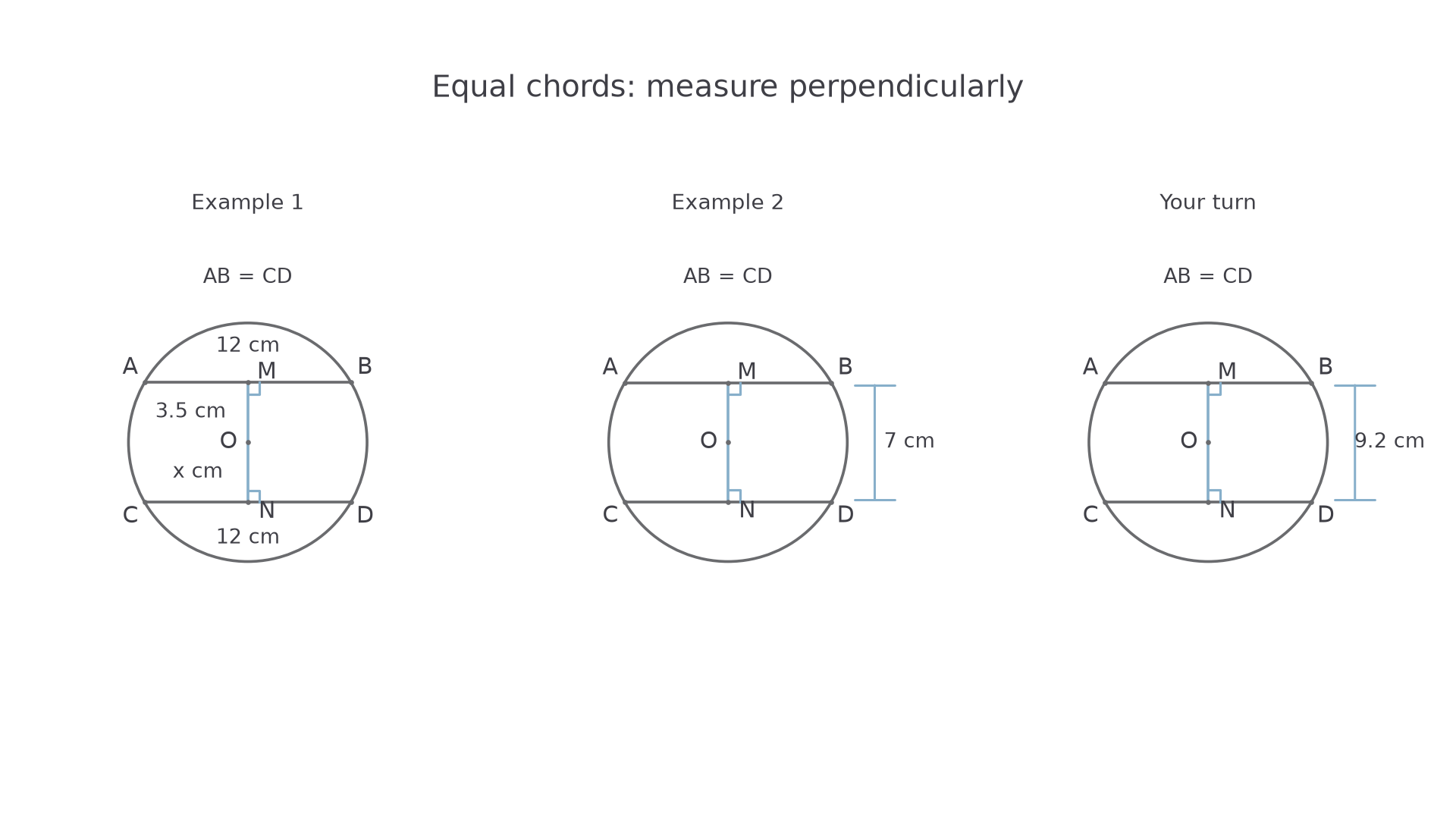
Worked example 1: copying a perpendicular distance
Question. In one circle with centre , . Perpendiculars from meet the chords at respectively, and . Find , giving a reason.
Plan. Use the equality of the chords to equate their perpendicular distances.
Answer. .
Check. The two perpendicular segments have equal lengths, so exchanging the two equal chords leaves the given distance unchanged. No radius calculation is needed.
Keep the equal opposite parallel chords, but give their total separation instead of one individual distance.
Worked example 2: sharing the gap equally
Question. Equal parallel chords and lie on opposite sides of centre . Their common perpendicular meets them at , with in that order and . Find and .
Plan. The distances are equal and together make the stated gap.
Answer. Both distances are .
Check. , and both lengths are perpendicular to their chords, as the distance definition requires.
Halving the gap used an additional condition: the parallel chords lie on opposite sides of the centre. The equal-chord distance property itself does not require parallel chords.
Watch out
“, so the chords are equally far from ” compares radii and proves nothing about chord distance. Mark the perpendicular feet before naming the distances.
Now answer the opening question with its fresh gap.
Perpendicular bisectors of chords
A perpendicular bisector of a chord is a line crossing the chord at its midpoint at . Circle symmetry connects that line to the centre: reflecting the circle across it swaps the chord's endpoints and leaves the centre fixed.
Chord bisector and centre
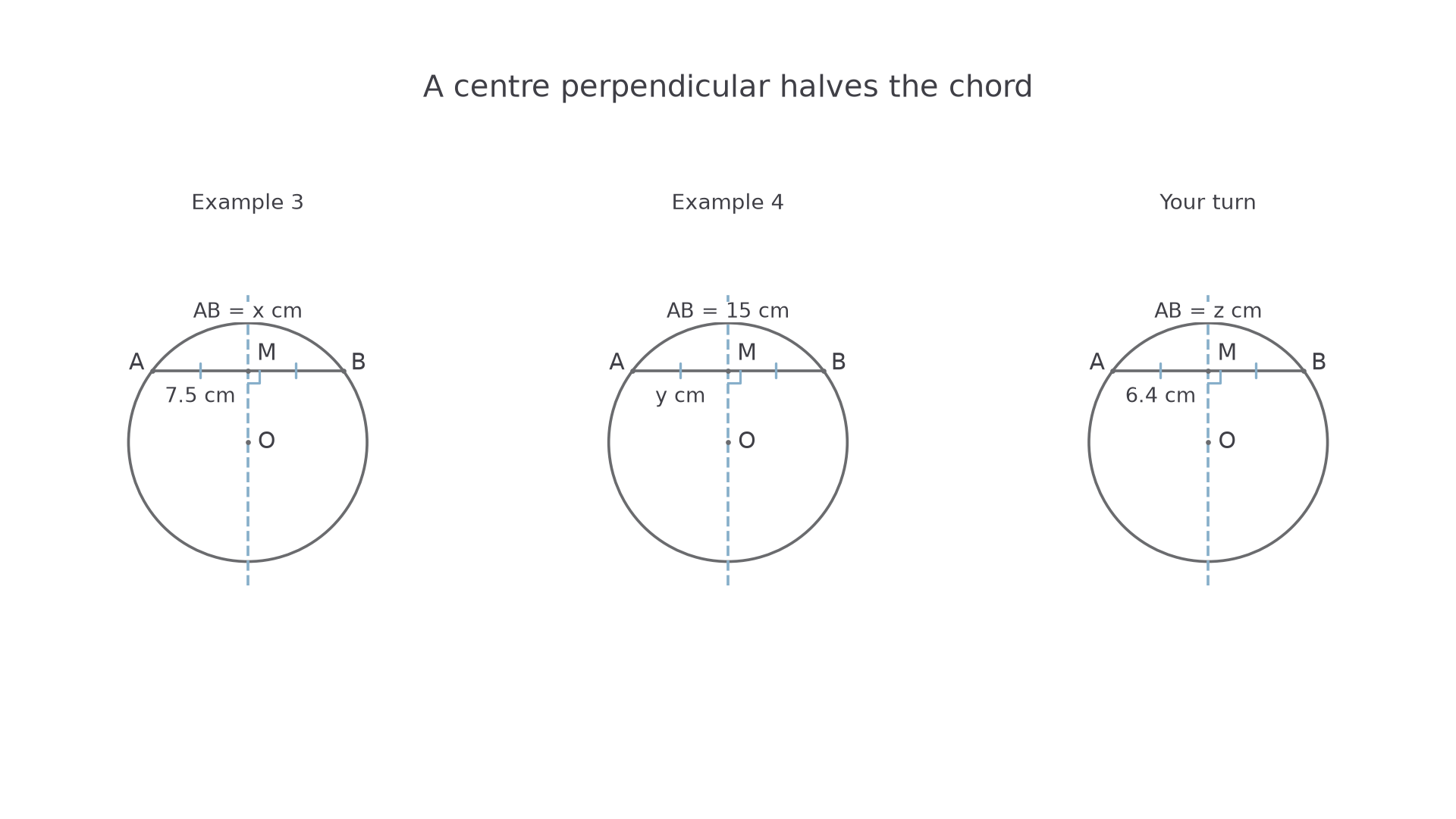
The perpendicular bisector of a chord passes through the centre of its circle. Equivalently, a line through the centre perpendicular to a chord bisects that chord.
For a non-diameter chord, if is the centre, lies on , and , then
For a diameter, its midpoint is the centre, and the perpendicular bisector still passes through that centre.
Not given in the List of formulas: learn this circle property.
The two conditions work together. For a non-diameter chord, passing through the centre alone does not establish that a line halves the chord; the right-angle condition does. A perpendicular line through some other point of a chord need not pass through the centre.
[DIAGRAM: asset_name: A perpendicular from the centre bisects a chord; asset_slug: chord_perpendicular_bisectors; caption: Right angle plus centre gives equal chord halves.; description: Three exact circles have chord AB, centre O, midpoint M and line OM meeting AB at a right angle. Matching ticks mark AM and MB. In the first AM is 7.5 centimetres and the whole AB is x. In the second AB is 15 centimetres and AM is y. In the third AM is 6.4 centimetres and AB is z. A dashed extension of OM continues through O to show the full perpendicular bisector.]
Continue this lesson.
You’re previewing NovaLearn without an account. Create a free account to read the rest.
Create free account