C5.1; E5.1 - Metric units and conversions
A metre contains one hundred centimetres, but a square metre contains many more than one hundred square centimetres. You will convert metric lengths and masses, explain square and cubic conversion factors, and connect the volume of a container to its capacity in litres.
Length and mass conversions
If , why is not ? First separate the size of a unit from the number of units you need.
A desk has the same length whether you describe it as or . Centimetres are smaller units, so more of them fit along the desk. A conversion changes the number and the unit together; it does not change the actual length.
You already know
Multiplying or dividing by , or changes decimal place value. Use the conversion relationship to choose which operation is needed, rather than moving a decimal point without a reason.
The standard length relationships are
For mass, . Mass describes how much matter an object contains. A gram measures mass, so it cannot be converted into centimetres, which measure length.
To go to a smaller unit, multiply by the number of those smaller units in one larger unit. To reverse the conversion, divide by the same factor. A zero measurement remains zero; ordinary physical lengths and masses are non-negative.
Worked example 1: measuring in a smaller unit
Question. A cable is long. Write its length in centimetres.
Plan. Replace each metre by one hundred centimetres.
Answer. .
Check. Two metres account for , leaving . This agrees with .
Keep the same cable but reverse which unit is given. The factor is unchanged; the operation reverses.
Worked example 2: measuring in a larger unit
Question. A cable is long. Write its length in metres.
Plan. Group the centimetres into hundreds.
Answer. .
Check. The result is between and , because lies between and .
The same reasoning applies to other metric units. For example, , , and .
Watch out
is wrong. A larger unit needs a smaller numerical count: divide by , giving .
Use the unit size to check the direction of each conversion.
Square and cubic units
An area unit covers a surface; a volume unit fills space. Their conversion factors come from counting in two or three directions.
Imagine a square with side . Each side is , so it contains rows of centimetre squares:
A cube of side has centimetre cubes along each edge and layers. Therefore
[DIAGRAM: asset_name: Units in two and three dimensions; asset_slug: square_cubic_conversion; caption: Count rows for area and layers as well for volume.; description: A square metre has both sides labelled 100 centimetres and the equation 100 times 100 equals 10000 square centimetres. Beside it a cube has three edges labelled 100 centimetres and the equation 100 times 100 times 100 equals 1000000 cubic centimetres. A note explains the grid divisions are grouped and not individual centimetre cells.]
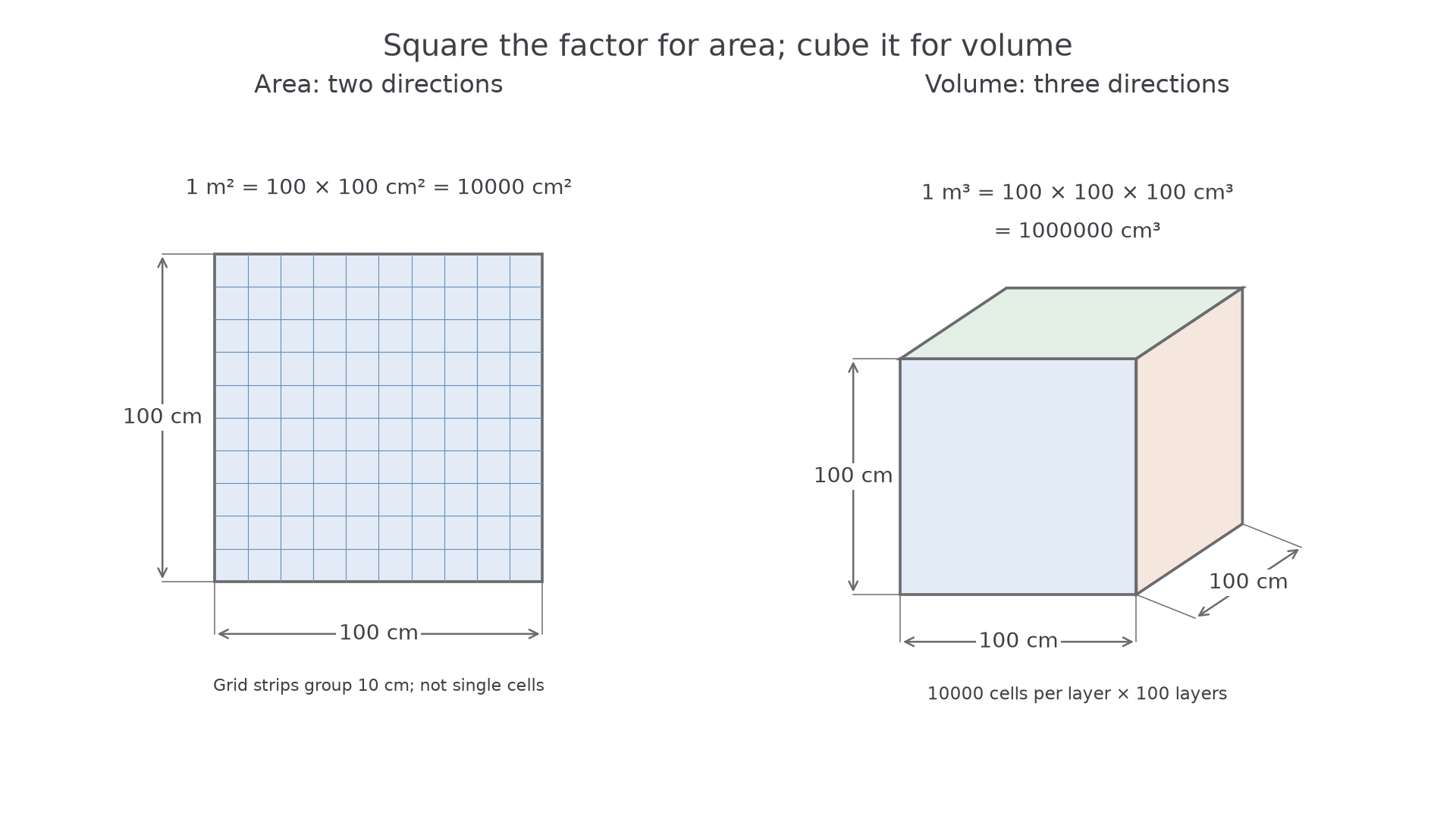
Square and cubic conversion factors
If one large length unit equals small length units, then
Here . Reverse either conversion by dividing by its factor.
Not given in the List of formulas: understand the counting.
Useful consequences are , , and . The exponent belongs to the whole unit, not to the measurement's numerical value.
Continue this lesson.
You’re previewing NovaLearn without an account. Create a free account to read the rest.
Create free account