C4.6; E4.6 - Angles in polygons
A regular polygon's angles follow from its number of sides, so you can calculate them without measuring. You will build interior-angle sums from triangles, understand exterior angles as turns, and work backwards from an angle to the number of sides.
Interior angle sums
Could a regular polygon have an interior angle of ? The answer will reveal exactly how many sides it needs. Start with the total amount of angle inside a polygon.
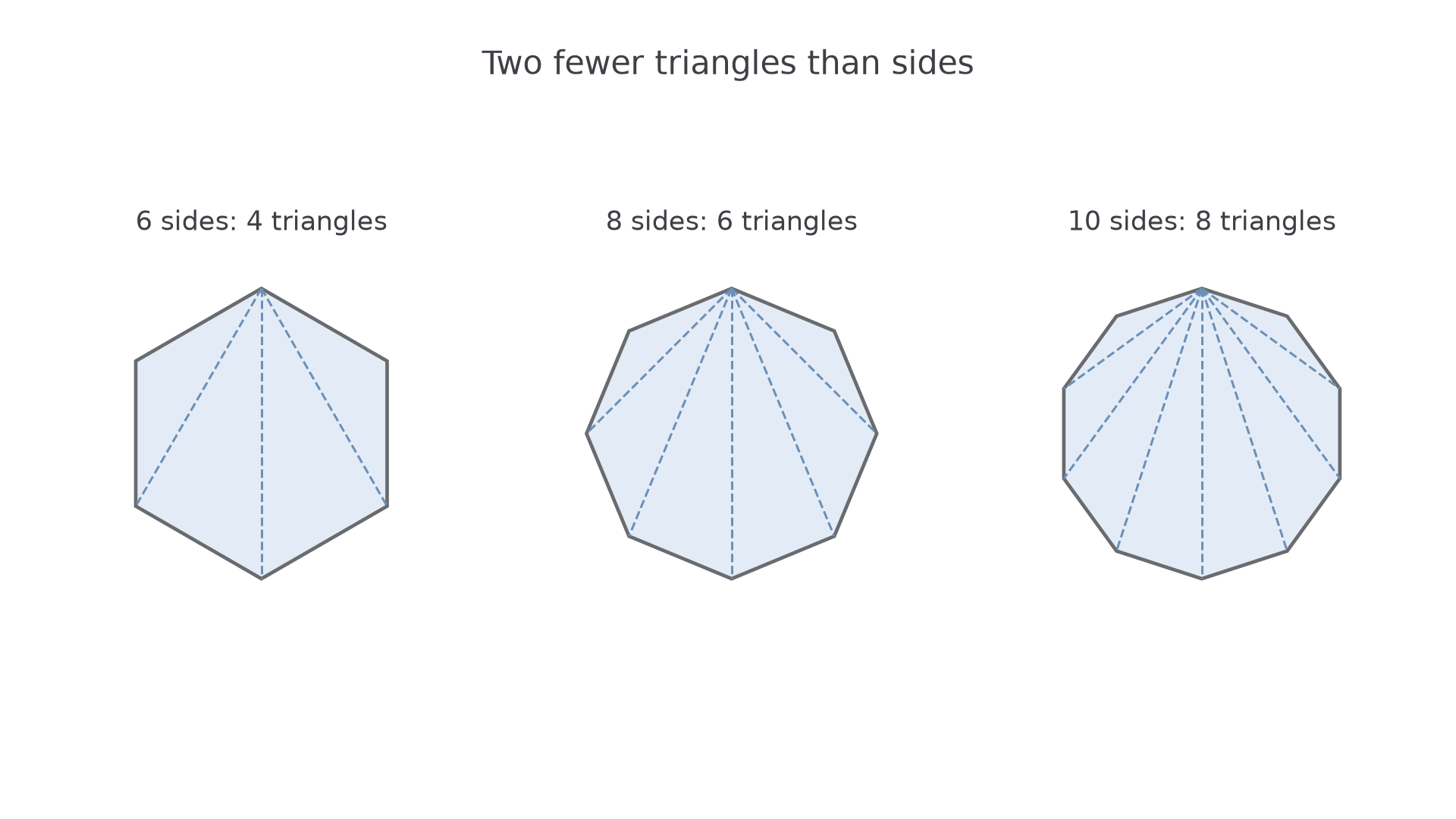
An interior angle lies inside the polygon at a vertex. Choose one vertex of a convex polygon and draw diagonals to every non-neighbouring vertex. The diagonals stay inside and split the polygon into triangles without gaps or overlaps. A pentagon makes three triangles; adding one side makes room for one more triangle.
[DIAGRAM: asset_name: Triangulating convex polygons; asset_slug: polygon_triangle_fans; caption: A fan from one vertex contains two fewer triangles than the number of sides.; description: A regular hexagon, octagon and decagon are each divided from one chosen vertex into respectively four, six and eight non-overlapping triangles. Diagonals are dashed blue and each diagram labels its triangle count.]
Interior-angle sum
For a convex polygon with sides, the fan contains triangles, so
Here is a whole number at least . The formula gives a total, not an individual angle.
Not given in the List of formulas: understand the triangle derivation.
Why subtract two? Of the other vertices, the two neighbours connect by sides already present. The remaining diagonals divide the interior into one more region than the number of diagonals: triangles. We use regular convex polygons here; regular means equal sides and equal angles.
Worked example 1: the sum for a hexagon
Question. Calculate the sum of the interior angles of a regular hexagon.
Plan. Count the triangles from one vertex, then multiply by their angle sum.
Answer. .
Check. Dividing equally between six angles gives each. Six such angles total .
Change only the side count. Each additional side contributes one more triangle to the fan.
Worked example 2: the sum for an octagon
Question. Calculate the sum of the interior angles of a regular octagon.
Plan. Replace six sides by eight in the triangle count.
Answer. .
Check. There are two extra sides compared with the hexagon, so the total increases by . Indeed, .
Watch out
“An octagon's angle is ” confuses a total with one angle. The total is ; regularity is needed before dividing it equally among eight vertices.
Keep the triangle count separate from the side count.
Exterior angles and a full turn
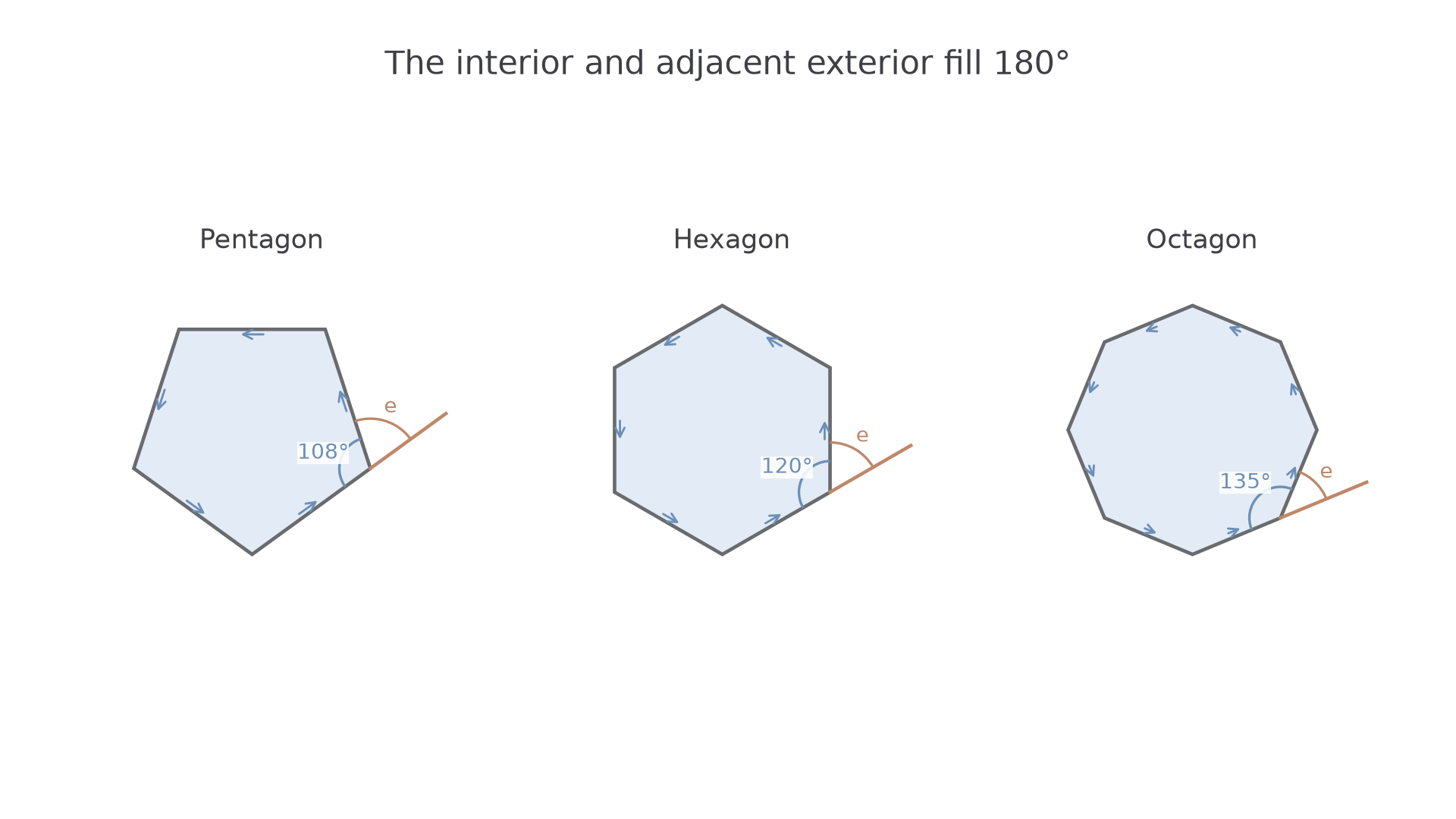
Walk round a convex polygon, continuing along each side and turning at the corners. When you arrive back facing your original direction, your turns total one full turn, . At each vertex, the turning angle is the exterior angle between a side's forward extension and the next side.
Interior and exterior angles
At a vertex of a convex polygon, an interior angle and its adjacent exterior angle lie on a straight line:
One exterior turning angle at each vertex, taken consistently round the polygon, totals .
Not given in the List of formulas: connect the straight angle with the full turn.
[DIAGRAM: asset_name: Interior angles and outside turns; asset_slug: regular_exterior_turns; caption: Extend the incoming side forwards to identify the adjacent exterior angle.; description: A regular pentagon, hexagon and octagon each have one incoming side extended forwards at a highlighted vertex. Interior arcs are labelled 108 degrees, 120 degrees and 135 degrees, while adjacent exterior arcs are labelled e. Small arrows show consistent anticlockwise travel around each polygon.]
Continue this lesson.
You’re previewing NovaLearn without an account. Create a free account to read the rest.
Create free account