C1.2; E1.2 - Sets and two-set Venn diagrams
A person can belong to two clubs without becoming two people. For Core and Extended, C1.2/E1.2 uses sets to organise such overlaps. You will describe sets, read union, intersection and complement notation, and fill two-set Venn diagrams without counting anyone twice.
Defining sets and a universal set
In a class of , students play football and play basketball. Does that mean different students play a sport? Some could play both. Before counting them, we need a way to say exactly which people each group contains.
A set is a well-defined collection of distinct objects, called its elements. “The prime numbers below ten” defines a set: you can decide whether any proposed number belongs. “The nicest numbers” does not, unless you supply an agreed rule for “nicest”.
Set notation
List a set's elements inside braces, for example . Order does not matter, and repeating an element does not add another element. The notation means the number of distinct elements in , so here .
The universal set, , contains all the objects being considered in the problem. Every set in that problem stays within it.
You can describe the same set by a condition. For example,
The colon means “such that”; the letter stands for a possible element. With , only numbers in that universal set are available. The dots continue the stated pattern; they are safe here because every integer from one to ten is intended.
Worked example 1: a condition becomes a list
Question. The universal set is the integers from to , inclusive. Set contains the factors of . List and find .
Plan. Find the distinct positive factors, then count the list.
Answer. , .
Check. Each listed number divides exactly; the six available integers do not.
Keep the factor rule, but reduce the universal set. This changes which otherwise valid factors are available.
Worked example 2: the universal set matters
Question. Now , and again contains the numbers in that are factors of . List and find .
Plan. Test only the six available elements against the factor rule.
Answer. , .
Check. Of the six available numbers, only fails. Therefore five belong; cannot be included because it is outside .
The list describes the same set as . A set records which elements are present, rather than how often a label was written.
Watch out
confuses a count with a set. Write and .
In the next problem, the factor rule and the universal set both restrict the list.
Union, intersection and complement
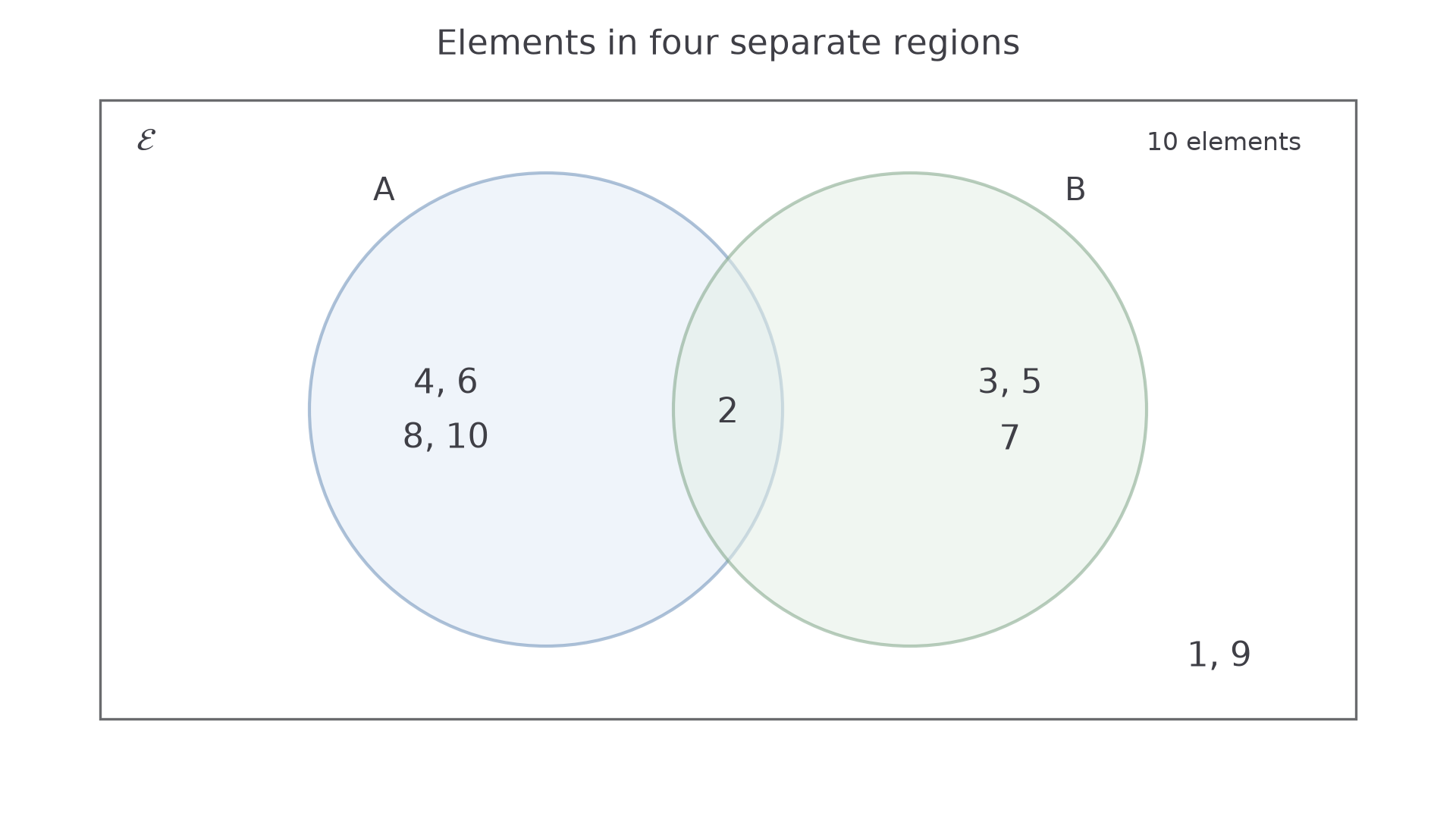
A Venn diagram draws the universal set as a rectangle and each named set as a closed region, usually a circle. An element inside both circles belongs to both sets. Put it in the overlap once, rather than writing a copy in each circle.
Take , and . The overlap contains , the only number here that is both even and prime.
[DIAGRAM: asset_name: Elements in two overlapping sets; asset_slug: sets_elements_regions; caption: Each element occupies exactly one of the four regions.; description: A universal rectangle contains overlapping circles A and B. A only contains 4, 6, 8 and 10; the intersection contains 2; B only contains 3, 5 and 7; outside both contains 1 and 9.]
Union, intersection and complement
, the union, contains elements in or , including those in both. , the intersection, contains elements in both and .
, the complement of , contains every element of that is not in . The prime mark means “not in this set”, rather than “not in either circle”.
“Or” in a union includes the overlap. Everyday language sometimes uses “or” to demand a choice, but set union means at least one of the sets. Complement always needs a universal set: the complement of the even numbers in this picture is not every odd number in existence.
Worked example 3: finding the union and intersection
Question. For the sets and above, list and .
Plan. Collect all elements inside either circle for the union, and only shared elements for the intersection.
Answer. The union contains eight elements; the intersection is .
Check. The two universal elements missing from the union are and , precisely those outside both circles. Only appears in both original lists.
Continue this lesson.
You’re previewing NovaLearn without an account. Create a free account to read the rest.
Create free account