E6.3 - Exact trigonometric values
A calculator gives decimals for trigonometric ratios, but a carefully chosen triangle gives their exact values. You will derive the values for special angles, use surds in exact calculations, and explain what happens at zero and ninety degrees. This lesson is for Extended.
The forty-five-degree triangle
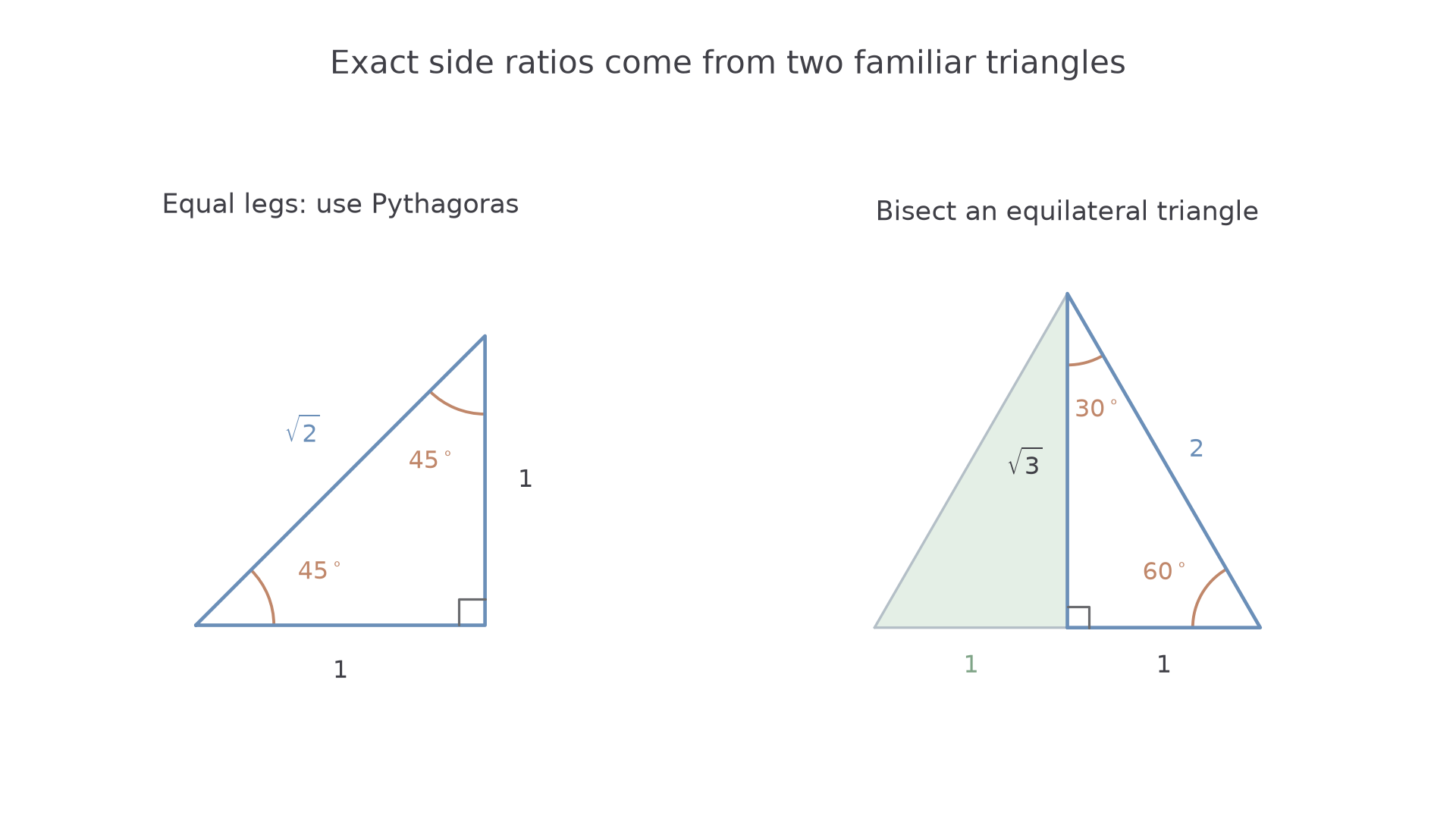
Can a triangle give you an exact answer that a long decimal cannot? Draw a right-angled isosceles triangle with two legs of length . Its two acute angles are equal and add to , so each is .
Pythagoras gives the hypotenuse . The sine and cosine ratios are both . Multiplying numerator and denominator by writes this as , with no approximation.
[DIAGRAM: asset_name: The exact special triangles; asset_slug: exact_triangles; caption: Pythagoras fixes the side ratios for 45 degrees and for 30 and 60 degrees.; description: Two exact right triangles side by side. The first has legs 1 and 1, hypotenuse square root 2 and two 45 degree angles. The second is half of an equilateral triangle of side 2, with short leg 1, long leg square root 3, hypotenuse 2, and angles 30 and 60 degrees. The remaining half of the equilateral triangle is shown faintly. All right angles are marked.]
Exact values at forty-five degrees
These are ratios, so enlarging the triangle does not change them.
Not given in the List of formulas: learn them.
For a length problem, still choose opposite, adjacent and hypotenuse first. An exact ratio replaces a calculator key; it does not replace the triangle.
Worked example 1: finding a leg
Question. A right-angled triangle has a angle and hypotenuse . Find the exact length of each leg.
Plan. Use cosine for one leg; isosceles symmetry gives the other.
Answer. Each leg is .
Check. . This verifies the original hypotenuse without using decimals.
Now the given length is a leg instead of the hypotenuse. The unknown moves to the denominator of the ratio.
Worked example 2: finding the hypotenuse
Question. A right-angled isosceles triangle has legs of length . Find its exact hypotenuse .
Plan. Use the same ratio, but solve for the whole hypotenuse.
Answer. .
Check. Pythagoras gives , and . Also, the hypotenuse is longer than either leg.
Watch out
is not exactly. If asked for an exact value, keep the surd. Replacing it by a rounded decimal loses the exact relationship.
The thirty-sixty-degree triangle
Split an equilateral triangle of side down its line of symmetry, as in the second diagram. The perpendicular bisects both its base and its top angle. One half has hypotenuse , short leg , and angles and .
Its remaining leg has length . Looking from and then swaps the opposite and adjacent legs.
Exact values at thirty and sixty degrees
For , tangent is . For , it is .
Not given in the List of formulas: learn them.
The short leg is opposite ; the long leg is opposite . This gives a useful independent check on any calculation.
Worked example 3: viewing from thirty degrees
Question. A right-angled triangle has hypotenuse and an angle of . Find the exact opposite and adjacent lengths relative to that angle.
Plan. Multiply the hypotenuse by sine and cosine.
Answer. Opposite ; adjacent .
Check. Their ratio is . Also, .
Keep the same triangle but view it from its other acute angle. Only the reference angle changes.
Continue this lesson.
You’re previewing NovaLearn without an account. Create a free account to read the rest.
Create free account