C4.6; E4.6 - Angles in parallel lines
Parallel lines let an angle at one crossing determine an angle at another. You will distinguish corresponding, alternate and co-interior angles, then combine these facts with straight-line and triangle sums in reasoned chains.
Corresponding and alternate angles
Can one angle beside a railway line determine an angle beside the other rail? Yes, if the rails are parallel and the same straight line crosses both. That crossing line is a transversal. The parallel condition links its two intersections.
Corresponding and alternate angles
Corresponding angles occupy the same relative position at the two crossings of a transversal and parallel lines. They are equal.
Alternate interior angles lie between the parallel lines, on opposite sides of the transversal. They are equal.
In the diagrams, , the transversal passes through upper intersection and lower intersection , and continues above to . Moving the lower crossing straight onto the upper one preserves the parallel-line directions and the transversal direction: corresponding sectors match. Alternate equality then follows by combining corresponding equality with vertically opposite equality at a crossing.
[DIAGRAM: asset_name: Corresponding and alternate positions; asset_slug: corresponding_alternate_positions; caption: Use the marked parallel lines and the same transversal to identify the pair.; description: Three exact panels have horizontal parallel lines AB and CD cut by transversal F P Q. The first marks BPF 62 degrees and DQP as x, a corresponding pair. The second marks DQP 62 degrees and APQ as y, an alternate interior pair. The third marks DQP 71 degrees and APQ as z for the fresh check. Matching arrows mark the horizontal lines as parallel.]
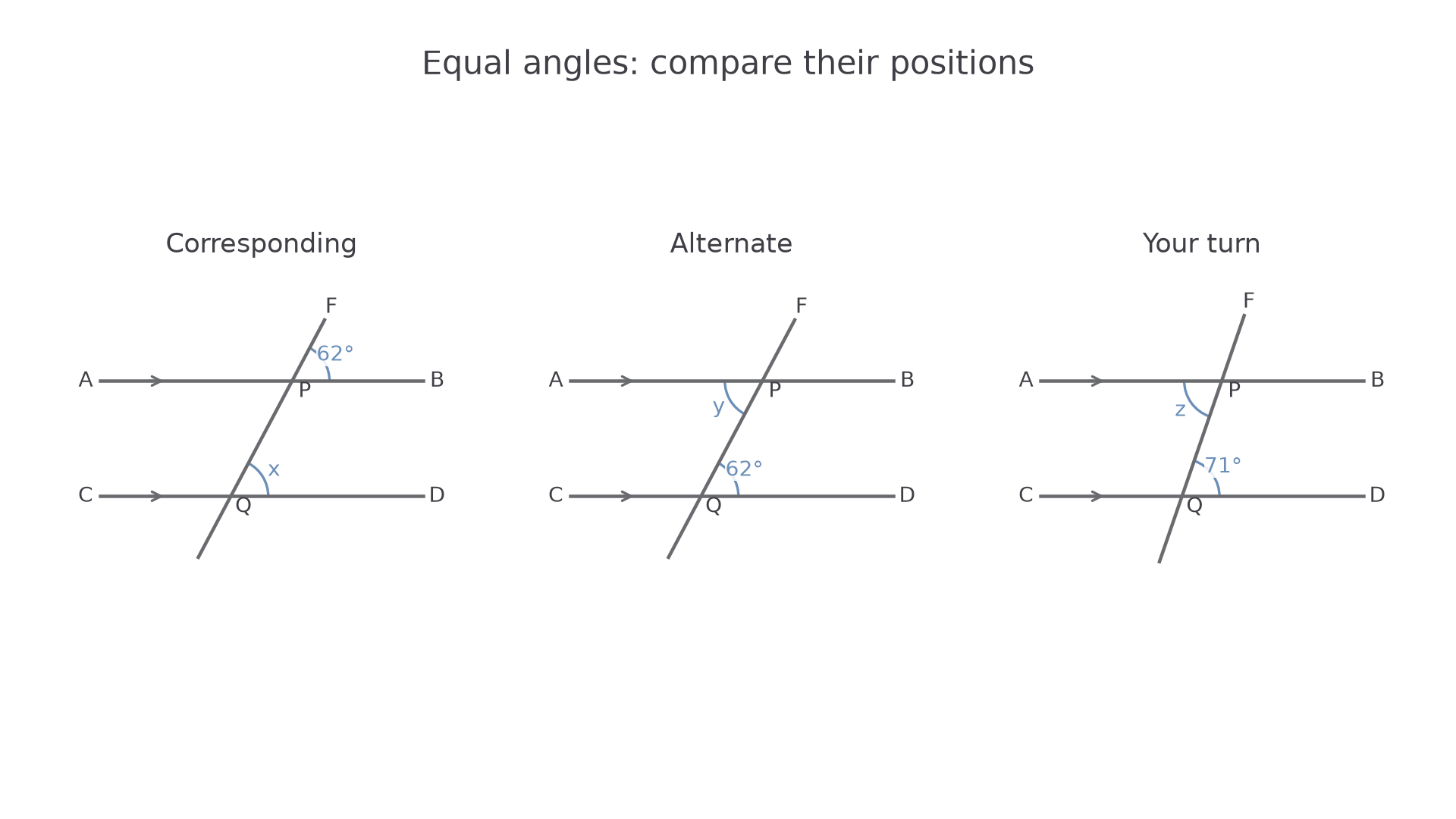
Worked example 1: corresponding positions
Question. . The straight transversal passes through in that order. Given , find and give a reason.
Plan. Compare the upper-right sector at each crossing.
Answer. , because corresponding angles in parallel lines are equal.
Check. Both angles lie above their parallel line and to the same side of the transversal. The neighbouring angle at would instead be .
Keep the same angle size and lines, but move the target to the opposite side of the transversal inside the strip.
Worked example 2: alternate positions
Question. in the same layout. Given , find and give a reason.
Plan. Pair the two interior sectors on opposite sides of .
Answer. , because alternate angles in parallel lines are equal.
Check. Corresponding equality first gives . Its vertically opposite angle is , confirming the same result by a second route.
Watch out
“These are equal because the diagram looks like a Z” leaves out the essential condition. State “alternate angles in parallel lines”. If parallelism is neither given nor established, the equality is not guaranteed.
Use the positions rather than the orientation of the page.
Co-interior angles
The interior angles on the same side of a transversal do something different: they complete a straight angle. They are called co-interior angles. You may also meet the name “interior angles on the same side”.
Co-interior angles
When a transversal crosses parallel lines, a pair of co-interior angles is supplementary:
They need not be equal. They are equal only in the perpendicular-transversal case, when both are .
Not given in the List of formulas: learn the parallel-line angle relationships.
Why the sum? Transfer one angle to a corresponding angle at the other crossing. There, it sits next to the other co-interior angle on a straight line. The corresponding equality turns that local sum into the co-interior rule.
[DIAGRAM: asset_name: Co-interior angles complete a straight angle; asset_slug: cointerior_supplementary; caption: Same side inside the parallel strip means add to 180 degrees.; description: Three exact parallel-line diagrams show co-interior angles APQ and CQP on the left of transversal PQ. APQ is respectively 64 degrees, 107 degrees and 78 degrees, while CQP is unknown. The transversal slopes appropriately in each panel, so all drawn interior arcs match the stated obtuse or acute angle.]
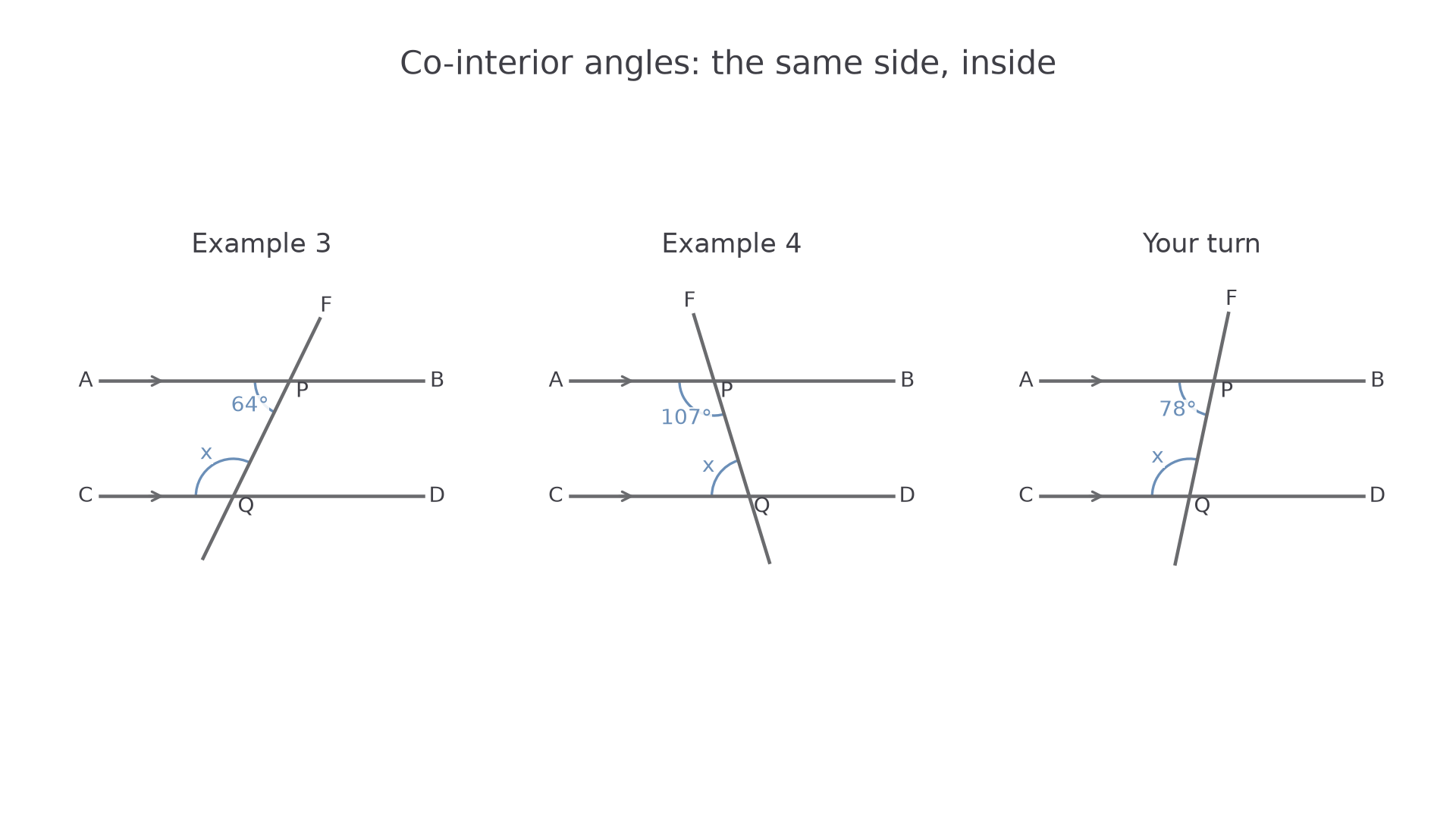
Worked example 3: an obtuse partner
Question. , and crosses the lines at . Given , find and give a reason.
Plan. Identify the two angles inside the parallel strip on the same side of the transversal.
Answer. .
Check. The angle is alternate to the given , so it is . At , , agreeing with the straight line .
Continue this lesson.
You’re previewing NovaLearn without an account. Create a free account to read the rest.
Create free account