E3.7 - Perpendicular lines and bisectors
A right angle has an algebraic signature: perpendicular sloping lines have related gradients. You will explain that relationship, find a perpendicular line through a point and combine it with midpoint calculations to find perpendicular bisectors, as required by E3.7.
Perpendicular gradients
If a line has gradient , why is a perpendicular line's gradient , rather than ? Draw a direction triangle with a run of right and a rise of up. Turn the whole triangle anticlockwise through : the three-unit horizontal side points up, and the two-unit vertical side points left. The new sloping side has signed run and rise , giving gradient .
[DIAGRAM: asset_name: A quarter-turn exchanges rise and run; asset_slug: perpendicular_gradient_turn; caption: Turning the whole right triangle through a right angle exchanges the changes and reverses one sign.; description: Equal-scale axes show O at the origin, A at three comma two and B at negative two comma three. OA has horizontal change three and vertical change two. Its anticlockwise quarter-turned copy OB has horizontal change negative two and vertical change three. Both right-angled direction triangles are shown, and a right-angle marker between OA and OB identifies the perpendicular directions.]
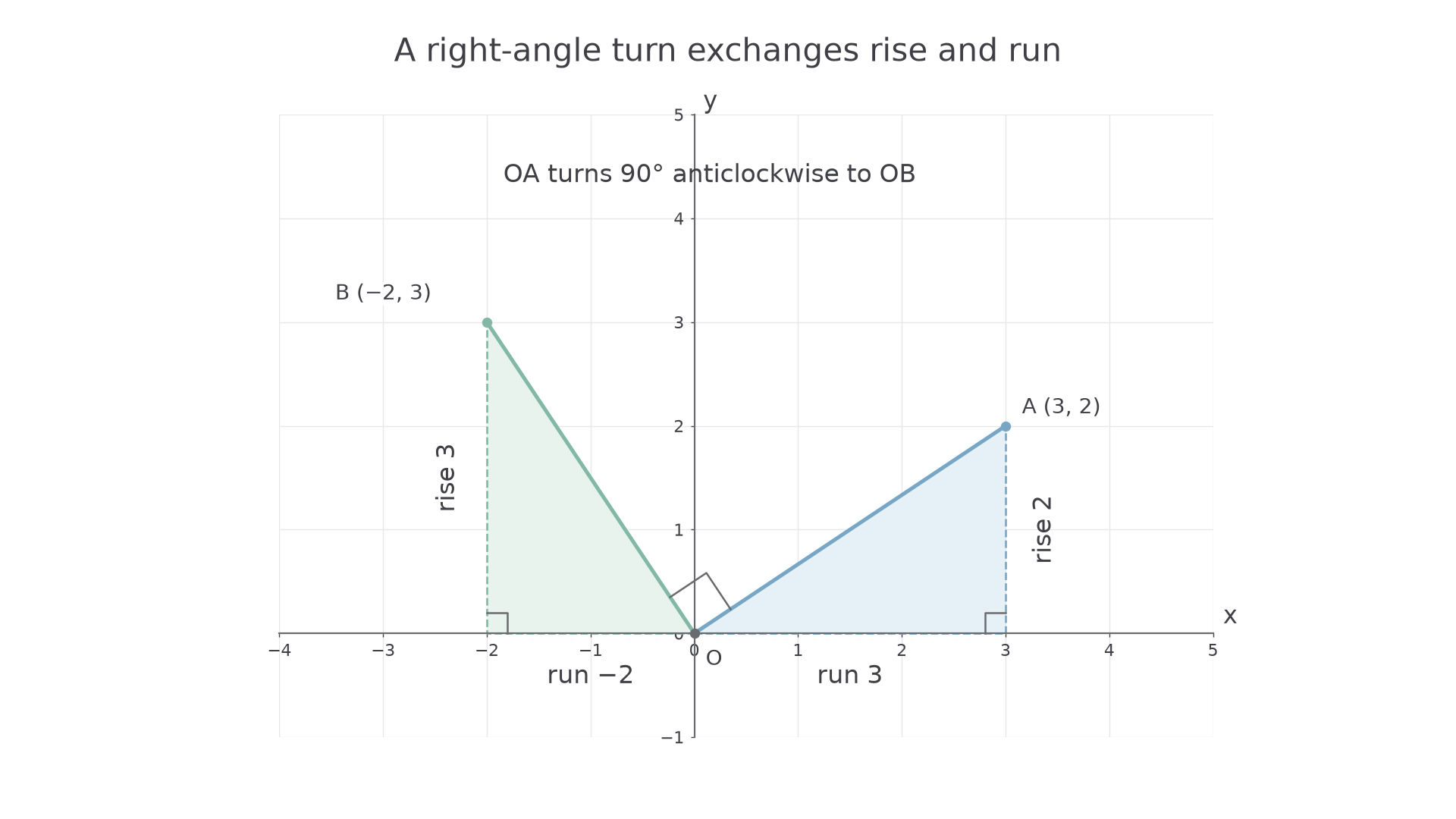
This works with signed changes too. Call the original non-zero horizontal change and its non-zero vertical change . The gradient is . A quarter-turn gives horizontal change and vertical change , so the new gradient is . If is negative, the original line falls and the perpendicular line rises.
Perpendicular gradients
Two non-vertical, non-horizontal straight lines are perpendicular exactly when
Equivalently,
Their gradients are negative reciprocals: invert the fraction and change its sign. Neither gradient is zero. A horizontal line is perpendicular to a vertical line; handle that pair separately. Not given in the List of formulas: learn it.
The rule works in both directions. Turning a line through produces a line with the calculated gradient; every line with that gradient has the same direction. Thus the rule can also establish that two given sloping lines are perpendicular.
Worked example 1: perpendicular to a rising line
Question. Find the gradient of a line perpendicular to .
Plan. Read the gradient, invert its fraction and change the sign.
Answer. .
Check. The original direction goes three right and two up. A right-angle turn gives two left and three up, whose gradient is , agreeing with the calculation.
Change only the original gradient's sign. Its perpendicular gradient must change sign as well.
Worked example 2: perpendicular to a falling line
Question. Find the gradient of a line perpendicular to .
Plan. Keep the original minus sign when dividing into negative one.
Answer. .
Check. A direction of three right and two down becomes two right and three up after an anticlockwise quarter-turn. Its gradient is , as found.
For a horizontal line, the rise is zero. Turning its direction through a right angle produces a vertical line, whose run is zero and gradient undefined. Do not try to calculate . Conversely, a perpendicular to a vertical line is horizontal, with gradient zero.
Watch out
Changing only the sign is insufficient: , not . Use . A special case is gradient , whose negative reciprocal happens to be .
The opening reciprocal appears because a quarter-turn swaps the horizontal and vertical changes, as well as reversing one direction.
A perpendicular line through a point
A perpendicular gradient fixes direction, but not position. To find the required line, first put the reference equation into , take the negative reciprocal of its gradient, then substitute the required point to find the new intercept.
You already know
For a line with known gradient , write . A point on it gives , so . This is the same point-substitution method used for parallel lines; only the gradient choice changes.
The point is on the new line; it need not be on the reference line. There is exactly one perpendicular line through a specified point.
Worked example 3: choosing direction and position
Question. Find the line perpendicular to and passing through . Give its equation in the form .
Plan. Rearrange to read the reference gradient, find the perpendicular gradient, then use the point.
Answer. .
Check. At , the new equation gives . Its direction is one right and two down; reversing that direction gives one left and two up, a quarter-turn of the reference direction two right and one up. Both the point and the right-angle condition are satisfied.
Change only the point's second coordinate from to . The required direction stays fixed; the intercept must change.
Worked example 4: moving the point
Question. Find the line perpendicular to and passing through , in the form .
Plan. Keep the perpendicular gradient , then substitute the new point.
Answer. .
Check. At , it gives . The new line is two units below the previous perpendicular line at every input, matching the point's two-unit fall; its unchanged direction is still perpendicular to the reference line.
For an axis-parallel reference line, choose the other direction directly. A perpendicular to through is horizontal, so . A perpendicular to through the same point is vertical, so . These cases need no reciprocal or intercept calculation.
Continue this lesson.
You’re previewing NovaLearn without an account. Create a free account to read the rest.
Create free account