C2.2; E2.2 - Expanding two brackets
Two brackets multiply two whole quantities, so every term in one must multiply every term in the other. You will organise those products, collect the resulting terms and check an expansion without confusing a successful numerical check with a proof.
Every term times every term
Why does contain more than ? Picture a rectangle whose side lengths are and , for positive . Splitting each side gives four smaller rectangles, not two: their areas are , , and .
[DIAGRAM: asset_name: Four areas from two brackets; asset_slug: two_bracket_area; caption: Splitting both sides gives four products, including two middle terms.; description: A rectangle has width x plus three and height x plus two. Vertical and horizontal divisions produce four regions labelled x squared, three x, two x and six. The x-squared region is pale blue, the two middle regions pale sage and the constant region pale clay. The side segments x, three, x and two are labelled outside. The diagram uses positive x; algebraic distribution also handles zero and negative values.]
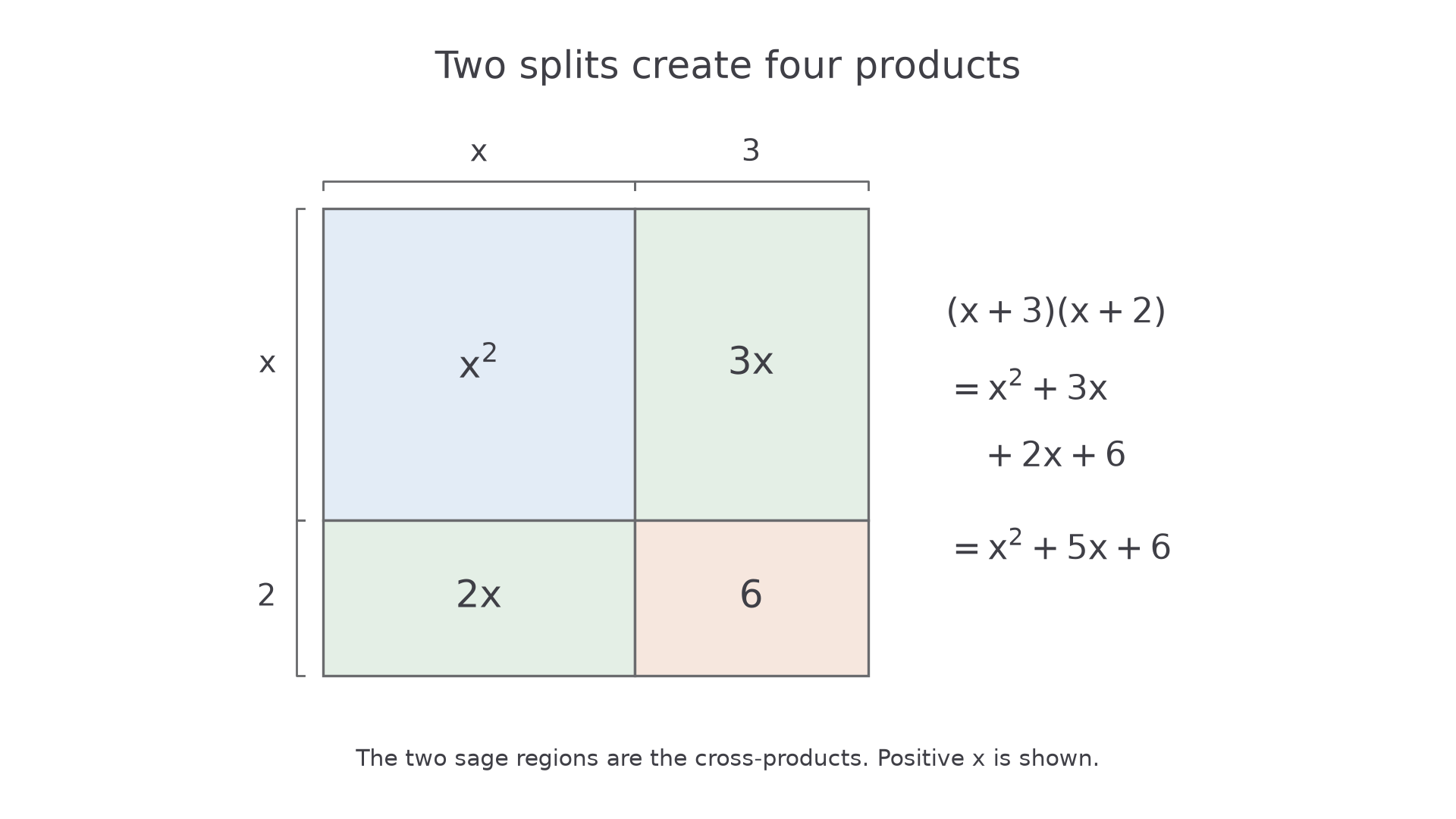
The same rule follows without a picture:
Each first-bracket term has multiplied the whole second bracket. This algebra works for every real ; the area picture is restricted to positive side lengths.
A product grid keeps the four multiplications visible:
| Multiply | ||
|---|---|---|
Worked example 1: four positive products
Question. Expand , showing all four products.
Plan. Multiply each term in the first bracket by both terms in the second.
Answer. The four terms are . Collecting the two -terms gives .
Check. At , the bracket product is . The four terms give .
Change only to . Two of the four products now contain that negative term.
Worked example 2: a negative term in one bracket
Question. Expand , showing all four products.
Plan. Pair each term with and with , keeping the signs.
Answer. The four terms are , which collect to .
Check. At , the brackets give ; the four terms give .
A grid is an organiser, rather than a different rule. Write negative entries as signed terms in its headers so their signs travel into each product.
Watch out
misses and . Every term must multiply every term, including these two cross-products.
Once all four products are present, collect like terms to finish.
Collecting terms after expansion
A number in front of belongs to its term and must also be multiplied. In , the first product is ; it is not and it is not .
After multiplying, match the letter parts before collecting. The square terms, the -terms and the constants belong in different groups. An expression with highest power and a nonzero -coefficient is called a quadratic expression.
Worked example 3: a coefficient in front of x
Question. Expand and simplify .
Plan. Write the four products, then add the coefficients of the two -terms.
Answer. .
Check. At , the original is . The answer is .
Now change only to . The -coefficient and constant change, but the leading product stays .
Worked example 4: collecting signed middle terms
Question. Expand and simplify .
Plan. Multiply with the signed term , then collect .
Answer. .
Check. At , the bracket product is . The answer is .
Continue this lesson.
You’re previewing NovaLearn without an account. Create a free account to read the rest.
Create free account