C7.1; E7.1 - Translations and enlargements
A translation moves every point by the same amount; an enlargement scales every distance from one centre. You will use column vectors, draw positive and fractional enlargements, and recover the movement from corresponding shapes. These are the translation and enlargement requirements of C7.1 and E7.1.
Translations and column vectors
Can an enlargement make a shape smaller? It can, but first compare it with a move that keeps the shape's size: a translation.
Translation vector
A translation slides every point by the same displacement. A column vector records horizontal displacement on top and vertical displacement below. Positive means right or up; negative means left or down.
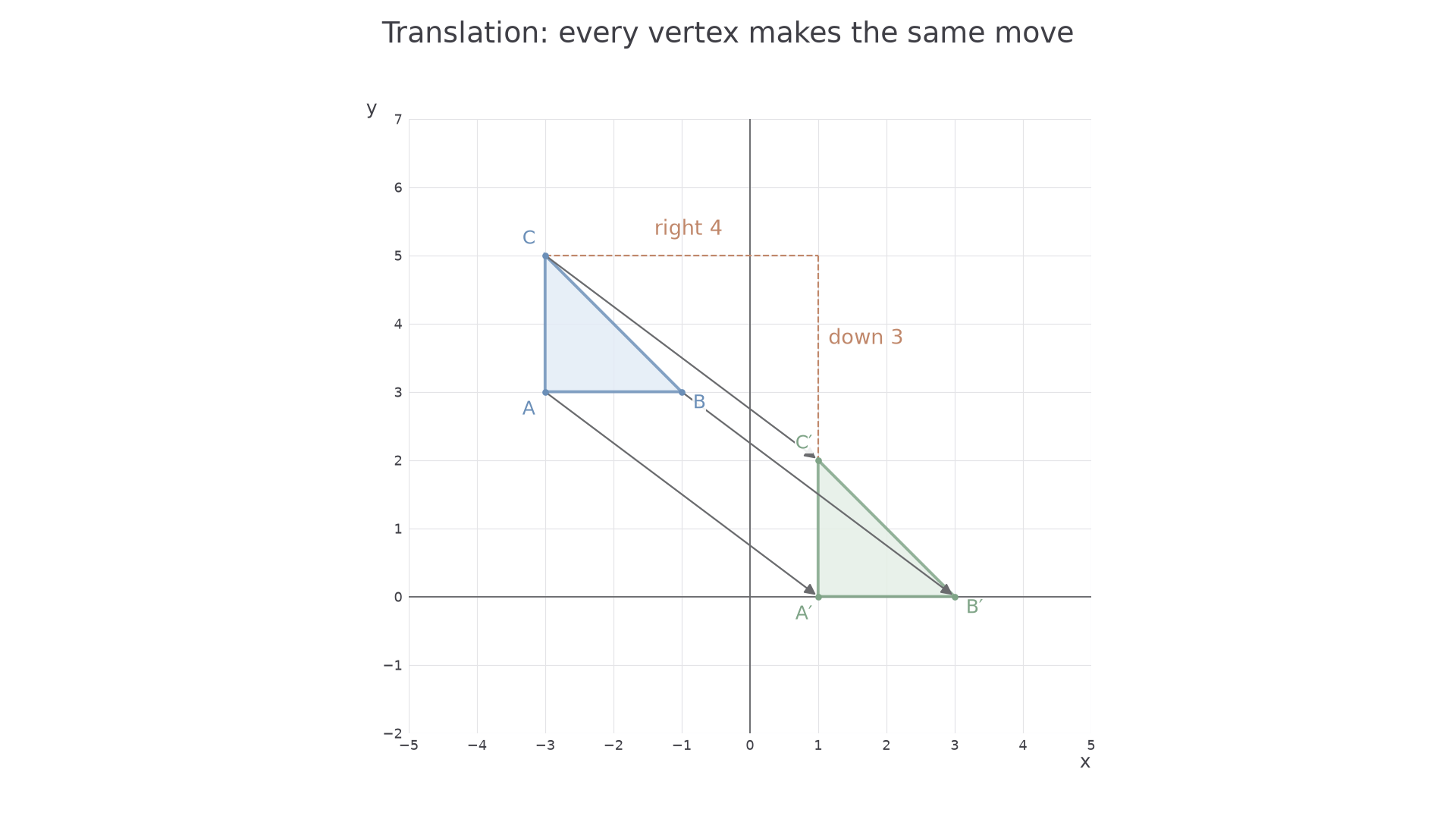
The vector means four units right and three down. It describes a movement, not a point at . The two entries are stacked without a comma. A zero entry means no movement in that direction. Translation preserves size, angles and orientation; it does not turn or reflect the shape.
[DIAGRAM: asset_name: Translating every vertex equally; asset_slug: translation_vectors; caption: Every vertex moves four units right and three units down.; description: An equal-scale grid shows triangle A at negative three three B at negative one three C at negative three five, and its translated image at one zero three zero one two. Parallel directed arrows join corresponding vertices, with one horizontal and vertical step guide labelled right four and down three.]
Worked example 1: drawing a translation
Question. Translate triangle by .
Plan. Add four to every horizontal coordinate and subtract three from every height.
Answer. Plot and join the sides with a ruler.
Check. The image still has horizontal and vertical sides of length . Moving it four left and three up restores all three original vertices.
Keep the two triangles, but reverse the direction of the question: now describe the image-to-original translation.
Worked example 2: recovering the reverse vector
Question. Describe the translation mapping the triangle with vertices onto the corresponding vertices .
Plan. Calculate destination minus start in each direction and check another vertex.
Answer. Translation by .
Check. Adding to the third start gives , its required destination.
Watch out
means left four and up three, not up negative four and right three. Read the horizontal entry first. Reverse a translation by reversing both signs.
Enlargement from a centre
In an enlargement with scale factor other than , points farther from the centre move farther. All distances from the centre are multiplied by the same scale factor, so the image is similar to the original.
Centre and scale factor
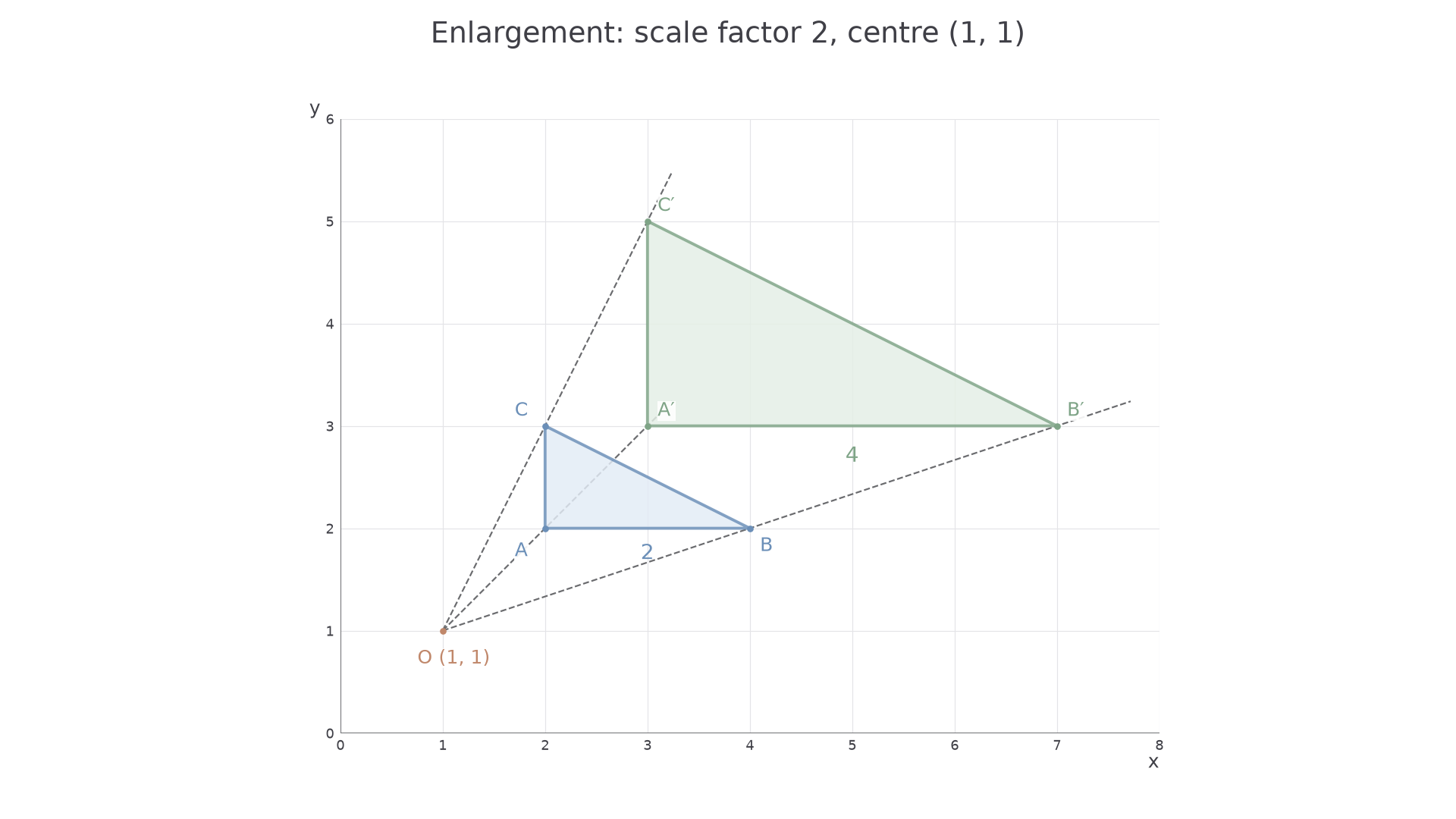
For an enlargement with centre and positive scale factor , each point has image on the ray from through , with . The centre stays fixed. If , the image is larger; leaves every point unchanged.
Draw rays from the centre through each original vertex. Measure the full distance from the centre and multiply it by ; do not add the same number to every coordinate. On a grid, scale both horizontal and vertical offsets from the centre. Rule the image sides after locating all vertices.
[DIAGRAM: asset_name: Enlargement from a centre away from the origin; asset_slug: positive_enlargement; caption: Scale factor two doubles every offset from the centre at one one.; description: Equal-scale grid shows centre O at one one, triangle A at two two B at four two C at two three, and its scale factor two image at three three seven three three five. Rays from O pass through each corresponding pair. Separate corresponding edge lengths of two and four are marked.]
Continue this lesson.
You’re previewing NovaLearn without an account. Create a free account to read the rest.
Create free account