C2.11; E2.11 - Sketching lines and parabolas
A sketch keeps a graph's essential features without calculating a long table. You will recognise and sketch straight lines and parabolas, marking intercepts, roots and symmetry for C2.11 and E2.11. The aim here is a clear shape and correct labelled features.
Sketching linear graphs
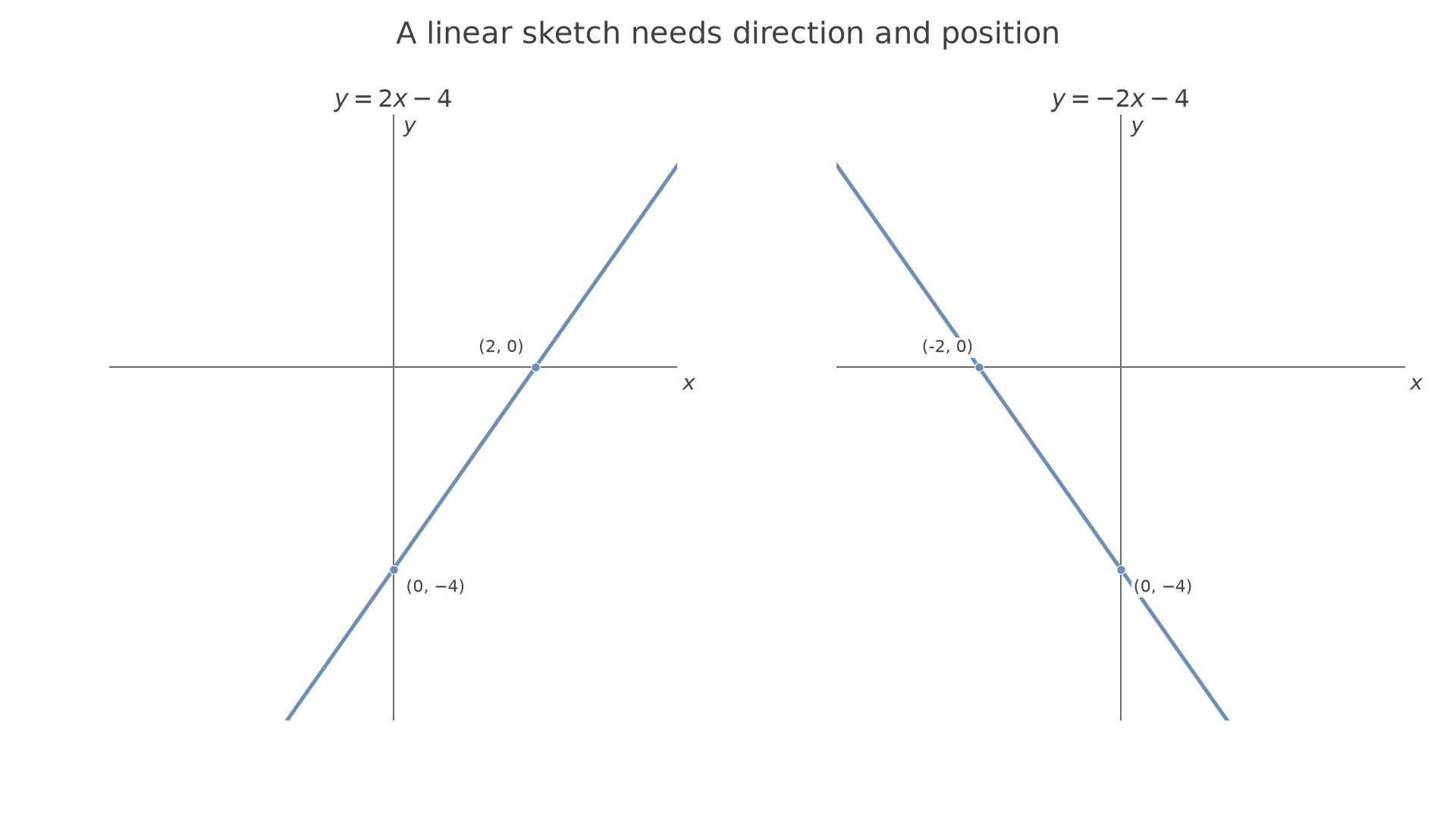
Could two graphs have the same intercept but head in opposite directions? The lines and do exactly that. A sketch should make both their shared crossing and their different directions visible.
Sketch and accurate plot
An accurate plot uses a numbered scale and carefully positioned points. A sketch shows the correct general shape and relative position, with important features labelled. It need not have an accurate scale. Draw labelled axes in either case.
For a non-vertical line, use its gradient's sign and its axis crossings. At the vertical axis, ; at the horizontal axis, . Two distinct points fix the line. You already met equations for horizontal lines and for vertical lines: these should also be recognisable from their equations.
[DIAGRAM: asset_name: Linear sketch features; asset_slug: linear_sketches; caption: Keep the same vertical intercept but reverse the gradient.; description: Two simple coordinate-axis sketches show y equals two x minus four and y equals negative two x minus four. Each has the y-intercept labelled zero comma negative four. The left line crosses the x-axis at two comma zero and rises rightwards; the right crosses at negative two comma zero and falls rightwards.]
Worked example 1: a rising line
Question. Sketch , showing both axis crossings.
Plan. Find one crossing by setting , the other by setting .
Answer. Draw a straight line through labelled points and , extending in both directions, as in the left sketch.
Check. The independent point satisfies the equation and lies above the horizontal axis to the right of the positive crossing.
Change only the sign of the gradient. Keep the constant term, so the vertical crossing stays fixed.
Worked example 2: a falling line
Question. Sketch , showing both axis crossings.
Plan. Repeat the crossing calculations and make the line fall to the right.
Answer. Draw the straight line through and , as in the right sketch.
Check. At , , so the line is above the horizontal axis on the left. This agrees with its negative gradient.
If a line passes through the origin, both axis crossings give the same point. Find a second point using another input. A non-zero constant rule has no horizontal-axis crossing, and a vertical line should not be forced into .
Watch out
A rough scale is allowed in a sketch; incorrect labelled crossings are not. Keep negative crossings on the negative side of the correct axis.
Roots and symmetry of quadratics
A parabola has a vertical line of symmetry: reflecting one side in this line produces the other. Equal outputs occur at matching distances on either side. Two distinct roots have the same output, zero, so their horizontal midpoint lies on this symmetry line.
Symmetry from two distinct roots
If a quadratic has distinct roots and , its line of symmetry is
This is a vertical line, so its equation uses . Not given in the List of formulas: learn the symmetry relationship.
You can find simple roots by reading a graph or testing likely integer inputs. This sketching method does not require a new general method of solving quadratic equations. Combine the roots with the sign of the squared term and the vertical-axis crossing.
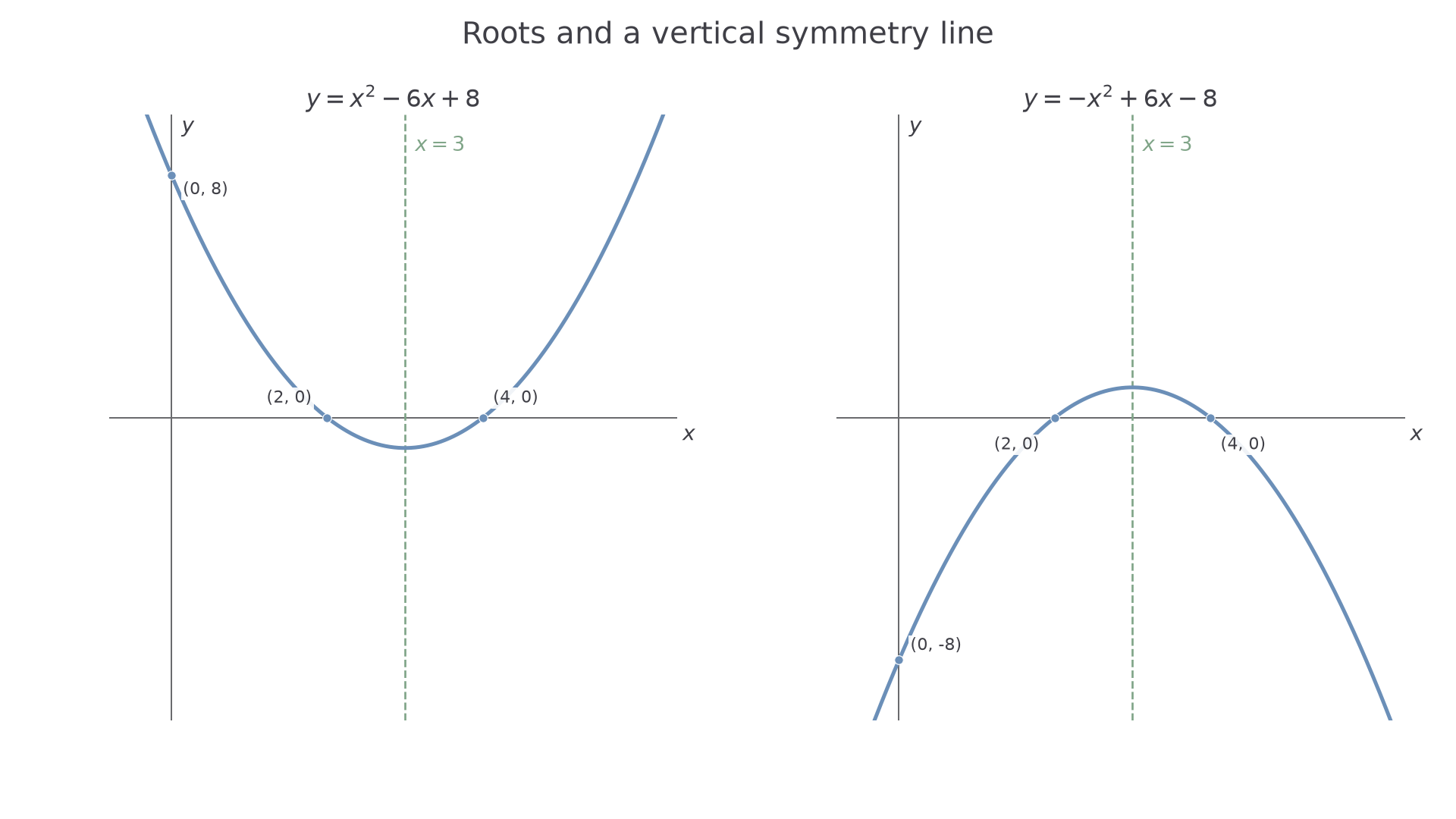
[DIAGRAM: asset_name: Quadratic roots and symmetry; asset_slug: quadratic_symmetry; caption: Opposite output signs reverse the opening direction but preserve the roots and symmetry line.; description: Two coordinate-axis sketches show y equals x squared minus six x plus eight and its negative. Both meet the x-axis at two and four, with a dashed symmetry line x equals three. The first opens upwards and crosses the y-axis at eight; the second opens downwards and crosses at negative eight. No turning-point coordinate is labelled.]
Worked example 3: two positive roots
Question. Sketch . Its roots are 2 and 4. Show the roots, vertical-axis crossing and line of symmetry.
Plan. Mark the supplied roots, find the middle input and use the coefficient sign for the shape.
Answer. Draw an upward-opening parabola through , and , symmetric about , as in the left sketch.
Check. At the unused inputs 1 and 5, the outputs are both 3. Their equal distances from 3 confirm the proposed symmetry. Substituting 2 and 4 also confirms both zeros.
Continue this lesson.
You’re previewing NovaLearn without an account. Create a free account to read the rest.
Create free account