C6.2; E6.2 - Bearings and linked right triangles
A map or a larger shape may hide several right triangles. You will choose a useful triangle, turn bearings into the angle a ratio needs, and carry an unrounded shared length from one triangle into the next.
Selecting a useful right triangle
A route goes east, then north. A straight path joins its start and finish. What information would let you find that path if the northward distance were missing? A right angle plus two sides suggests Pythagoras; a right angle plus an acute angle and one side suggests trigonometry.
Draw the relevant triangle and label only what the question supplies. East-west and north-south directions are perpendicular. Rectangle corners, stated perpendicular lines and previously established angle facts can also justify right angles. A sloping-looking or nearly square corner is not evidence on its own.
| Information in one right triangle | Useful method |
|---|---|
| Two side lengths, needing the third | Pythagoras |
| One acute angle and one side, needing another side | Sine, cosine or tangent |
| Two side lengths, needing an acute angle | An inverse trigonometric ratio |
The table is a choice guide, not a rule that forbids other valid methods. For instance, you could find an angle first and then a length, but that would add work when Pythagoras already has both lengths.
[DIAGRAM: asset_name: Selecting a right triangle method; asset_slug: trig_select_triangle; caption: The available information determines the method.; description: Left: a rectangular field has perpendicular sides thirty and forty metres and diagonal d. Right: the same thirty-metre base and a twenty-eight-degree angle to the diagonal are given instead of the height. Both right angles are marked.]
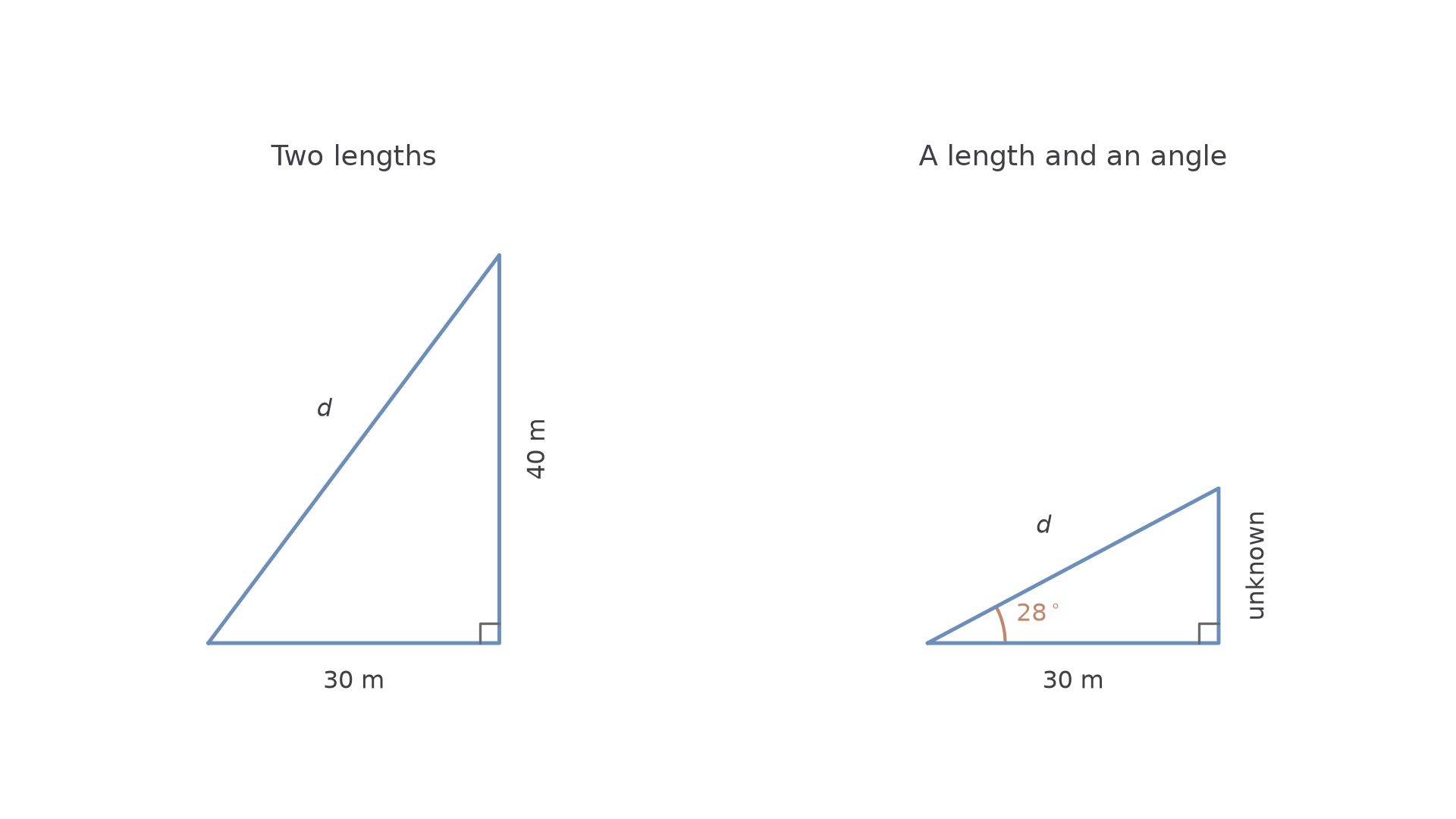
Worked example 1: two perpendicular lengths
Question. From , a route goes east to , then north to . Calculate the straight-line distance .
Plan. Use Pythagoras in right triangle , with as hypotenuse.
Answer. .
Check. The lengths are ten times the right triangle. The shortcut is shorter than the route along the two edges.
Now replace the known northward length by an angle of between and . One known side remains, so change method.
Worked example 2: an angle instead of a second side
Question. is horizontal, is perpendicular to , and angle . Calculate , correct to significant figures.
Plan. Use cosine because is adjacent to the given angle and is the hypotenuse.
Answer. , correct to significant figures.
Check. Tangent gives . Pythagoras then gives , confirming the distance independently of the cosine rearrangement.
Watch out
treats a degree angle as a length and omits the square root. Pythagoras combines three lengths. An angle and one length call for a ratio instead.
Select the two sides relative to the given angle before calculating.
Bearings and angles in a diagram
A bearing measures direction clockwise from north at the starting point. North is , east , south and west . Whole-degree bearings use three digits; a calculated bearing can also include decimal places when requested.
The small angle in a right triangle is not automatically the bearing. Draw north at the starting point and place the destination in its correct quadrant. For a destination west of north, the small angle to north is measured the opposite way from the bearing, so subtract it from .
[DIAGRAM: asset_name: Bearings on either side of north; asset_slug: trig_bearing_quadrants; caption: A small angle to north is not always the clockwise bearing.; description: Two maps show B eight kilometres north and six kilometres east of A, then eight kilometres north and six kilometres west of A. North arrows and the small angle to north are marked. The western case needs three hundred and sixty degrees minus the small angle.]
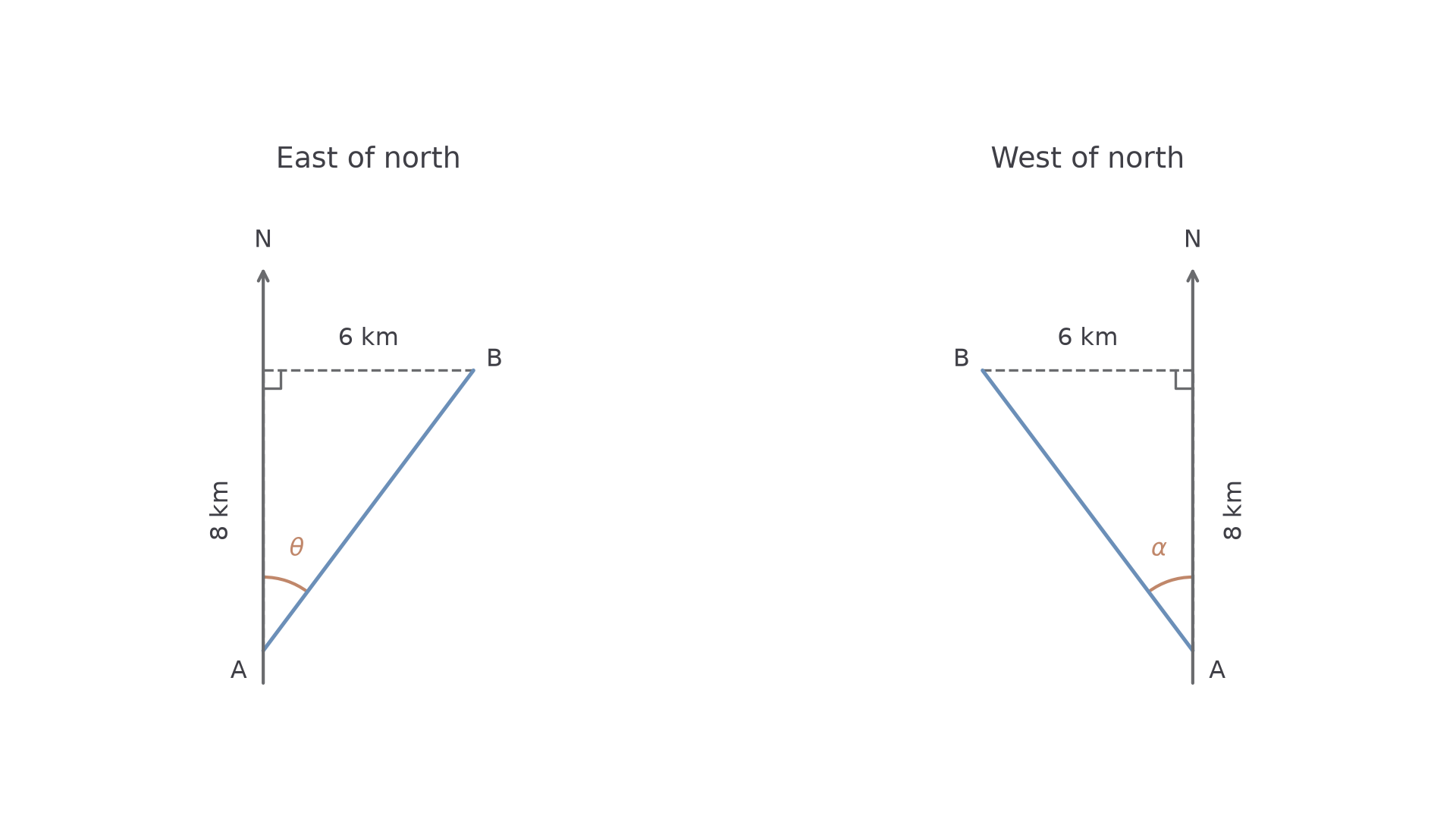
Use the east-west distance opposite the small angle to north, and the north-south distance adjacent to it. This is a geometric side choice, not a new trigonometric formula.
Worked example 3: east of north
Question. is north and east of . Calculate the bearing of from , correct to decimal place.
Plan. Find the angle east of north using tangent; here it is already clockwise from north.
Answer. The bearing is , correct to decimal place.
Check. The angle above east is . Subtracting it from gives , and the bearing lies between north and east.
Change only the horizontal direction from east to west. The triangle has the same lengths, but the bearing must now lie between west and north.
Worked example 4: west of north
Question. is north and west of . Calculate the bearing of from , correct to decimal place.
Plan. Find the small angle west of north, then complete the clockwise turn.
Answer. The bearing is , correct to decimal place.
Check. From west towards north, the remaining angle is . Adding it to west's gives .
Continue this lesson.
You’re previewing NovaLearn without an account. Create a free account to read the rest.
Create free account