E7.4 - Position vectors and geometric paths
Vector paths turn a diagram into algebra without needing to measure its angles. You will express directed journeys using two vectors, distinguish position vectors from displacements, and find points dividing a segment. These E7.4 methods prepare you to justify geometric relationships.
Directed paths and reverse vectors
Can two different routes give exactly the same displacement? If they start and finish at the same points, they must. The length travelled may change; the vector from start to finish does not.
Directed path
A directed line segment represents a vector by an arrow from its start to its finish. A path adds successive displacements head to tail. Reversing a segment negates its vector:
The middle point in then joins the two steps. You may choose any useful route between the same endpoints. A closed route has zero total displacement because it ends where it began. Here the vectors lie in one plane: they are coplanar.
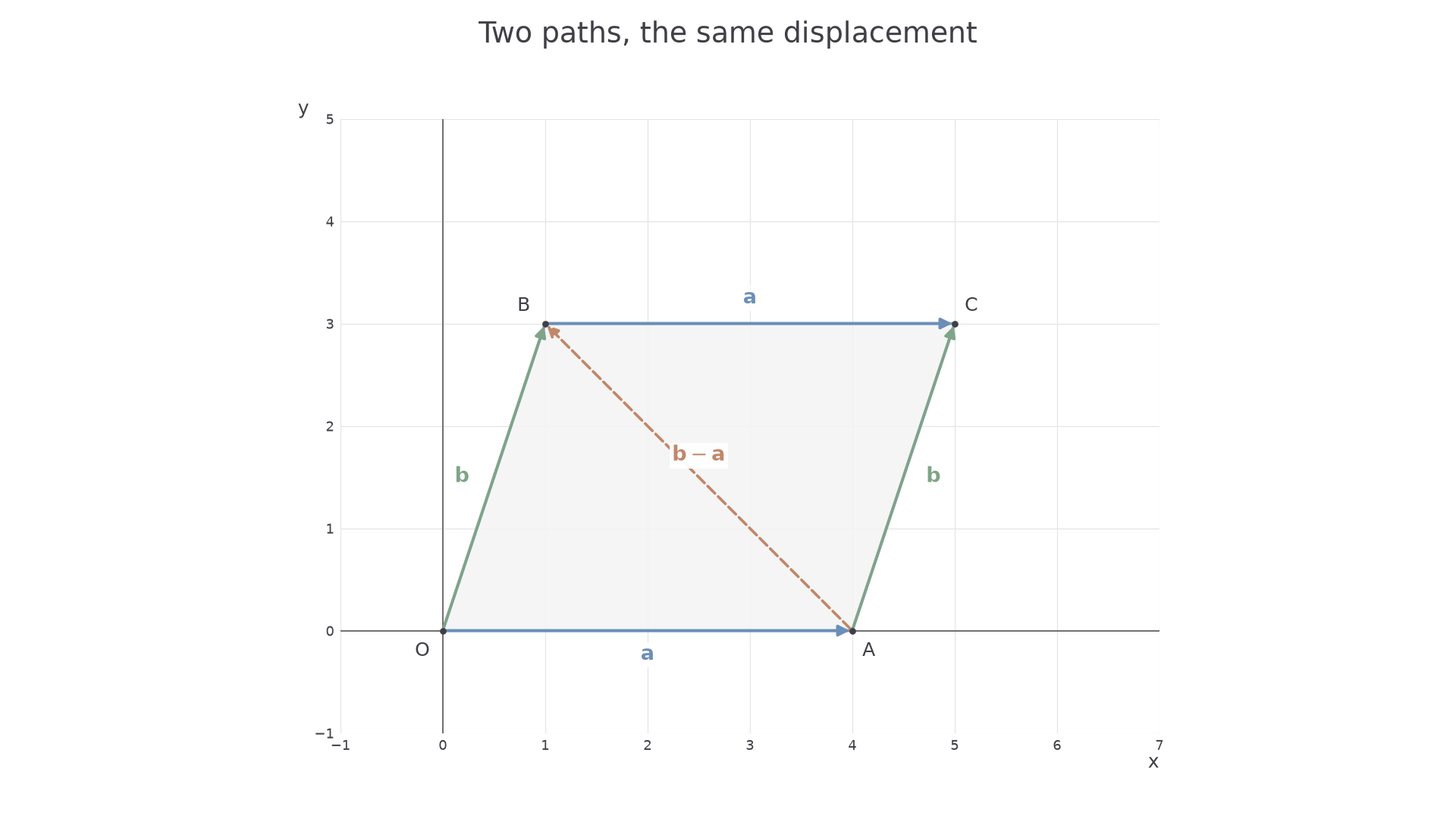
[DIAGRAM: asset_name: Two vector paths in a parallelogram; asset_slug: parallelogram_paths; caption: A to O to B and A to C to B have the same start and finish.; description: Parallelogram O A C B has O at zero zero A at four zero B at one three C at five three. Directed arrows O to A and O to B are a and b. Directed arrows A to C and B to C are b and a. A dashed arrow A to B shows b minus a.]
Worked example 1: a path through the origin
Question. is a parallelogram, with and . Express using and , following the path through .
Plan. Travel from back to , then from to .
Answer. .
Check. Take , , as in the drawing. From to , the displacement is , matching .
Keep the endpoints and diagram; change only the route to pass through .
Worked example 2: the other route
Question. Express using the path to to .
Plan. Use equal directed opposite sides of the parallelogram, reversing a side when necessary.
Answer. , the same result as before.
Check. The closed path has total , as a closed journey must.
Watch out
Equal parallel sides give equal vectors only when the directions match. In this parallelogram, , while .
Position vectors
A displacement says how to get from one point to another. A position vector fixes a point relative to a chosen origin, so every position arrow starts at that same origin.
Position vector
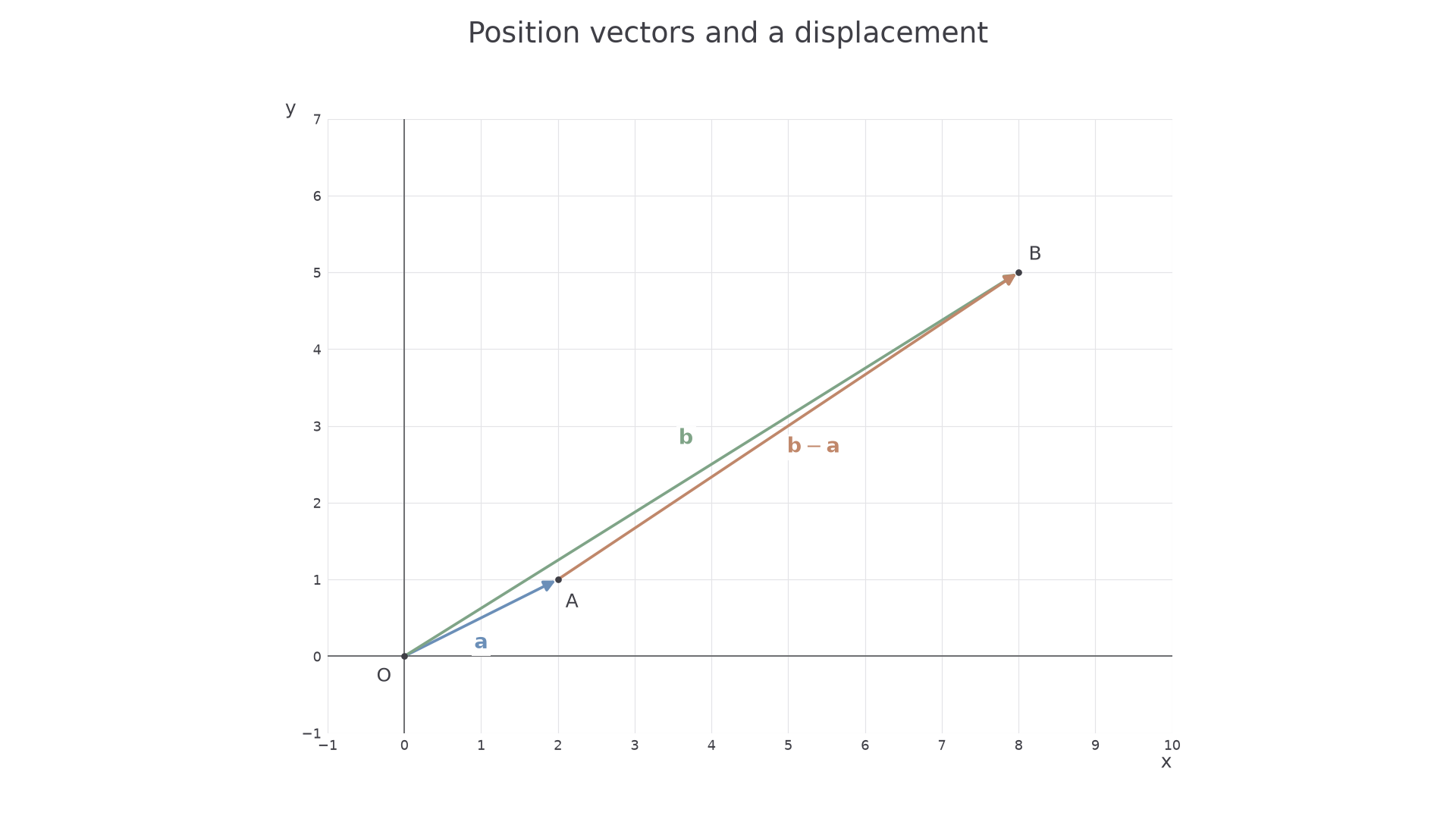
The position vector of , relative to origin , is . If and have position vectors and , then
This is destination position minus start position, because the path is .
In Cartesian coordinates, the position vector of is when . A column describing a displacement becomes a position vector only when its starting point is the chosen origin. If you change the origin, position vectors change, but the displacement between fixed points stays the same.
[DIAGRAM: asset_name: Position vectors and their difference; asset_slug: position_vector_difference; caption: The displacement from A to B is the difference of their position vectors.; description: Equal-scale grid shows O at zero zero A at two one and B at eight five. Blue arrow O to A is a, sage arrow O to B is b and clay arrow A to B is b minus a.]
Worked example 3: finding the destination position
Question. and . Find the position vector of .
Plan. Follow and add the two displacements.
Answer. .
Check. The coordinate displacement from to is , the supplied vector.
Continue this lesson.
You’re previewing NovaLearn without an account. Create a free account to read the rest.
Create free account