C1.1, C1.6; E1.1, E1.6 - Multiplying and dividing fractions
Taking a fraction of a quantity can make it smaller, while dividing by a fraction can make it larger. For Core and Extended, you will multiply fractions, use reciprocals to divide, and calculate with mixed numbers and negative fractions. C1.1/E1.1 supplies the reciprocal idea; C1.6/E1.6 puts it to work in calculations.
Multiplying fractions
How can be greater than ? Division counts how many pieces fit, and half-sized pieces change that count. First, build the multiplication idea that will explain the division.
Imagine a rectangle divided into five equal columns. Shade three columns, then take two thirds of that shaded area. Split each column into three equal pieces: the whole rectangle now contains fifteen equal pieces, and six are selected. So two thirds of three fifths is six fifteenths, or two fifths.
[DIAGRAM: asset_name: A fraction of a fraction; asset_slug: fraction_product_area; caption: Two thirds of three fifths selects six of the fifteen equal pieces.; description: A rectangle split into five columns and three rows. Three of its columns are pale blue. The top two rows of those three columns are sage green, making six selected cells out of fifteen. The width of the three selected columns is labelled three fifths of the whole width, and their top two rows are labelled two thirds of the height.]
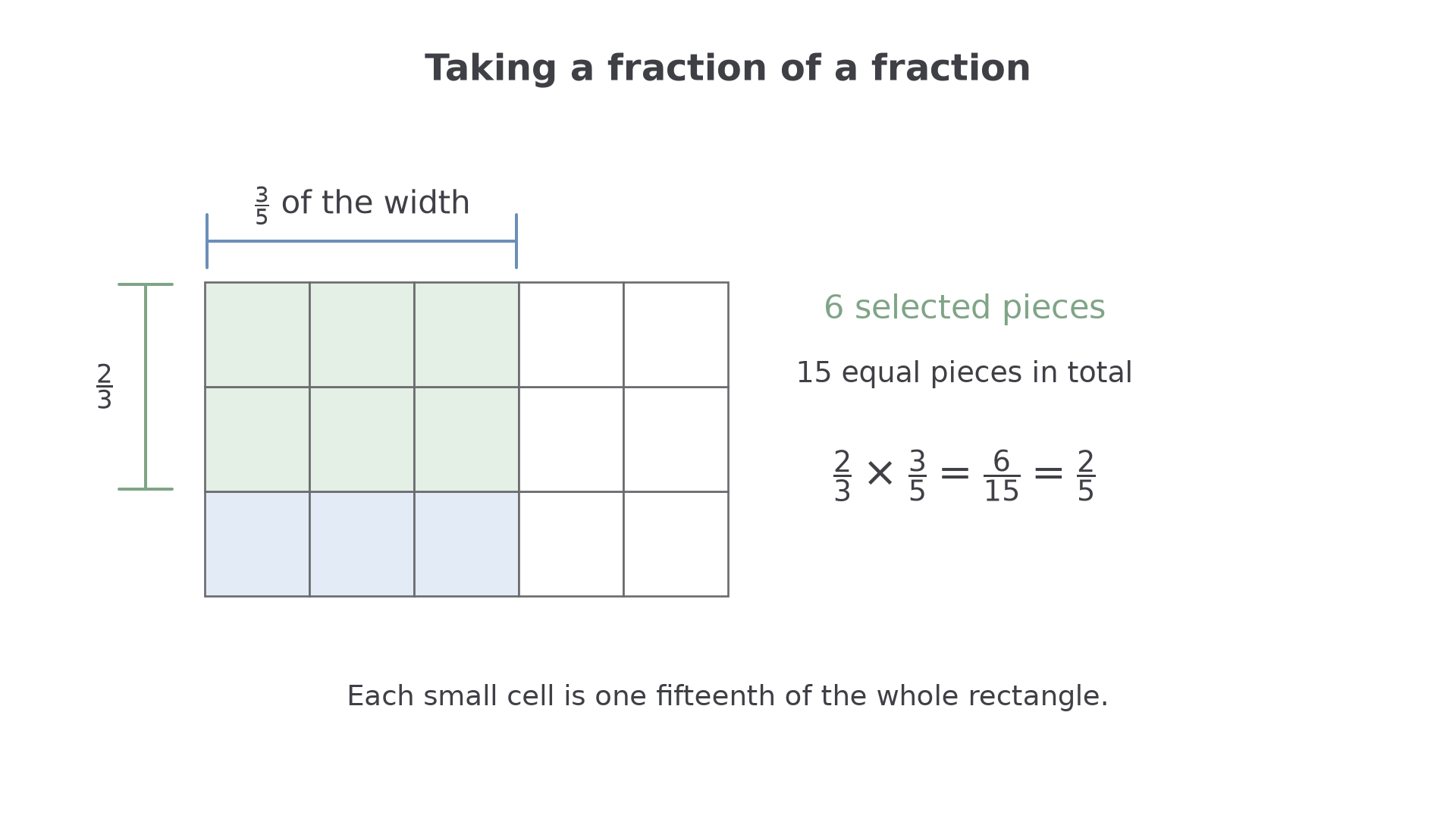
The denominators count the subdivisions of the whole; the numerators count the selected pieces. That is why you multiply the numerators and multiply the denominators. Then simplify. Every denominator must be nonzero.
Worked example 1: taking a fraction of a fraction
Question. Work out . Give your answer in its simplest form.
Plan. Multiply the numerators and denominators, then divide both by a common factor.
Answer. .
Check. Three fifths contains three equal fifths. Taking two of those three fifths leaves two fifths, agreeing with the area picture.
Now double only the second fraction. The product should double too. This also shows that the method works when a fraction is greater than one.
Worked example 2: an improper fraction as a factor
Question. Work out . Give your answer in its simplest form.
Plan. Simplify a common factor before multiplying to keep the numbers small.
Why this step? Dividing the entire numerator and denominator by the same nonzero factor leaves the fraction's value unchanged. Simplifying before multiplication is the same operation as simplifying afterwards.
Answer. .
Check. The second factor doubled from to , so the first answer doubles: .
A product with a positive proper fraction scales a positive quantity down. A product with a positive fraction greater than one scales it up. Multiplication does not always mean “make bigger”.
Watch out
is wrong: the denominators must be multiplied, not added. Also, simplifying across factors works in a product; do not cancel numbers across an addition sign.
Reciprocals and division
Dividing of a litre into half-litre portions asks how many half-litre portions it contains. There is one complete half-litre portion and half of another, so the answer is . The number of portions can exceed the number of litres because the portion is smaller than a litre.
Reciprocal
The reciprocal of a nonzero number is the number you multiply it by to obtain . For a nonzero fraction, interchange its numerator and denominator: the reciprocal of is , since .
The reciprocal of is , and the reciprocal of is . Zero has no reciprocal, because zero multiplied by any number is zero, never one.
To divide by a nonzero fraction, multiply by its reciprocal. Here is why: multiplying by the reciprocal turns one whole divisor into . Apply the same scaling to the quantity being divided, and you count its number of divisors. For half-litre portions, scaling litres into half-litres multiplies the count by two.
Worked example 3: counting halves
Question. Work out .
Plan. Replace division by one half with multiplication by two.
Answer. , or .
Check. Multiply the number of portions by their size: . This restores the amount we started with.
Change only the divisor from to . The pieces are now three times as large, so only a third as many fit.
Worked example 4: dividing by a larger fraction
Question. Work out .
Plan. Keep the first fraction and multiply it by the reciprocal of the divisor.
Answer. .
Check. , so half of the divisor makes the dividend. Also, is a third of the previous answer .
Division by zero is undefined, including division by a zero fraction such as . In contrast, zero divided by a nonzero number is zero: .
Watch out
is wrong. Only the divisor is replaced by its reciprocal. Keep the first fraction unchanged.
Mixed numbers and signed products
A mixed number must become one fraction before you multiply it or take its reciprocal. For example, . The whole-number part represents eight quarters, with one more quarter added.
You already know
One negative factor gives a negative product; two negative factors give a positive product. The same sign rules apply to division. A minus sign before a mixed number applies to its entire value: .
For multiplication, convert the mixed numbers, apply the sign rule, then multiply. For division, convert before taking the divisor's reciprocal. In either case, simplify the final fraction; change it to a mixed number if the question asks.
Worked example 5: a negative mixed number
Question. Work out . Give your answer in its simplest form.
Plan. Convert both mixed numbers, then multiply by the reciprocal of the second.
Answer. .
Check. , the starting value. Dividing its size by a number greater than one also correctly reduces its size.
Change only the sign of the divisor. The sizes stay the same; the quotient becomes positive.
Worked example 6: two negative mixed numbers
Question. Work out . Give your answer in its simplest form.
Plan. Convert to fractions and keep the negative sign when taking the reciprocal.
Answer. .
Check. , so the result reverses the division correctly.
The reciprocal step is unnecessary for multiplication: for example, is already a product. Use the operation sign to decide what to do.
Watch out
The reciprocal of is , because . Writing or flipping just the fractional part does not give the reciprocal of the whole mixed number.
Quick Recap
- Multiply numerators and denominators; simplify common factors.
- A nonzero number and its reciprocal multiply to one. Zero has no reciprocal.
- Divide by a nonzero fraction by multiplying by its reciprocal.
- Convert mixed numbers first and apply the usual negative-number sign rules.
The opening division gives : one and a half half-sized pieces fit into three quarters.