E2.12 - Stationary points and their nature
A horizontal tangent identifies a stationary point, but its gradient alone does not tell you whether the point is a maximum or minimum. You will find stationary coordinates and justify their nature using nearby gradient signs, a second derivative or an accurate sketch. This lesson is for Extended.
Finding stationary coordinates
Can a point have gradient zero without having height zero? The parabola has its lowest point below the horizontal axis. “Horizontal” describes the tangent's direction, not the point's height.
Stationary point
A stationary point is a point on a differentiable curve where , so the tangent is horizontal. To find its coordinates, solve the derivative equation for , then substitute each solution into the original function for . A root of the original function instead solves ; that is a different question.
Finding the coordinates and classifying the point are two separate jobs. Begin by finding all the zeros of the derivative, using linear or quadratic equation methods as appropriate. The original function still supplies the heights.
Worked example 1: a stationary point below the axis
Question. Find the coordinates of the stationary point of .
Plan. Set its derivative to zero, then calculate the original output at that input.
Answer. The stationary point is .
Check. Completing the square gives , whose vertex is . Independently, the derivative at 3 is zero. The height is , not zero.
Negate only the whole original function. The stationary input stays the same, but its output changes sign.
Worked example 2: the reflected curve
Question. Find the stationary point of .
Plan. Differentiate the reflected rule and again use its original output for the second coordinate.
Answer. .
Check. The rule is , confirming the vertex. Reflection in the horizontal axis takes the first point to , as the calculation found.
A derivative can have more than one zero. For a cubic, its quadratic derivative may have two real solutions; keep both and find each original height. If the derivative has no real zero, there is no stationary point. A zero derivative marks a candidate for a maximum or minimum; the next parts justify which kind it is.
Watch out
Substituting a stationary input into the derivative gives zero again. That only checks its gradient; it cannot find the missing height. Return to the original -equation for the coordinates.
Use a new quadratic for the check.
Maximum and minimum from gradient signs
A local maximum is higher than nearby curve points; a local minimum is lower. Follow the curve from left to right. If it rises before a stationary point and falls afterwards, the point is a maximum. If it falls then rises, the point is a minimum. The sign of the gradient, not the sign of the height, gives this change.
Gradient sign test
At an interior stationary point:
- positive gradient on the left, negative on the right: local maximum;
- negative gradient on the left, positive on the right: local minimum.
Check intervals immediately on either side, separated by consecutive derivative zeros. A derivative that stays the same sign does not show either of these turns. These tests are not given in the List of formulas.
For a factorised derivative, inspect the signs of its factors on each interval. A sample input is useful when you also know that the derivative cannot change sign again within that interval without another zero. Do not compare distant points beyond an intervening stationary point.
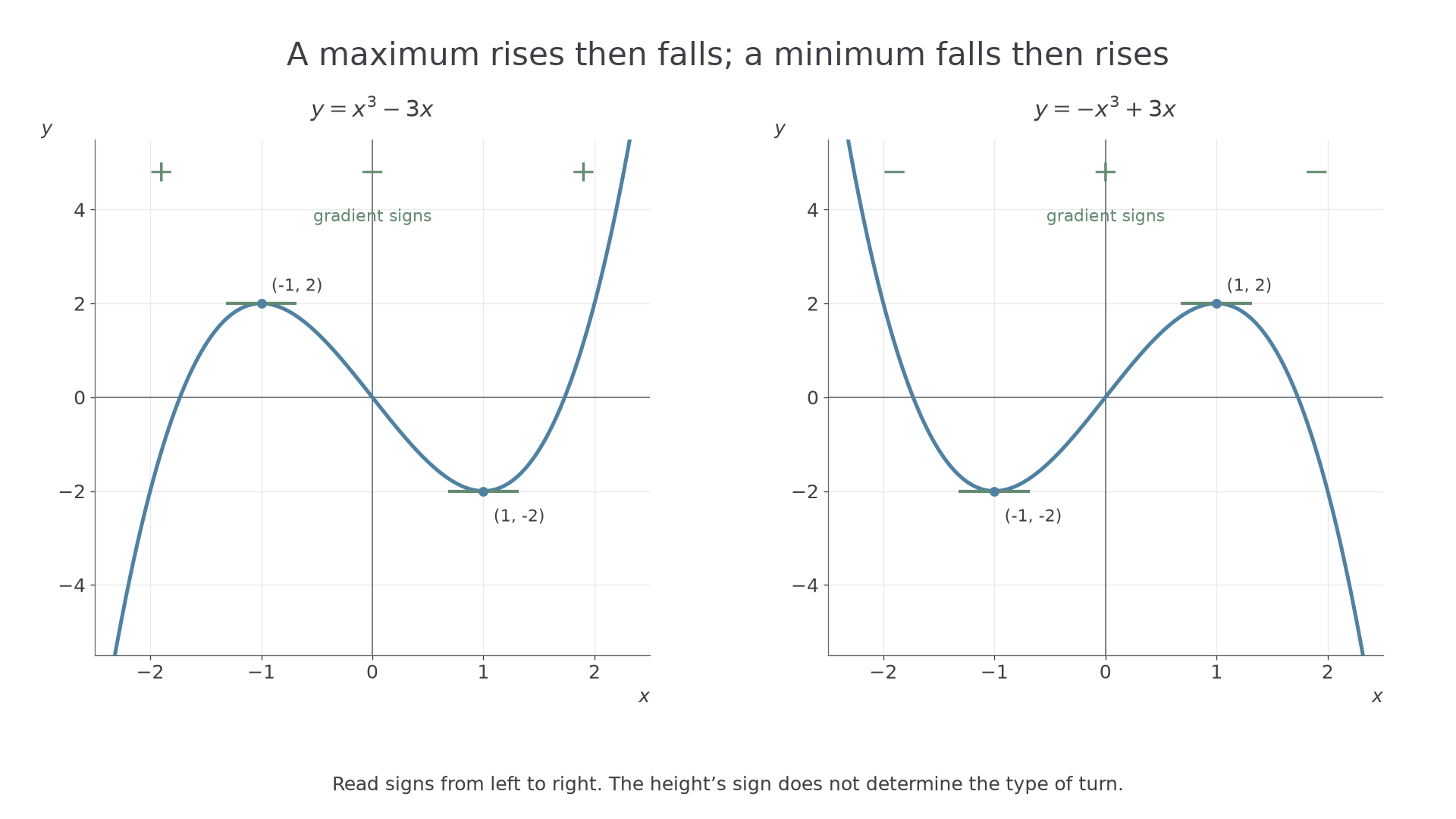
[DIAGRAM: asset_name: Gradient signs distinguish the two turns; asset_slug: gradient_sign_turns; caption: Negating the curve reverses all gradient signs and swaps the nature of each stationary point.; description: Two numbered coordinate grids show y equals x cubed minus three x and its negative. The first marks local maximum negative one comma two and local minimum one comma negative two, with gradient signs positive, negative, positive on the three input intervals. The second marks local minimum negative one comma negative two and local maximum one comma two, with signs negative, positive, negative. Smooth curves and horizontal tangent snippets show both turns.]
Worked example 3: classifying both turns of a cubic
Question. The curve has stationary points and . Determine their nature using gradient signs.
Plan. Factor the derivative and check its sign in the three intervals it creates.
Answer. At , the gradient changes positive to negative, so it is a local maximum. At , it changes negative to positive, so it is a local minimum.
Check. Heights at are 1.969, 2 and 1.971, confirming a local high. Heights at are , confirming a local low. The plotted shapes agree.
Negate only the whole function. Its zeros of the derivative stay fixed, while every gradient sign and height reverses.
Worked example 4: reversing the rises and falls
Question. The curve has stationary points , . Determine their nature using gradient signs.
Plan. Reverse the previous derivative's signs and read each new change from left to right.
Answer. is a local minimum, since the gradient changes negative to positive. is a local maximum, since it changes positive to negative.
Check. Reflecting the earlier graph in the horizontal axis swaps its local highs and lows, exactly as the sign test predicts. Nearby heights at are , both above .
Continue this lesson.
You’re previewing NovaLearn without an account. Create a free account to read the rest.
Create free account