C5.4; E5.4 - Pyramids, cones and spheres
Pointed and rounded solids need different formulas from prisms. In C5.4 and E5.4, you will use the supplied volume and surface formulas, distinguish perpendicular height from slant height, and calculate both the curved and flat surfaces of half a sphere.
Pyramids and cones
Can a cone and a cylinder with the same base and height hold the same amount? The cone narrows towards its apex, so its cross-sections shrink. It holds exactly one third of the corresponding cylinder's volume.
You already know
A prism keeps a uniform cross-section. A pyramid has a polygonal base and triangular side faces meeting at an apex; a cone has a circular base and a curved side. A triangle's area uses its own perpendicular height.
A pyramid's base area is . Its perpendicular height measures the shortest distance from the apex to the base plane. For a right circular cone, the slant height , called the sloping edge in the formula list, runs from the apex to the circle along the curved surface. It is longer than .
[DIAGRAM: asset_name: Heights in a pyramid and cone; asset_slug: pointed_solid_heights; caption: Interior perpendicular height measures volume; face or surface slant height measures area.; description: A right regular square pyramid has base edge six centimetres, perpendicular interior height four centimetres and triangular-face height five centimetres to a base-edge midpoint. A right circular cone has radius three centimetres, perpendicular height four centimetres and slant height five centimetres. Right-angle marks distinguish the interior heights from the sloping measurements.]
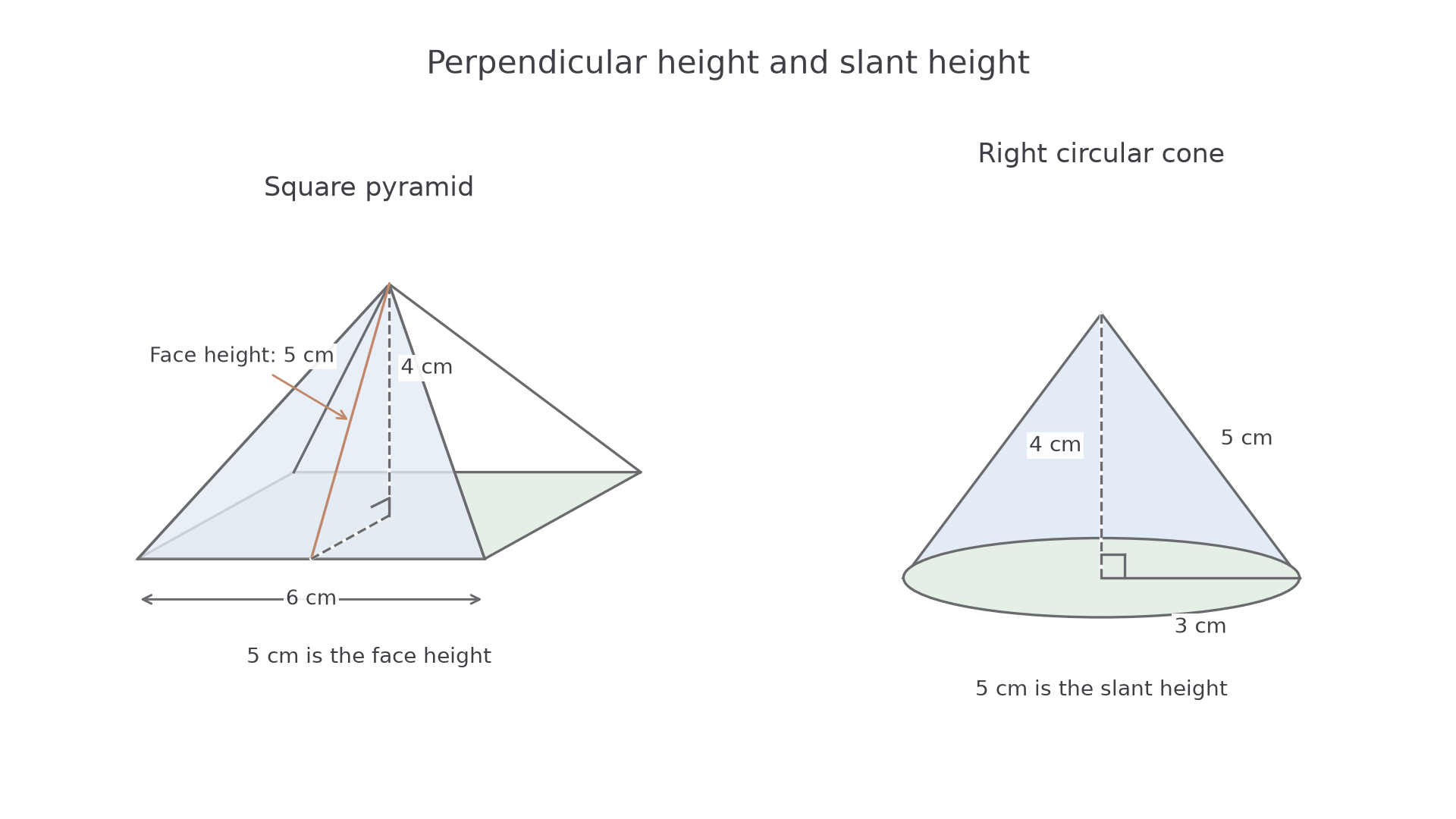
Pyramid and cone
These formulas are given in the List of formulas. is perpendicular height; is the cone's slant height. Add for a cone's total area when its circular base is included.
A pyramid's surface area is the sum of its base and triangular faces; no single pyramid-area formula is supplied.
The factor one third belongs to volume, not surface area. A cube provides one concrete model: choose one vertex as a common apex and use the three opposite square faces as bases. The cube splits into three equal-volume pyramids, each with a square base and perpendicular height equal to the cube edge. The same one-third factor holds for any pyramid, and a cone has the corresponding relationship to a cylinder. The exact factor is supplied; you still decide which base and height belong in it.
For cone area, imagine cutting and opening the curved side into a sector: its radius is the slant height, and its outer arc is the cone-base circumference. That explains why the sloping length, rather than the interior height, belongs in the curved-area formula.
Worked example 1: a square-based pyramid
Question. A right regular square-based pyramid has base side , perpendicular height , and each triangular face has perpendicular face height . Find its volume and total surface area.
Plan. Use the interior height for volume; use the given face height to add the four triangles.
Answer. Volume ; surface area .
Check. The matching by by prism has volume , three times . The net has one square of area and four triangles of area , totalling .
Change the base boundary from a square of width to a circle of diameter . Keep the perpendicular height and the surface slant height .
Worked example 2: a cone
Question. A right circular cone has radius , perpendicular height , and slant height . Find its volume and total surface area in terms of .
Plan. Substitute the perpendicular height in volume and the slant height in curved area, then include the base.
Answer. Volume ; total area .
Check. The matching cylinder volume is , three times the cone volume. The opened curved surface is of a radius- circle, since its arc is out of a full ; its area is .
Watch out
“Cone volume ” uses the wrong height. The line through the interior perpendicular to the base is . The sloping line belongs in curved area. In a pyramid, a sloping edge to a vertex is also different from a triangular face's perpendicular height.
All needed lengths are given; select them rather than trying to find another height.
Spheres and half-spheres
A sphere has no flat base. Cutting it through its centre makes two equal solid halves, each with half the original curved surface and one new flat circular face. A cut away from the centre does not make equal halves.
Half a sphere
Half a sphere is one of the two equal solids made by a plane cut through the centre of a sphere. Its curved surface is half the sphere's surface, and its flat face has the sphere's radius. The name hemisphere means the same thing.
Continue this lesson.
You’re previewing NovaLearn without an account. Create a free account to read the rest.
Create free account