C2.7; E2.7 - Square and cube sequences
Some sequences grow by an ever larger amount. You will recognise square and cube patterns, find simple nth-term rules, and relate a new sequence to one you already know. A rule lets you reach a distant term without listing everything before it.
Square-number patterns
A square made from tiles has side lengths . Its tile counts are . Why do the gaps grow by two each time, and how could you find the hundredth count without drawing a hundred squares?
The position number starts at . A square with rows of tiles contains tiles. The nth term gives the value at position , rather than the amount added to the previous term.
[DIAGRAM: asset_name: Growing a square by an odd border; asset_slug: square_odd_border; caption: A three-by-three square gains seven tiles to become a four-by-four square.; description: Nine blue tiles form a three-by-three square. Four sage tiles extend its right edge and three more extend its top edge, creating a four-by-four square. The labels state old square nine tiles, new border seven tiles and total sixteen tiles.]
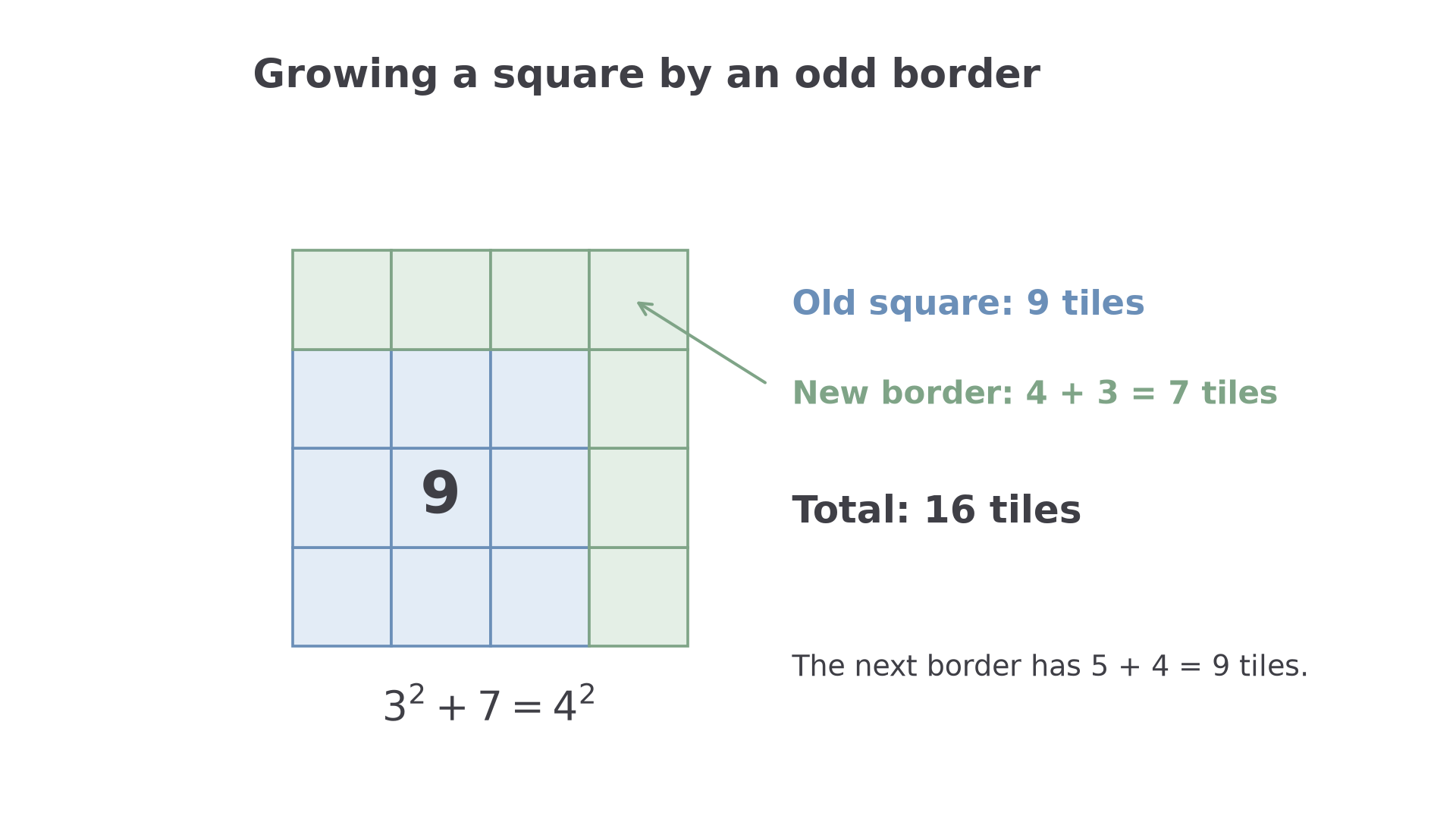
The next border has tiles. The differences between successive squares are the odd numbers : the square's two growing edges explain the pattern.
Simple quadratic pattern
A quadratic sequence has an nth-term rule whose highest power, after collecting terms, is with a non-zero coefficient. A simple example is , where the same number is added at every position. For , each term is three more than the corresponding square number.
Compare terms at the same positions. The sequence is not obtained by adding three repeatedly: its gaps are .
Worked example 1: three above the squares
Question. A sequence is formed by adding to each square number. Its first terms are . Find its nth term and eighth term.
Plan. Compare with , then substitute the required position.
Answer. The nth term is ; the eighth term is .
Check. The seventh term is . The next square-number gap is , and .
Change just the sign of the adjustment. The square-number gaps remain the same, although some early terms are now negative.
Worked example 2: three below the squares
Question. A sequence is formed by subtracting from each square number. It begins . Find its nth term and eighth term.
Plan. Use the same square pattern with an adjustment of minus three.
Answer. The nth term is ; the eighth term is .
Check. The fifth term is . Continuing the gaps gives , matching the rule.
Watch out
and are different rules. At position , they give and . “Three more than a square” means add after squaring.
Cube-number patterns
A cube with side length small cubes has layers, each containing small cubes. Its total is . The cube numbers are .
Simple cubic pattern
A cubic sequence has an nth-term rule whose highest power, after collecting terms, is with a non-zero coefficient. In a simple pattern such as , compare every term with the cube number at the same position.
The cube-number gaps are , so adding the last gap forever would lose the pattern. An nth-term rule is more reliable than guessing a constant difference where there is none.
Continue this lesson.
You’re previewing NovaLearn without an account. Create a free account to read the rest.
Create free account