C4.2; E4.2 - Measuring and constructing triangles
A careful drawing can solve a geometry problem without guessing its shape. You will use a ruler and protractor accurately, construct triangles from three side lengths with compasses, and combine two triangles to construct a rhombus.
Measuring and drawing accurately
Can three lengths fix a triangle even when no angle is given? Yes: two compass arcs can locate the missing vertex. Before building that triangle, make sure each measurement starts from the correct place.
Place a ruler's zero mark, not its physical end, at the first endpoint of a segment. Read the other endpoint at eye level. Each millimetre is , so . If zero cannot be aligned, subtract the starting reading from the finishing reading. To draw a segment, mark its two endpoints at the required readings and join them with a ruled line.
For an angle, place the protractor's centre exactly on the vertex. Align its baseline with one arm. Read the scale that starts at zero on that arm, then follow it to the second arm. If an arm is too short, extend it lightly with a ruler. Judge acute or obtuse first: an obtuse angle cannot correctly read , even if that number appears on the other scale. To draw an angle, mark its required reading, then rule a ray from the vertex through the mark.
[DIAGRAM: asset_name: Reading ruler and protractor scales; asset_slug: ruler_and_protractor; caption: Start at the correct zero and follow the correct angle scale.; description: A ruler diagram shows endpoints at readings 1.2 and 6.4 centimetres and the difference 5.2 centimetres. Beside it a semicircular protractor has its centre on O, baseline pointing right and an obtuse ray at 128 degrees, with the competing 52 degree reading identified as the wrong scale. The illustration explicitly says screen guide, not physical centimetres.]
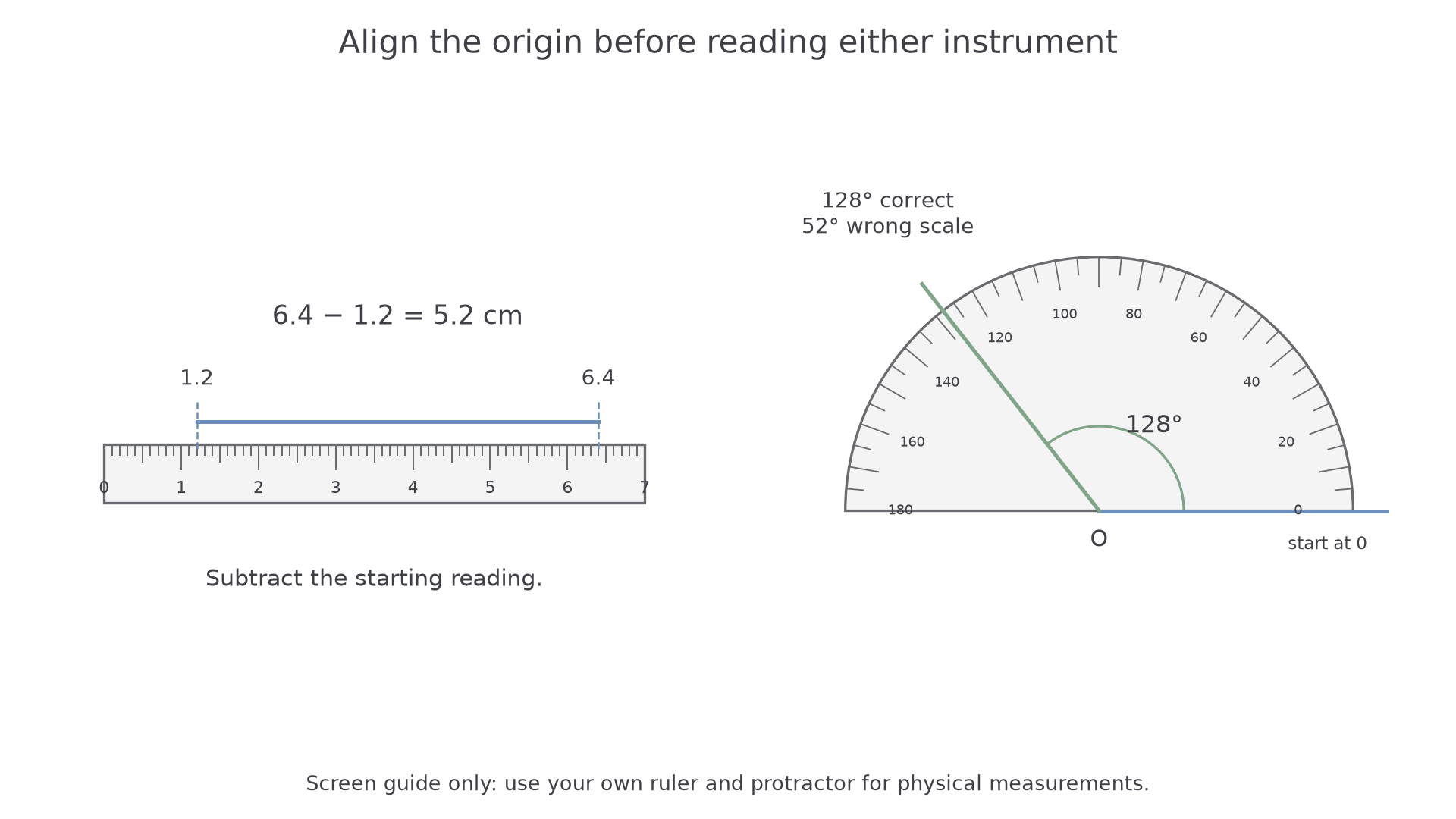
On your own paper, draw lengths in actual centimetres using your ruler. A displayed image can resize on different screens: do not infer physical centimetres from its displayed width. If a diagram gives no guaranteed print size, use its stated measurements or scale bar instead.
Worked example 1: drawing an acute angle
Question. Draw , then draw ray so that , above .
Plan. Draw the baseline accurately, then measure the turn from at .
Mark at zero and at ; rule . Centre the protractor at , with zero towards . Mark above the line and draw through that mark. can be any point farther along that ray.
Answer. A ruled baseline and an acute angle at .
Check. Re-measure from its other end. Then place the protractor on and measure back towards ; the smaller angle is still .
Keep the same baseline but change only the angle. This makes the choice between the two protractor scales visible.
Worked example 2: drawing an obtuse angle
Question. Draw , then draw ray so that , above .
Plan. Start from the same zero direction and continue past the right-angle mark.
Draw the baseline. Centre the protractor at , with zero towards . Follow that scale to , mark the point and rule . The other scale reads at the same mark; it starts at the wrong end for this question.
Answer. An obtuse angle on a baseline.
Check. The ray points above and to the left of , so the marked turn from the rightward baseline is larger than . Re-measure with the protractor correctly centred.
Watch out
“” ignores the starting reading. The length between those ruler marks is . Likewise, a protractor reading is measured from the chosen arm, not whichever zero is nearest the printed number.
Practise on paper so the instruments, rather than the screen size, set the measurements.
Constructing a triangle from three sides
Compasses keep a fixed distance from their centre. If , point must lie on a circle of radius centred at . A second distance from places on a second circle. Where the circles meet, both length conditions hold at once.
SSS construction
An SSS construction uses the three side lengths to construct a triangle with a ruler and compasses. Draw one side, then use arcs from its endpoints to locate the third vertex. Keep the construction arcs visible.
[DIAGRAM: asset_name: Triangle from intersecting arcs; asset_slug: triangle_sss_arcs; caption: The arc intersection satisfies both remaining side lengths at once.; description: Two exact SSS constructions share baseline AB equal to 7 centimetres. Both have AC equal to 5 centimetres; the first has BC equal to 4 centimetres and the second BC equal to 6 centimetres. Blue and sage compass arcs cross at each labelled C, and the ruled triangle sides are shown. A note says lengths are labels, not screen measurements.]
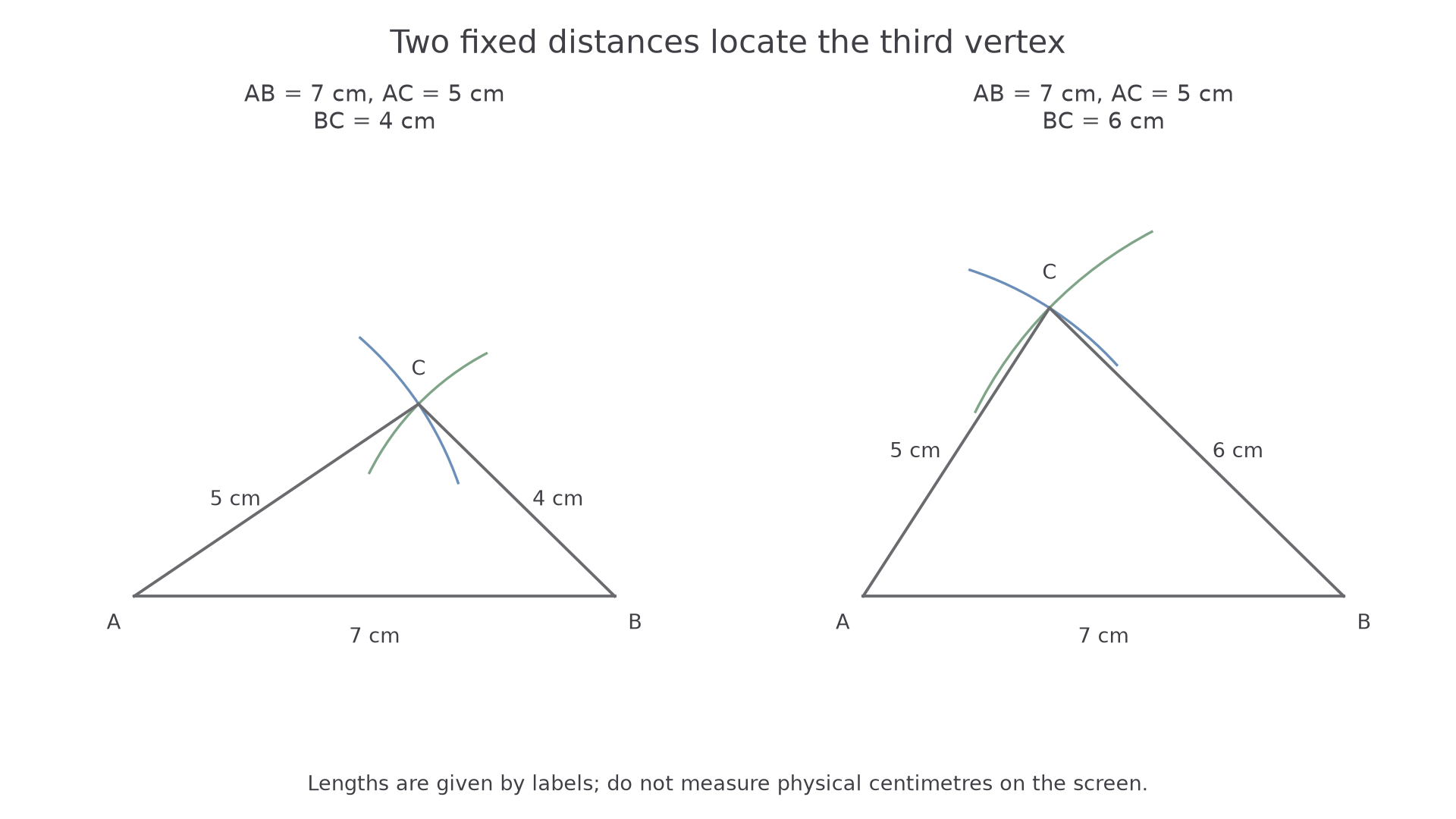
Only short arcs near the intended crossing are needed; full circles are unnecessary. Keep the compass point on the endpoint, and set the opening using the ruler before drawing the arc. Normally there are two intersections, one on each side of the baseline, producing mirror-image triangles with the same side lengths. Use the side the question specifies; otherwise either is valid.
Worked example 3: locating the third vertex
Question. Using a ruler and compasses only, construct triangle with , and . Put above .
Plan. Draw , then intersect an arc of radius from with an arc of radius from .
Mark the upper crossing . Rule and , and leave both arcs visible.
Answer. The constructed triangle has the three required side lengths.
Check. Use the ruler to re-measure all three sides. In particular, the arc from fixes , while the arc from independently fixes .
Continue this lesson.
You’re previewing NovaLearn without an account. Create a free account to read the rest.
Create free account