C1.1, C1.5, C1.6; E1.1, E1.5, E1.6 - Integers and the number line
A minus sign changes where a number belongs, how you compare it and what a calculation means. You will use a number line to recognise integers, order positive and negative numbers, add and subtract, and work out changes that cross zero.
Integers and zero
The temperature rises from to . Has it risen by or ? Keep that question in mind: the minus sign is doing something more useful than making the numbers look awkward.
Think of a building with a ground floor labelled . Floors above it have positive numbers; basement floors have negative numbers. The label means two floors below the reference level. It does not mean “two floors that do not exist”.
Integer
An integer is a positive whole number, a negative whole number, or zero:
For example, and are integers. The numbers and are not integers: they lie between whole-number positions.
The natural numbers are the counting numbers in this course. They are all integers, but the integers also include zero and negative whole numbers. A number's value matters, rather than how it is written: is an integer because it equals .
[DIAGRAM: asset_name: Integers on a number line; asset_slug: integers_number_line; caption: Equal steps represent equal changes. Numbers increase to the right.; description: A number line from negative eight to positive eight with every integer marked. Negative six and negative two are labelled in blue, zero in grey and positive four in green. Negative integers are left of zero and positive integers right of zero.]
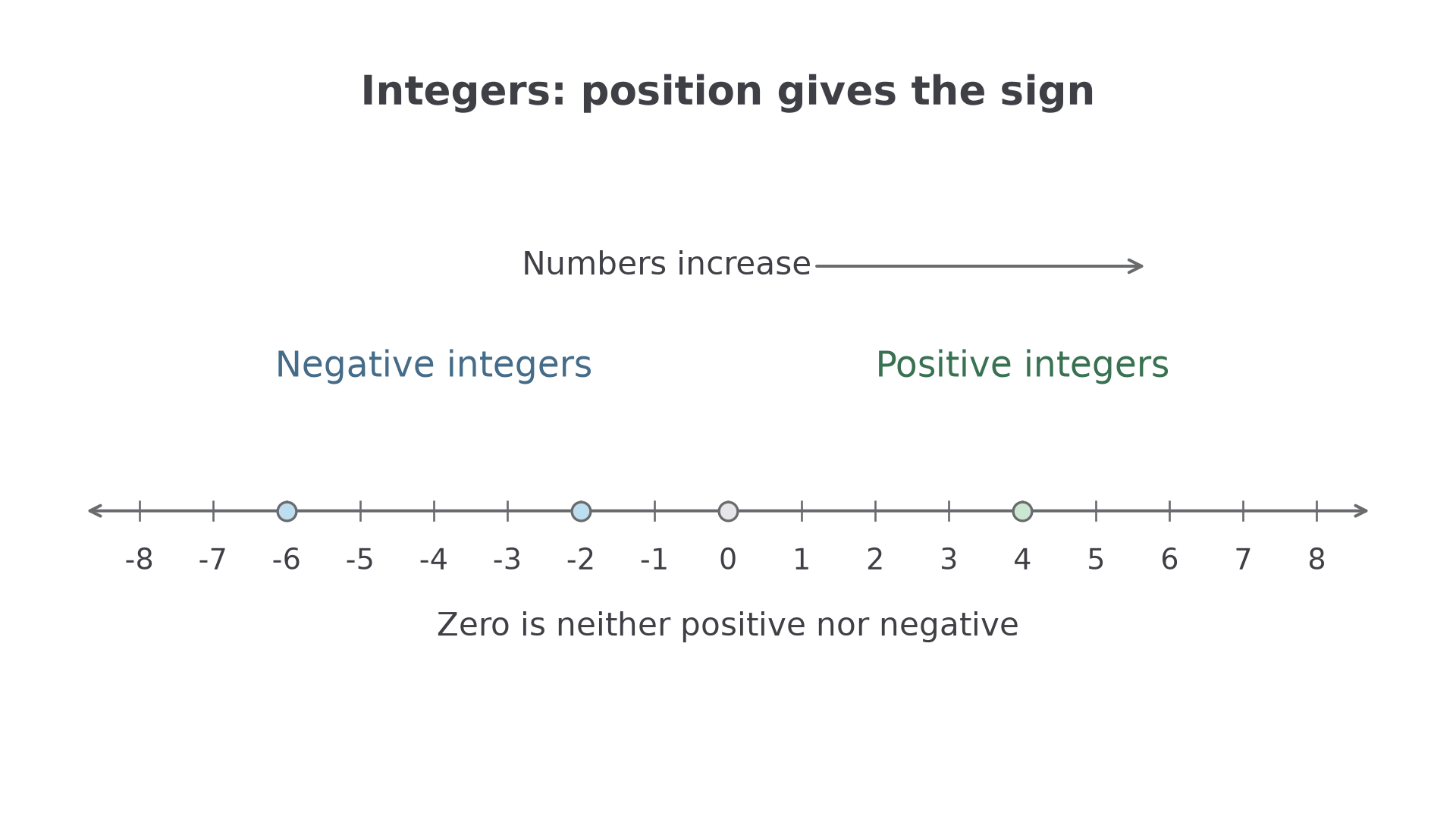
Each gap between neighbouring integers has length . The dots continue in both directions; the edge of the picture is not the end of the numbers. Zero is the reference point separating the two signs.
Key idea
Zero is an integer, but it is neither positive nor negative. Opposite numbers such as and sit equally far from zero on opposite sides.
Ordering integers
The number farther to the right on a number line is greater. This works on both sides of zero: is greater than , because lies farther right. In temperature language, is warmer than .
Comparison symbols
means “ is less than ”; means “ is greater than ”. The wide end faces the greater number.
means “less than or equal to”, and means “greater than or equal to”. The symbols and mean “equal to” and “not equal to”.
Equality matters. For instance, is true, while is false. Likewise, : equal distances from zero do not make the numbers equal.
Worked example 1: ordering across zero
Question. Write these integers in order of size, starting with the smallest:
Plan. Place the numbers mentally on the number line, then read from left to right.
Answer. .
Check. Read backwards: is largest, followed by , then , then . Each step moves left.
Now change just the sign of . Its place in the list must change too.
Worked example 2: changing one sign
Question. Write these integers in order of size, starting with the smallest:
Plan. Put all three negative numbers to the left of zero and compare their positions.
Answer. .
Check. The gaps are , so the ordered numbers occupy evenly spaced positions heading right towards zero.
Watch out
“ because ” is wrong. The signs put both numbers left of zero. Eight steps left is farther left than three steps left, so .
Adding and subtracting on the line
An addition or subtraction tells you how to move from your starting number. Adding a positive number moves right; subtracting a positive number moves left. You can cross zero during either move.
For example, beginning at and adding takes you three steps to zero and another two to . Beginning at and subtracting takes you five steps farther left, to .
Adding a negative number moves left by its size: . Subtracting a negative number reverses that leftward move, so it moves right: . The sign inside the brackets belongs to the number; the sign outside tells you the operation.
Worked example 3: crossing zero to the right
Question. Work out .
Plan. Start at , move right to zero, then use the remaining steps.
Answer. .
Check. Undo the addition: , which returns to the starting number.
Keep the start and distance the same, but change addition to subtraction. Only the direction changes.
Worked example 4: moving farther below zero
Question. Work out .
Plan. Start seven steps left of zero and move eleven more steps left.
Answer. .
Check. Undo the subtraction: . Also, subtracting a positive number must give a result below .
Watch out
is wrong: that answer comes from moving right. The subtraction of positive tells you to move left. By contrast, , because subtracting a negative reverses the direction.
Changes and gaps across zero
A change tells you both the size and the direction of a move. A gap tells you only how far apart the two values are. A temperature can change by a negative amount, but the gap between two temperatures cannot be negative.
Return to the opening question. From to , you must first rise to zero, then another . The rise is , not .
[DIAGRAM: asset_name: A change across zero; asset_slug: change_across_zero; caption: The rise from negative six to four is six plus four, making ten.; description: An evenly spaced temperature number line from negative eight to positive eight. An arrow from negative six to zero is labelled rise six degrees Celsius and an arrow from zero to four is labelled rise four degrees Celsius. A long arrow from negative six to four is labelled total rise ten degrees Celsius.]
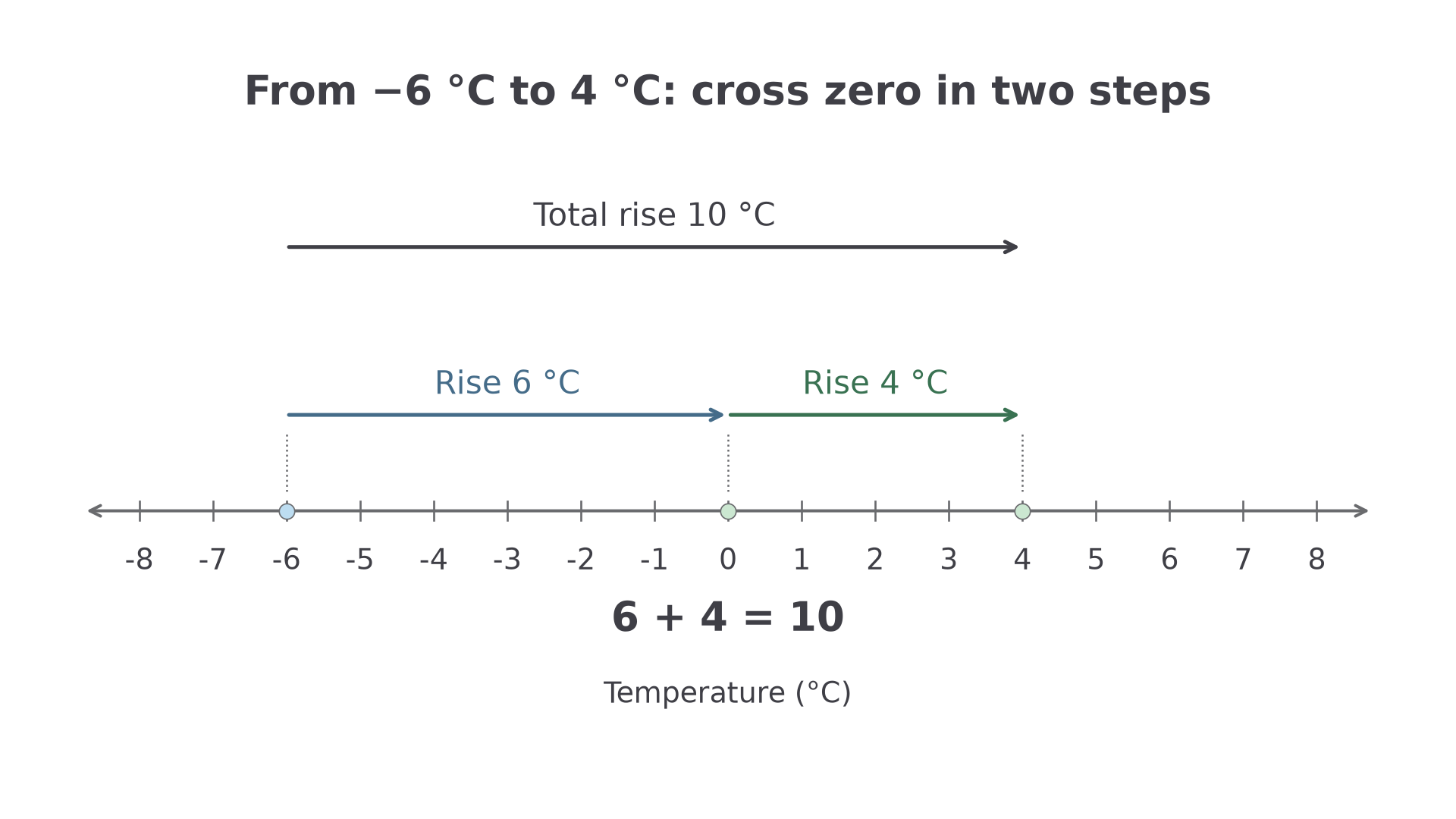
You can write any signed change as final value minus starting value. For a gap, subtract the smaller value from the larger value. If the values are equal, the gap is zero.
Worked example 5: a rise across zero
Question. A freezer display changes from to . Work out the increase in temperature.
Plan. Count the rise to zero, then the rise above zero.
Answer. The increase is .
Check. Start plus change gives finish: .
Now reverse the journey. The distance between the temperatures stays the same; the direction changes.
Worked example 6: the same gap, opposite change
Question. The freezer display changes from to . Work out the signed change in temperature and state the temperature decrease.
Plan. Subtract the starting value from the final value, then describe the size of the fall.
Answer. The signed change is . The temperature decreases by .
Check. , so the change reaches the stated final temperature.
There is a useful surprise here: subtracting can make a number larger. In , subtracting the negative starting value measures the whole gap across zero. “Subtraction always makes smaller” only works when you subtract a positive number.
Watch out
The “difference between” two temperatures usually asks for their gap. Give a non-negative value. If asked for a signed change, keep the direction: final minus starting value.
Quick Recap
- Integers include positive whole numbers, negative whole numbers and zero.
- Numbers farther right on a number line are greater. Zero is neither positive nor negative.
- Adding a positive number moves right; subtracting a positive number moves left. A negative number reverses that direction.
- Signed change is final value minus starting value. A gap has no direction and cannot be negative.
The opening temperature rose by : six degrees to zero, then four more.