E8.3 - Events without replacement
Removing an object changes what can happen next. This Extended lesson develops E8.3 by updating the remaining counts, building dependent probability trees and calculating events reached by several paths. You will also compare the same experiment with and without replacement.
How the first outcome changes the second
A bag contains five red counters and three blue counters. If the first counter is red and stays out of the bag, is another red still as likely as before? There are fewer reds, but there are also fewer counters altogether. Both changes matter.
Without replacement means keeping the selected object out before the next selection. At every selection here, each counter remaining in the bag is equally likely to be chosen. After one draw, the total falls from eight to seven, whichever colour was removed. The numerator depends on that colour.
Dependent events
Two events are dependent when knowing whether one occurred changes the probability of the other. Here, knowing the first colour changes the chance of a red second counter, because different contents remain after red and after blue.
The remaining counts are easier to see before writing fractions.
[DIAGRAM: asset_name: Contents after the first counter is removed; asset_slug: without_replacement_remaining; caption: The total becomes seven in either case, but the colour counts differ.; description: An initial bag has five red counters and three blue counters, shown using distinct pale colours and R or B labels. Two arrows lead to remaining-bag panels: after red is removed there are four red and three blue counters; after blue is removed there are five red and two blue counters. Both remaining panels contain seven counters.]
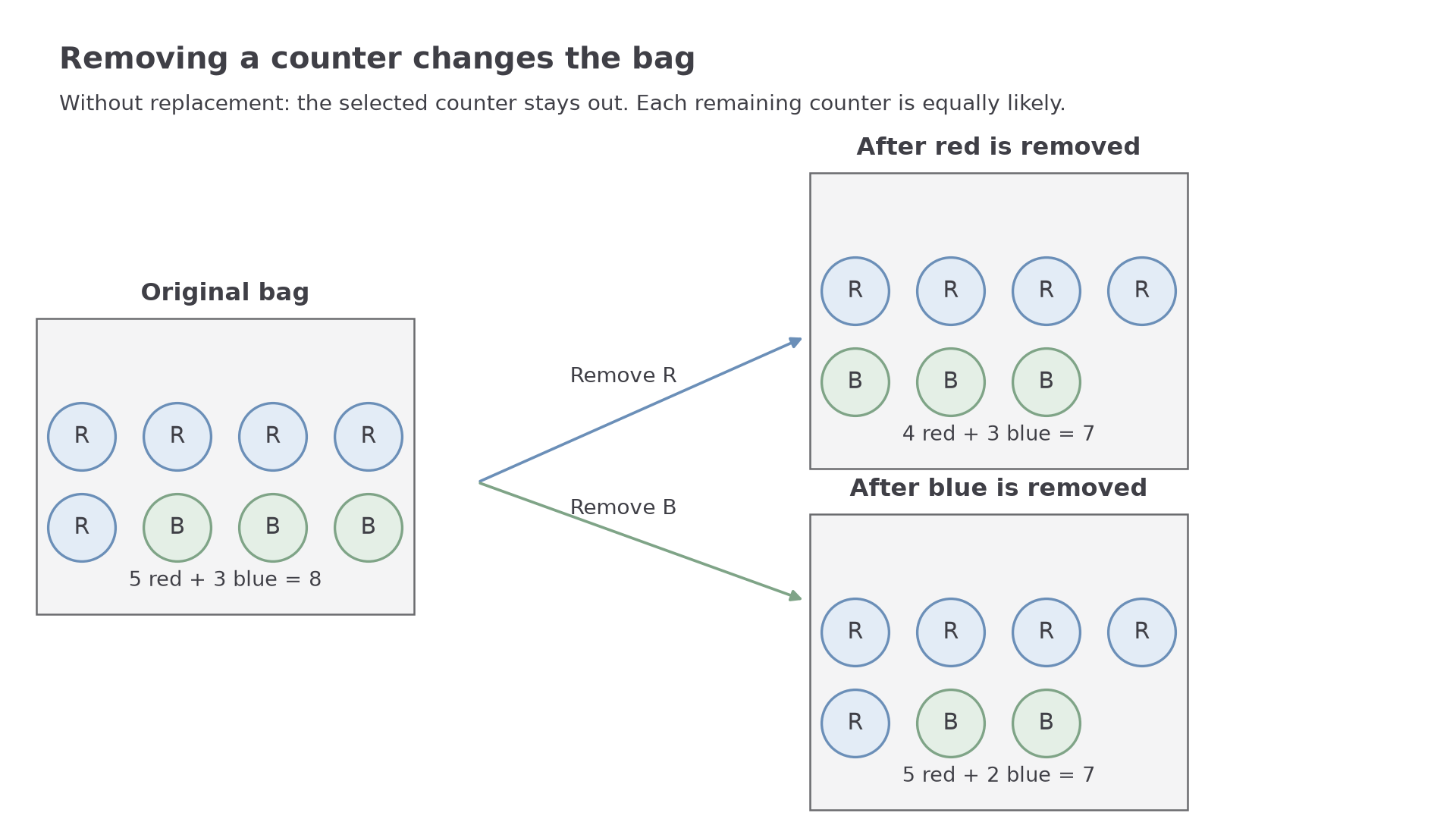
Worked example 1: a red counter is removed
Question. A bag contains five red and three blue counters. One counter is removed and is red. Every remaining counter has equal chance on the next draw. Find the probability that the next counter is red.
Plan. Remove one red from both the red count and the total, then form the new fraction.
Answer. .
Check. Three blue counters remain, with probability ; . Also , as : removing a red has reduced its chance.
Keep the original bag and change only the known first colour. The total still falls by one; the number of reds does not.
Worked example 2: a blue counter is removed
Question. Start again with five red and three blue counters. This time the first removed counter is blue. Find the probability of red on the next equally likely selection from the remaining counters.
Plan. Keep all five reds, remove one blue, and count the seven counters still available.
Answer. .
Check. The alternative blue chance is , and these add to one. The red chance has increased from to because all five reds are now among fewer counters.
These are probabilities after the first colour is known. Do not multiply by the chance of that first colour when the question has already told you it happened. A question about the whole two-draw sequence will need that first branch too.
With replacement and thorough mixing, either first colour would instead leave the original five reds and three blues: the next red probability would be . It is the selection procedure, not just the original counts, that determines the second-stage probabilities.
Watch out
After a red is removed, updates only the numerator and updates only the denominator. Update the whole bag: the correct red probability is .
First find the remaining counts for this different bag.
Dependent tree diagrams
A dependent tree records a different second-stage situation after each first-stage outcome. Begin with the original bag at the first split. Before labelling a later split, mentally follow the path to it and count what remains.
For five red and three blue counters drawn twice without replacement, the first probabilities are and . After red, use four reds and three blues; after blue, use five reds and two blues. The tree has the same shape as a replacement tree, but its second branch probabilities differ.
[DIAGRAM: asset_name: A dependent tree for two counters; asset_slug: without_replacement_tree; caption: Read the first result before choosing the probabilities on the second split.; description: A two-stage tree starts with R probability five eighths and B probability three eighths. After R, the second probabilities are R four sevenths and B three sevenths. After B, the second probabilities are R five sevenths and B two sevenths. Complete-path probabilities are RR twenty fifty-sixths, RB fifteen fifty-sixths, BR fifteen fifty-sixths and BB six fifty-sixths.]
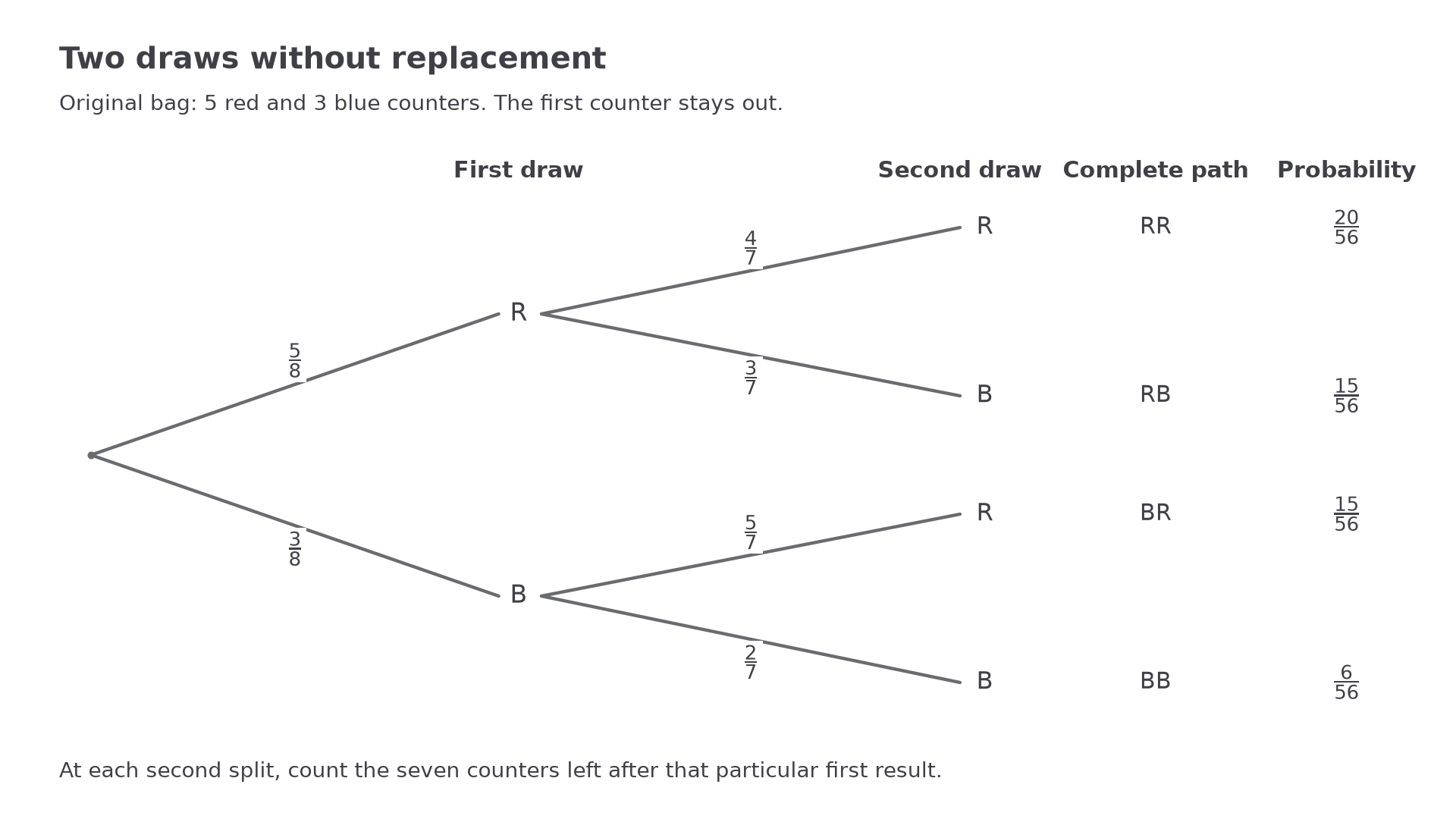
Multiplication along a path still works. Its second factor is the chance appropriate to the first result on that path; independence is not needed when those updated branch probabilities are used.
Continue this lesson.
You’re previewing NovaLearn without an account. Create a free account to read the rest.
Create free account