E2.2 - Completing the square
A quadratic can be written as a square plus a correction, even when it has no simple integer factors. You will build that form, handle coefficients other than one and verify that your new expression is identical to the original. This lesson is for the Extended route.
Completing a monic square
Can be written using just one occurrence of ? Since , the square adds four too much. Subtracting gives exactly the expression we wanted.
Start with an area picture for : an -by- square and two strips, each -by-, almost fill a square of side . The missing corner has area . The picture explains the construction; expansion then proves the identity for every real , including negative values that cannot represent lengths.
[DIAGRAM: asset_name: Completing the missing corner; asset_slug: completing_square_corner; caption: Two strips of area 3x need a corner of area 9 to complete the square.; description: A square of side x plus 3 is divided into an x by x region labelled x squared, two strips each labelled 3x, and a pale clay corner labelled 9. Side lengths x and 3 are marked. The diagram assumes x is positive and shows why x squared plus 6x plus 9 equals the square of x plus 3.]
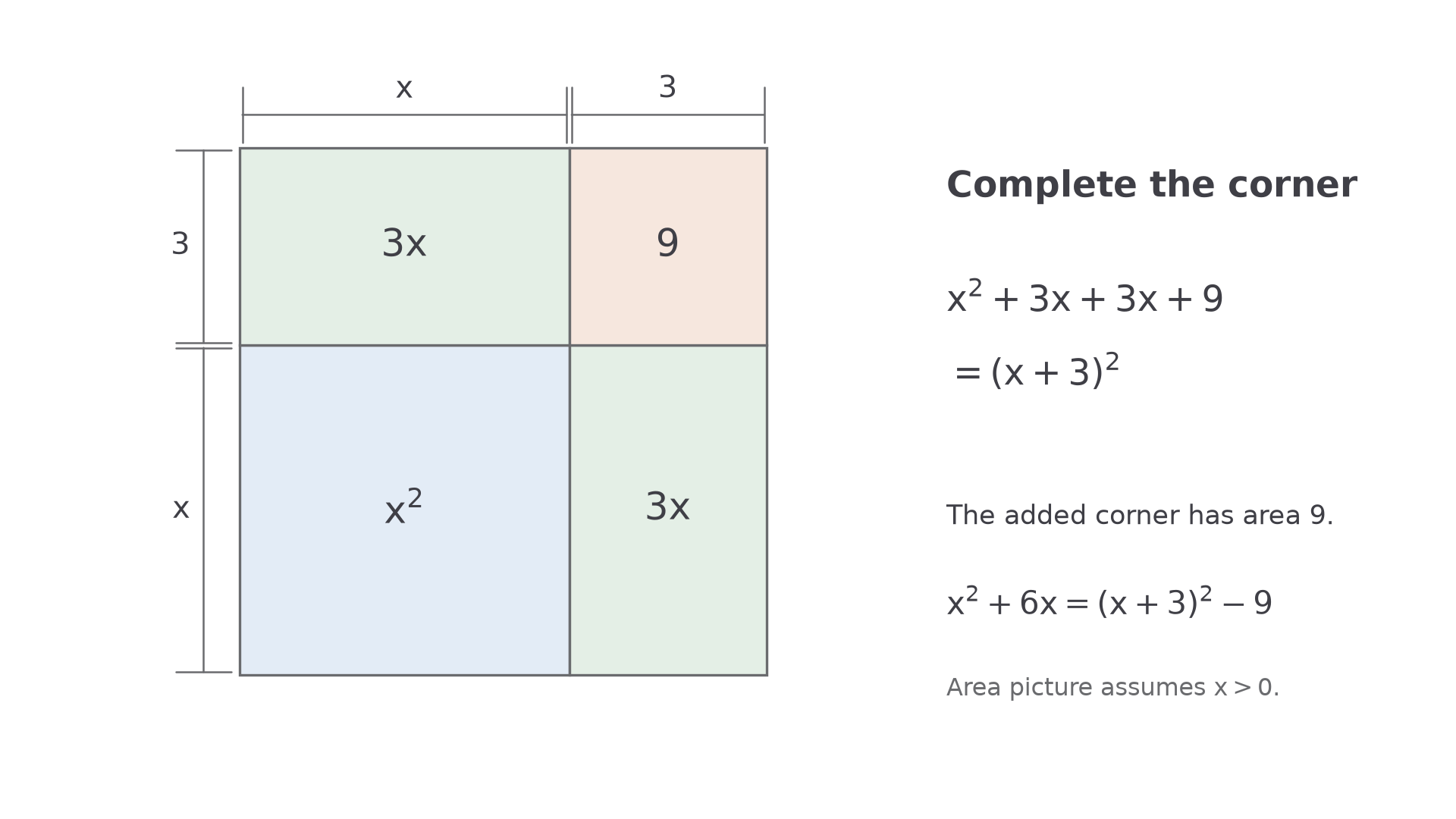
Completing the square
Completing the square rewrites a quadratic as , where . It changes the form of the expression, not its value. For a monic quadratic, .
Half the coefficient of gives the number inside the bracket, because the cross-term in is . Add and subtract its square to keep the total unchanged.
Worked example 1: an even middle coefficient
Question. Write in completed-square form.
Plan. Use half of , then compensate for the new square term.
Answer. .
Check. Expanding gives .
Change only the middle coefficient from to . Its half is now a fraction, so keep the arithmetic exact.
Worked example 2: an odd middle coefficient
Question. Write in completed-square form.
Plan. Use inside the bracket and subtract .
Answer. .
Check. Expansion gives .
For a negative middle term, half its signed coefficient: . The squared correction is still positive before it is subtracted.
Watch out
is wrong: the cross-term becomes . Half the middle coefficient, then subtract the square you introduced.
Fractions inside a completed square are exact numbers; a common denominator keeps the correction clear.
A coefficient before the square
When the leading coefficient is , the whole completed square and its correction must be multiplied by . First factor the leading coefficient out of the quadratic and linear terms. Keep the original constant outside, so you can see the correction clearly.
For example, . Completing the bracket gives , so the outside correction is , not .
General completed-square form
For real with ,
The condition permits division by and ensures the expression is quadratic. The method works for positive and negative . Not given in the List of formulas: learn the method.
You can use the formula to check your work, but factoring first makes the source of every correction visible.
Worked example 3: a positive leading coefficient
Question. Complete the square for .
Plan. Take out from the first two terms, complete the inner square, then distribute .
Answer. .
Check. Expanding gives .
Continue this lesson.
You’re previewing NovaLearn without an account. Create a free account to read the rest.
Create free account