C2.5; E2.5 - Solving linear equations
An equation turns an unknown number into something you can find. You will keep equality true while undoing operations, solve equations with brackets and numerical fractions, and build an equation from a situation before checking the answer.
Keeping an equation balanced
I triple a number, add five and get twenty. Can you find the number without guessing? The equation records exactly what happened, with standing for the number.
Equation and solution
An equation states that two expressions have equal values. A solution is a value of the unknown that makes the equation true. For example, solves , because .
Think of equal values as a balanced scale. Adding or subtracting the same amount on both sides keeps them equal. Multiplying or dividing both sides by the same non-zero number also keeps the same solutions. Dividing by zero is undefined; multiplying by zero would erase information.
[DIAGRAM: asset_name: Keeping equality balanced; asset_slug: equation_balance; caption: Remove five from both sides, then divide both sides into three equal groups.; description: Three rows of algebra tiles show three x tiles plus five unit tiles equal to twenty unit tiles, then three x tiles equal to fifteen unit tiles after subtracting five from both sides, then one x tile equal to five unit tiles after dividing both sides by three.]
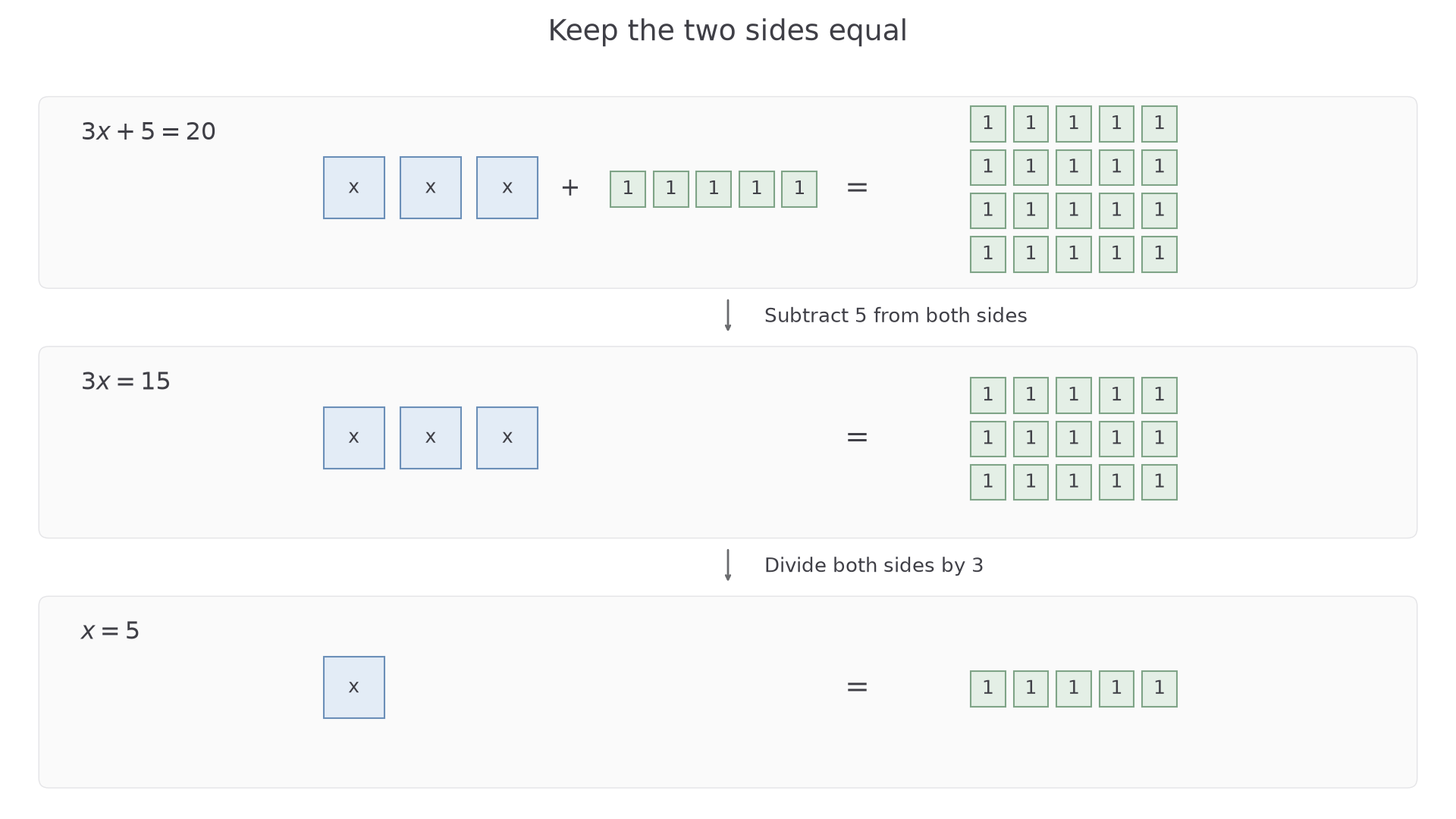
Work backwards through the operations: undo the last operation first. Each written equation should still say that its left and right sides are equal.
Worked example 1: undoing addition then multiplication
Question. Solve .
Plan. Subtract five from both sides, then divide both sides by three.
Answer. .
Check. In the original equation, .
Change only the total from twenty to negative ten. The balance operations stay the same; the solution changes sign.
Worked example 2: a negative solution
Question. Solve .
Plan. Remove the added five before dividing by three.
Answer. .
Check. , the required total.
A negative solution is possible even when the coefficient and added number are positive; substituting it checks the sign.
Watch out
From , writing changes the balance. Subtract five from both sides: . A term does not move by magic; the same operation acts on each side.
Use the original equation for your check, so an earlier rearrangement error cannot hide.
Brackets and unknowns on both sides
When the unknown appears on both sides, collect its terms on one side and the ordinary numbers on the other. Expand brackets first so that every term is visible. Subtracting from each side preserves equality just as subtracting a number does.
You already know
Expansion multiplies every term inside a bracket: . Like terms can then be collected, so .
Choose a side for the unknown; either side works if you keep the signs. A negative coefficient is allowed, so there is no need to start again when it appears.
Worked example 3: removing an unknown term
Question. Solve .
Plan. Expand, subtract from both sides, then remove eight.
Answer. .
Check. Original left side: . Original right side: .
Now change only the right-hand coefficient from one to three. Subtracting gives a negative coefficient, which is still a valid route.
Worked example 4: a negative coefficient
Question. Solve .
Plan. Expand, put all unknown terms on the left and then isolate .
Answer. .
Check. and : both sides agree.
Sometimes the unknown cancels completely. The equation reduces to the false statement , so it has no solution. In contrast, is true for every value of . Do not try to divide by a zero coefficient to invent a single answer.
Watch out
is wrong. The multiplier is , so the correct expansion is . Carry the minus sign to every term.
Collecting on the other side is equally valid: a different route should lead to the same solution.
Continue this lesson.
You’re previewing NovaLearn without an account. Create a free account to read the rest.
Create free account