C2.6; E2.6 - Inequalities on a number line
One small line under an inequality sign decides whether a boundary value is allowed. You will read strict and inclusive inequalities, represent intervals with the correct circles, and list integer values that satisfy both ends of an interval.
Strict and inclusive inequalities
A ride admits children who are at least four years old. Can a child aged exactly four enter? What changes if the rule says “older than four”? Inequality signs make this boundary decision precise.
An inequality compares values. Recall that means is less than four, while means it is greater than four. The wide end faces the greater value. Equality is allowed only when the sign includes the extra line.
Strict and inclusive inequalities
A strict inequality, using or , excludes equality. An inclusive inequality, using or , allows equality.
For example, means “at least four”, including four itself. The statement is false, while is true.
Test a value by replacing the letter with that value and deciding whether the comparison is true.
Worked example 1: a strict upper limit
Question. Which of , and satisfy ?
Plan. Test each value against the same upper limit.
Answer. Only .
Check. Only the value three lies strictly left of four on a number line.
Change only to . Values below and above the limit keep their status; the boundary itself changes.
Worked example 2: an inclusive upper limit
Question. Which of , and satisfy ?
Plan. Test whether each value is below or equal to four.
Answer. and .
Check. The accepted values are left of four or exactly at four; lies to its right.
“At most” means ; “at least” means . “Less than” and “greater than” are strict. These phrases work for negative limits too: is true because is farther right.
Watch out
“At least four” is , not . The words include the boundary. “Older than four” excludes exactly four.
Drawing and reading intervals
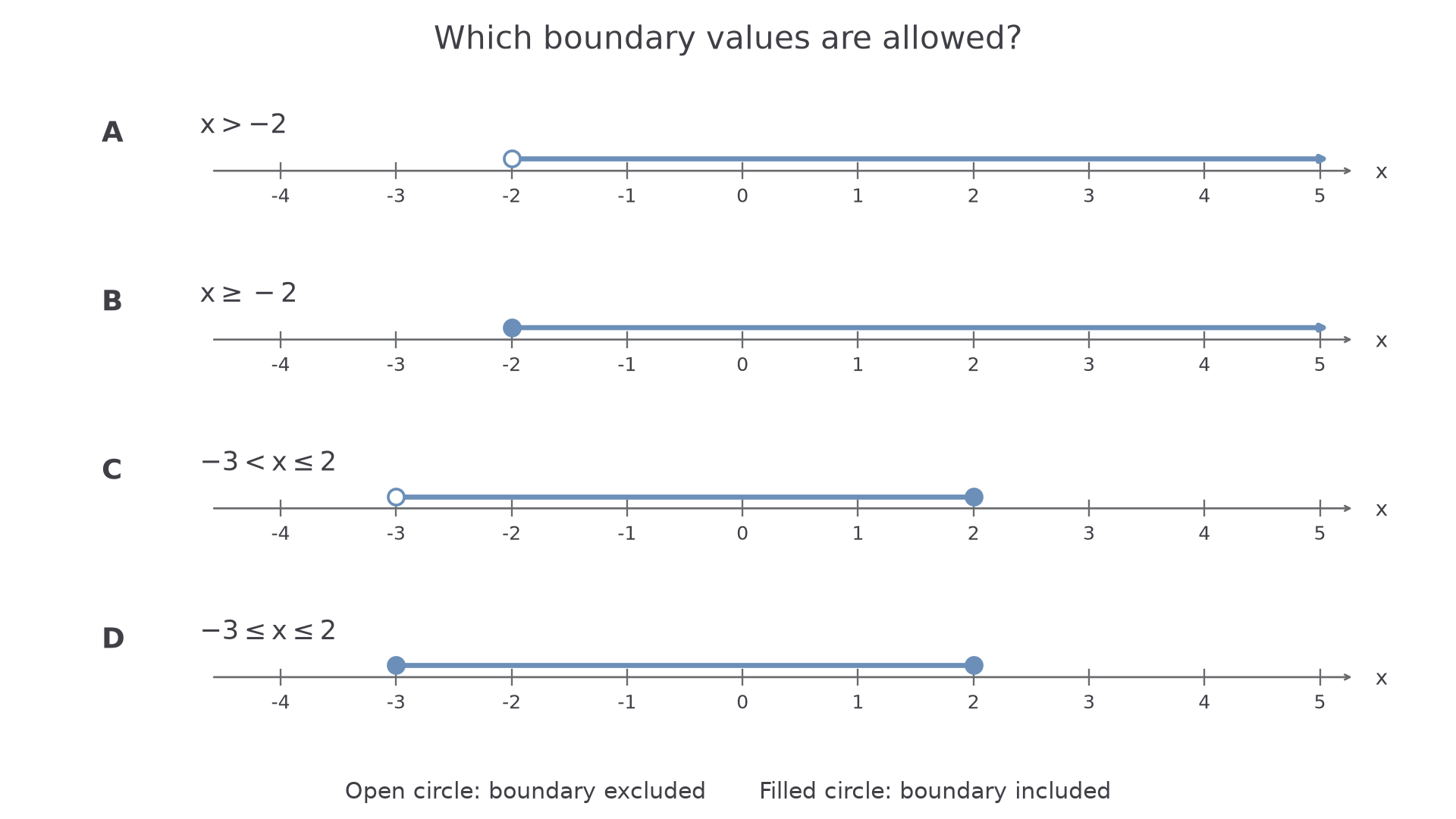
A number line shows every permitted value, including fractions and decimals between labelled ticks. Use an open circle for an excluded boundary and a filled circle for an included boundary. Draw a segment between two limits, or an arrow if the allowed values continue in one direction without a final limit.
For , put an open circle at and draw an arrow to the right. For , fill that circle. A left-pointing arrow represents values below an upper limit. An arrow continues indefinitely; the last printed tick is not a boundary.
[DIAGRAM: asset_name: Strict and inclusive intervals; asset_slug: inequality_intervals; caption: Open circles exclude a boundary. Filled circles include it. A segment must satisfy both limits.; description: Four evenly spaced number lines labelled A to D. A shows x greater than negative two with an open circle and rightward arrow. B shows x greater than or equal to negative two with a filled circle and rightward arrow. C shows negative three less than x less than or equal to two, open at negative three and filled at two. D shows the same segment with both endpoints filled.]
Compound inequality
A compound inequality combines two comparisons. For example, means and at the same time. It describes the interval between those limits, with only the right endpoint included.
Read compound notation from left to right: “negative three is less than , and is less than or equal to two”. The middle letter is one value satisfying both conditions.
Continue this lesson.
You’re previewing NovaLearn without an account. Create a free account to read the rest.
Create free account