C1.10; E1.10 - Limits of rounded measurements
A rounded measurement stands for a range of possible values. You will find that range, identify its lower and upper bounds, and decide what the recorded measurement does and does not tell you.
Rounding intervals
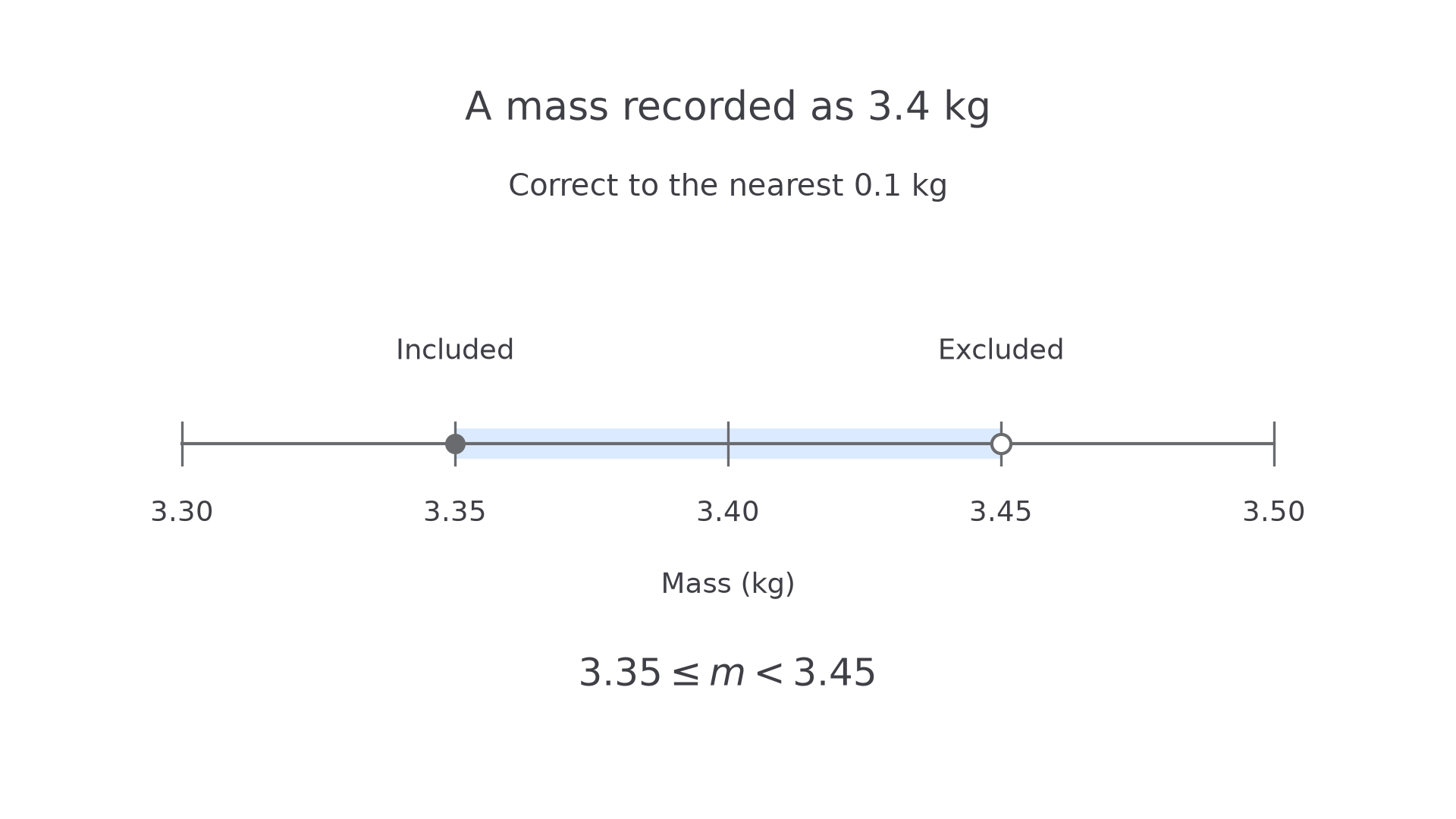
A parcel's mass is recorded as , correct to the nearest . Could its actual mass be ? Yes: different masses can give the same rounded reading. How far can that uncertainty extend?
The neighbouring readings are , and . The changeover points are halfway between them: and . Using the usual rule that a halfway positive value rounds up, rounds to , but rounds to .
Rounding interval
A rounding interval contains all values which round to a stated value at the specified accuracy. For the positive readings here, whose intervals stay above zero, the boundaries are half a rounding unit below and above the recorded value. The lower boundary is included; the upper boundary is excluded.
The rounding unit here is , so half a rounding unit is , not . Any extra restriction on the quantity still applies: an actual length cannot be negative, even if a rounding calculation extends below zero.
[DIAGRAM: asset_name: The interval for a rounded mass; asset_slug: rounded_mass_interval; caption: Every mass from 3.35 kg up to but not including 3.45 kg rounds to 3.4 kg.; description: An exact number line from 3.30 to 3.50 kg. The interval from 3.35 to 3.45 is highlighted pale blue. A filled circle at 3.35 marks the included lower boundary and an open circle at 3.45 marks the excluded upper boundary. The recorded value 3.40 is marked midway between them.]
Worked example 1: nearest centimetre
Question. A length is , correct to the nearest centimetre. Write its rounding interval.
Plan. Go half a centimetre below and above the reading.
Answer. The length is at least and less than .
Check. rounds to , while rounds to . A value just inside either boundary rounds to .
Keep the recorded length the same, but change the precision of the measurement. That changes the uncertainty.
Worked example 2: nearest tenth of a centimetre
Question. A length is , correct to the nearest . Write its rounding interval.
Plan. Use half of on either side.
Answer. At least and less than .
Check. The interval has width , one rounding unit, and its midpoint is .
Watch out
The recorded value alone does not determine its bounds. to the nearest whole unit and to one decimal place have equal values but different stated accuracies.
Lower and upper boundaries
The lower bound is the lower boundary of the possible values; the upper bound is the upper boundary. An upper bound is still called a bound even when the measurement cannot equal it. There is no greatest possible real value below an excluded boundary: you can always choose one closer to it.
If denotes the parcel's actual mass, the opening interval can be written , with measured in kilograms. Read this as “ is at least , and is less than ”. The symbol includes equality; excludes it.
For significant figures, first identify the place value of the last retained digit. That tells you the rounding unit. A number rounded to two significant figures does not always have the same uncertainty as another number rounded to two significant figures.
Worked example 3: two significant figures
Question. A distance is , correct to two significant figures. Give its lower and upper bounds.
Plan. The last retained digit is in the tens column, so halve .
Answer. Lower bound ; upper bound . The interval is , for distance in metres.
Check. rounds to at two significant figures, but rounds to .
Now make the distance ten times as large while keeping two significant figures. The rounding unit also becomes ten times as large.
Worked example 4: a different last place
Question. A distance is , correct to two significant figures. Give its lower and upper bounds.
Plan. The last retained digit is now in the hundreds column.
Answer. Lower bound ; upper bound .
Check. The width is , matching the rounding unit, and the recorded distance lies halfway between the bounds.
Watch out
An upper bound of is not . That particular number lies inside the interval; values such as can lie closer to the boundary.
Interpreting measurement limits
A rounded reading tells you which values are possible, not which of them actually occurred. To test a proposed measurement, find the interval and compare it with both boundaries. Keep units consistent.
Worked example 5: a possible measurement
Question. A length is recorded as , correct to the nearest . Could the actual length be ?
Plan. Find the rounding interval and locate the proposed value.
Answer. Yes, is possible.
Check. Rounding to one decimal place gives .
Move only the proposed value to the upper boundary. The conclusion changes even though the movement is tiny.
Worked example 6: exactly on the upper boundary
Question. With the same recorded length and accuracy, could the actual length be ?
Plan. Compare the proposed value with the excluded boundary.
Answer. No, is excluded.
Check. rounds to , not , to one decimal place.
This explains the parcel at the start: is possible, but the recorded is not an exact mass. A count of exactly objects is different: it is exact, so do not invent a half-unit interval unless the count is stated to have been rounded.
Key idea
The stated accuracy supplies the uncertainty. A rounded value identifies an interval; it does not reveal the actual measurement within it.
Quick Recap
- Identify the rounding unit, then take half of it on either side of the recorded value.
- For the positive rounded measurements here, include the lower boundary and exclude the upper boundary.
- Significant figures require attention to the place value of the last retained digit.
- Bounds limit possible values; they do not give the actual measurement.
The parcel can have mass : every mass from up to but not including rounds to .