C6.2; E6.2 - Using sine, cosine and tangent
An angle can tell you a missing length even when Pythagoras has only one known side to work with. You will name sides relative to an acute angle, choose sine, cosine or tangent, and rearrange a ratio when the unknown is above or below the fraction line.
Opposite, adjacent and hypotenuse
Two right triangles have the same acute angle, but one is twice as large. Can an angle tell you an actual side length, or only how side lengths compare? A triangle can grow without changing its angles, so the angle determines ratios. One known length then sets the scale.
First choose the acute angle you are using: the target angle. The shorter side across from it is the opposite side. The shorter side touching it is the adjacent side. The hypotenuse also touches the target angle, so “adjacent” specifically means the touching side that is not the hypotenuse.
Sides relative to an acute angle
In a right-angled triangle:
- the hypotenuse is opposite the right angle;
- the opposite side is opposite the chosen acute angle;
- the adjacent side meets the chosen acute angle and is not the hypotenuse.
Opposite and adjacent depend on the chosen angle. The hypotenuse does not.
A triangle's orientation is irrelevant. Start at the marked right angle to identify the hypotenuse, then look from the target angle to identify the other two sides.
[DIAGRAM: asset_name: Sides depend on the target angle; asset_slug: trig_relative_sides; caption: Changing the target angle swaps opposite and adjacent.; description: Two copies of triangle ABC are right-angled at B. Relative to angle A, BC is opposite and AB adjacent; relative to angle C, AB is opposite and BC adjacent. AC is the hypotenuse in both copies.]
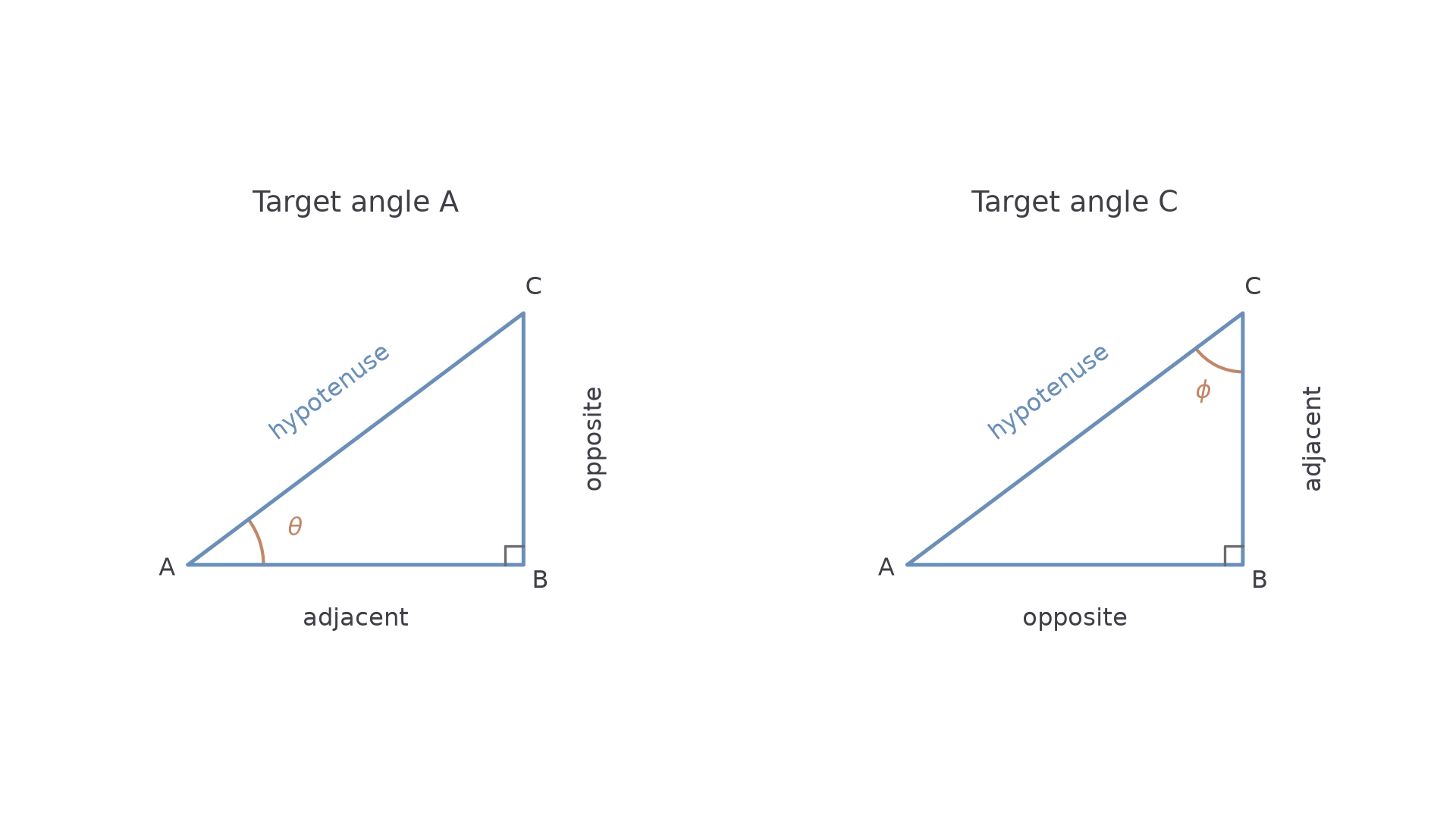
For angle , the opposite side is and adjacent is . For angle , these roles swap. The triangle's lengths have not changed; the question you ask of them has.
Similar right triangles have corresponding lengths in the same ratio. A triangle with opposite , adjacent and hypotenuse can be enlarged to lengths . Both have opposite-to-hypotenuse ratio , adjacent-to-hypotenuse ratio , and opposite-to-adjacent ratio . This is why ratios, rather than absolute lengths, describe an angle.
Watch out
“The vertical side is opposite” is not a rule. Opposite means across from the target angle, even when the triangle is turned or the other acute angle is chosen.
Use the named vertices rather than an imagined orientation in the next check.
Choosing a trigonometric ratio
Sine, cosine and tangent are names for the three useful side ratios. The angle selects the numerical value of each ratio. The length unit cancels because the numerator and denominator are measured in the same unit.
Right-triangle ratios
For an acute angle in a right-angled triangle,
The side lengths are positive and . The memory aid SOH CAH TOA gives the same three ratios.
Not in the List of formulas: learn these ratios.
Choose the ratio containing the side you know and the side you need. The third side is usually unnecessary.
| Two relevant sides | Ratio |
|---|---|
| Opposite and hypotenuse | Sine |
| Adjacent and hypotenuse | Cosine |
| Opposite and adjacent | Tangent |
The values of ratios can be supplied, allowing exact work without a calculator. In the next pair, the acute angle is unchanged and its ratios are supplied. Only the known side changes.
Worked example 1: using the hypotenuse
Question. For an acute angle , you are given , and . A right triangle has hypotenuse . Find the side opposite .
Plan. Choose sine because it joins the opposite side and hypotenuse.
Answer. The opposite side is .
Check. Cosine gives adjacent . Then , agreeing with the supplied tangent ratio.
Now supply the adjacent side instead of the hypotenuse. Sine is no longer the direct choice because its denominator is not given.
Continue this lesson.
You’re previewing NovaLearn without an account. Create a free account to read the rest.
Create free account