C5.5; E5.5 - Compound solids and exposed surfaces
A joined solid can hide faces, and a cut can create new ones. In C5.5 and E5.5, you will add or subtract volumes, identify the exposed boundary of compound solids, and keep exact answers when parts of circles appear.
Adding and subtracting volumes
If you cut a solid in half, is its total surface area necessarily halved? No: the cut exposes a new face. Volume is simpler to start with because it counts the space occupied, rather than the boundary.
You already know
A cylinder has volume , and half a sphere has volume . Joining non-overlapping pieces adds their volumes. A cavity is missing material.
Choose pieces whose volumes you can calculate. They may meet at a boundary, but their interiors must not overlap when you add them. For a hollow solid, calculate the outside solid's volume and subtract the space removed. Use the actual perpendicular height of each piece.
[DIAGRAM: asset_name: Adding a dome or removing a cavity; asset_slug: compound_volume_parts; caption: The same half-sphere volume can be added as material or subtracted as empty space.; description: Two axial section drawings show a cylinder of radius three centimetres and height eight centimetres. The first has a solid half-sphere of radius three above its top; the second has a half-spherical cavity of radius three cut down into the top. Material is pale blue and empty space is white; the joins or cut openings are shown explicitly.]
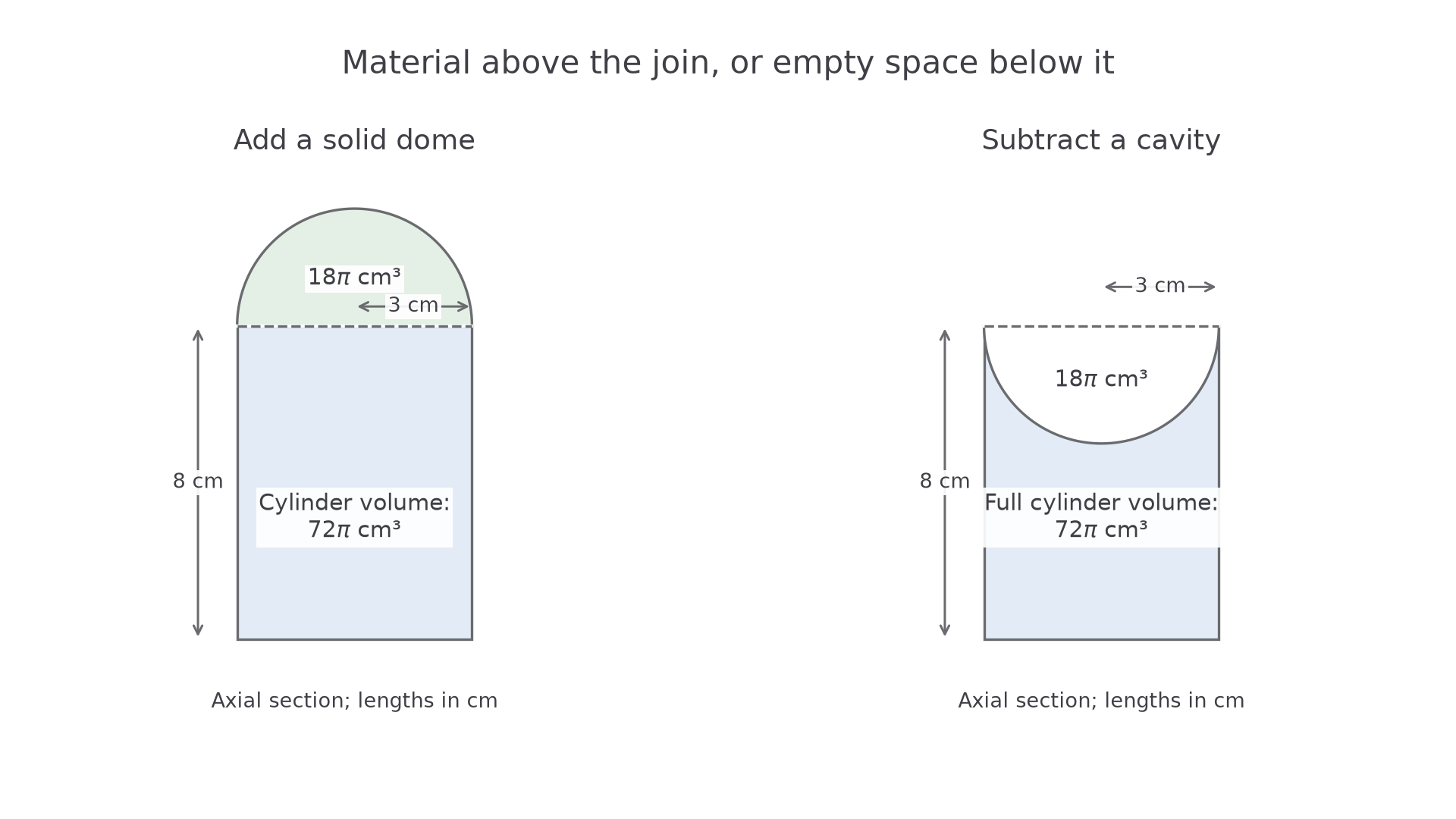
Worked example 1: a solid dome
Question. A solid consists of a cylinder of radius and height , topped by a solid half-sphere of the same radius. The pieces meet at one circular face. Find the total volume in terms of .
Plan. Add the volumes of the two non-overlapping pieces.
Answer. .
Check. The dome fits inside an extra cylinder of radius and height , volume . The result lies between and , as it should.
Change only the role of the half-sphere: remove it as a cavity instead of adding it above the cylinder.
Worked example 2: a half-spherical cavity
Question. A cylinder has radius and height . A half-spherical cavity of radius is cut down into its top. Find the remaining material volume in terms of .
Plan. Subtract the cavity volume from the full cylinder volume.
Answer. .
Check. Filling the cavity would restore the cylinder: . The cavity is deep, less than the cylinder height, so it fits.
A rectangular hole uses the same subtraction principle. For example, a by by block with a by hole passing straight through its height has material volume .
Watch out
“Add both volumes” is wrong when one shape describes a hole. Name each volume as material or empty space before deciding the sign.
The new cavity fits inside the stated cylinder.
Exposed surfaces and hidden joins
Surface area follows the exposed boundary. A face glued completely to another face is inside the finished solid and contributes nothing to the outside area. If you start with both pieces' total areas, subtract the shared joining area twice: each original piece counted it once.
Exposed surface
An exposed surface is a boundary surface of the final object that the question asks you to count. It can include the inside wall of an open cavity. A hidden join between solid pieces is not exposed.
A cylinder joined to a cone of the same radius has a cylindrical curved side, a conical curved side and a bottom circle. The cylinder's top circle and cone's base circle are both hidden. If the join covers only part of a larger face, the uncovered remainder still counts.
[DIAGRAM: asset_name: Exposed surfaces of a cone on a cylinder; asset_slug: exposed_cone_cylinder; caption: Count the two curved surfaces and the bottom; the matching circular join is hidden.; description: A right circular cone of radius three centimetres, height four centimetres and slant height five centimetres sits on a cylinder of radius three centimetres and height eight centimetres. The internal matching join is dashed, curved surfaces are pale blue and clay, and the bottom circular face is pale sage. A companion surface inventory labels two curved surfaces and one bottom circle.]
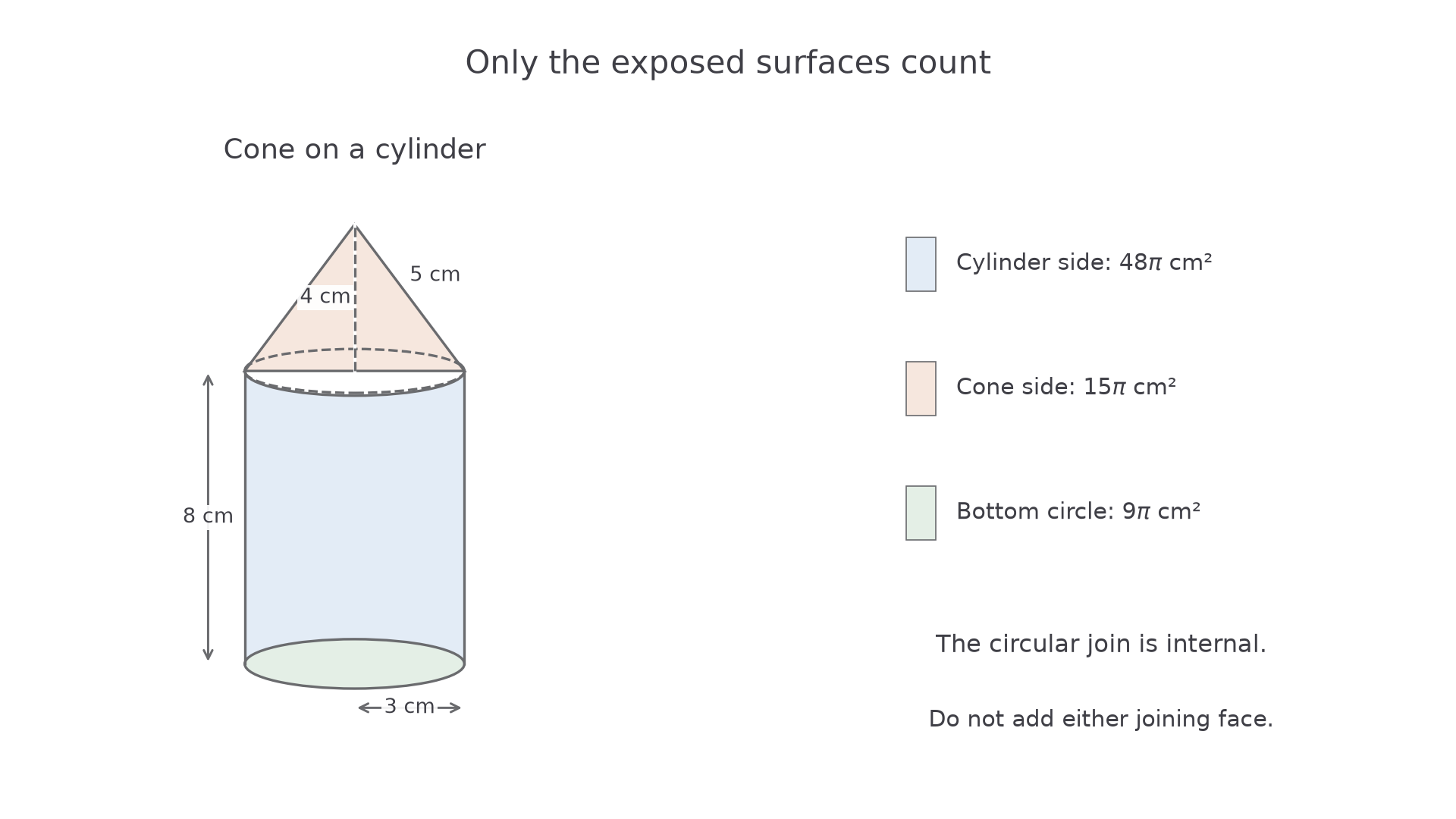
Worked example 3: a closed compound solid
Question. A cylinder of radius and height is joined to a cone with radius , perpendicular height and slant height . Find the total exposed surface area, including the bottom, in terms of .
Plan. Add both curved surfaces and the bottom circle; omit the hidden join.
Answer. .
Check. Separate closed-piece areas are and . Their sum is ; removing the two hidden circles gives .
Continue this lesson.
You’re previewing NovaLearn without an account. Create a free account to read the rest.
Create free account