C6.1; E6.1 - Pythagoras and missing lengths
A diagonal can be shorter than a journey round two sides, but its length is not a guess. You will use the right-angle relationship between three sides, find either missing side, and check whether lengths can belong to a right-angled triangle.
The right-angle relationship
A rectangle is wide and long. Is its diagonal , or something shorter? The diagonal cuts across instead of following both edges. To find its length, compare squares built on the sides of the right-angled triangle.
Hypotenuse
The hypotenuse is the side opposite the angle in a right-angled triangle. It is the longest side. The two sides meeting at the right angle are the shorter sides, however the triangle is turned.
For a right triangle with shorter sides and , the hypotenuse has length . The squares on those sides have areas , and : the first two areas add to the third. This relationship works for every right triangle, not just whole-number lengths.
[DIAGRAM: asset_name: An area argument for Pythagoras; asset_slug: pythagoras_area_relationship; caption: Subtract four equal triangles from the large square.; description: A square of side a plus b contains four congruent right triangles with perpendicular sides a and b. Their hypotenuses form an inner square of side c. The inner square area is the outer area minus four triangle areas.]
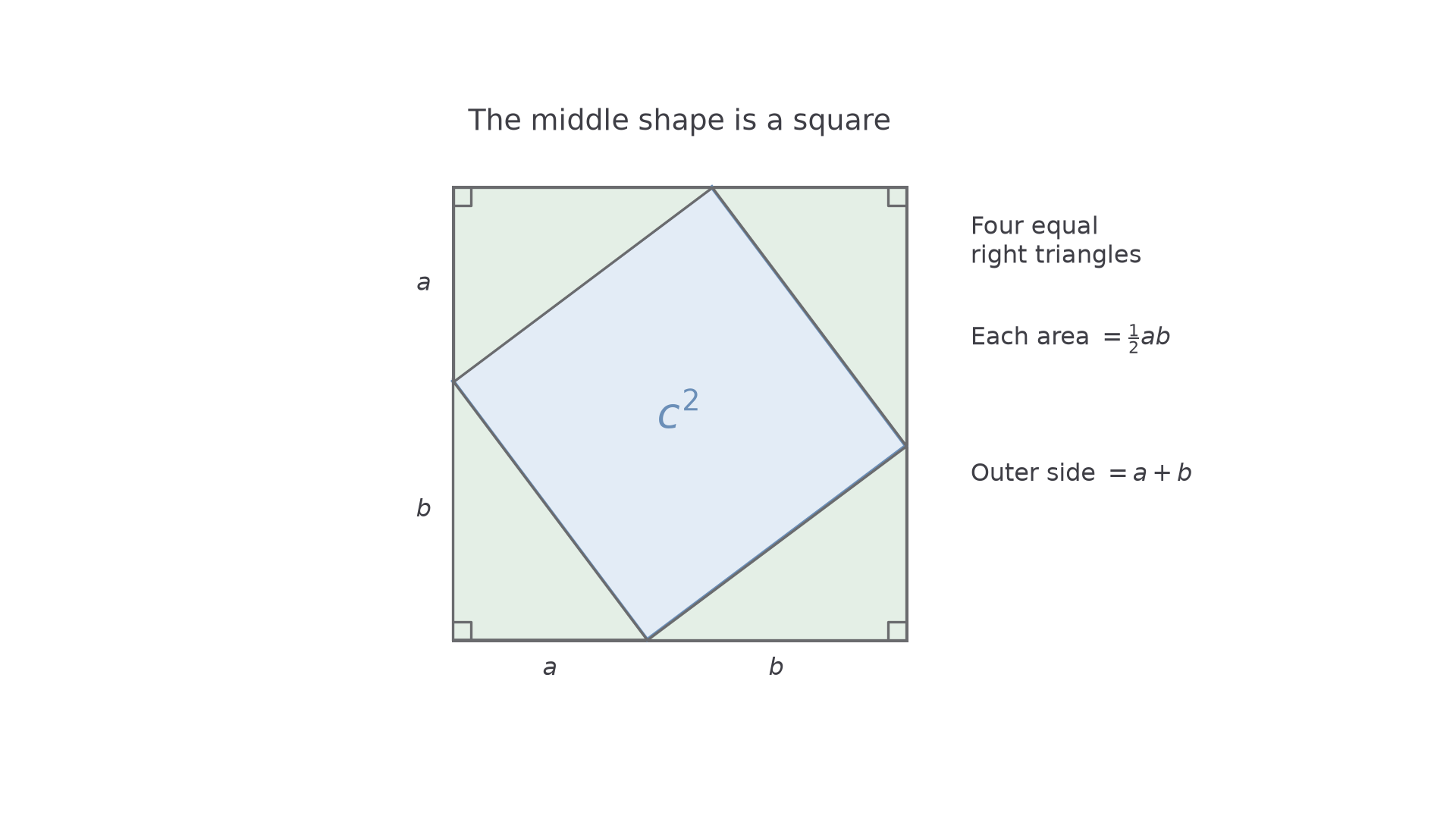
Here each small triangle has shorter sides and , and hypotenuse . Its two acute angles add to , so the angles of the middle shape are right angles. Its four equal sides have length , making it a square. The outer square can also be split into squares of areas and , plus two rectangles each of area . Subtract the four triangle areas from that total:
This is a relationship between squares of lengths, not a rule for adding the lengths themselves.
Pythagoras' theorem
In a right-angled triangle, with positive shorter side lengths and hypotenuse ,
Not in the List of formulas: learn it.
The reverse test also works: if the squares of the two shorter sides add to the square of the longest side, the triangle is right-angled. Identify the longest side first. If the equality fails, those three lengths do not form a right triangle.
Worked example 1: checking the right-angle relationship
Question. A triangle has side lengths , and . Determine whether it is right-angled.
Plan. Compare the sum of the two smaller squares with the largest square.
Answer. The triangle is right-angled, with hypotenuse .
Check. Dividing all three lengths by gives , the right triangle already considered. Scaling lengths preserves angles.
Change only the longest side from to . Having two familiar lengths does not guarantee a right angle.
Worked example 2: a failed test
Question. A triangle has side lengths , and . Determine whether it is right-angled.
Plan. Make the same comparison, using as the longest side.
Answer. The triangle is not right-angled.
Check. A right triangle with shorter sides and has longest side , not .
Watch out
is not Pythagoras. A genuine triangle's two shorter sides together are longer than its longest side. It is their squares that add in the right-angle relationship.
Apply the square test to a new triangle.
Finding a hypotenuse
When the missing side is opposite the right angle, its square is the sum of the other two squares. Find that sum, then take the positive square root. A length cannot be negative.
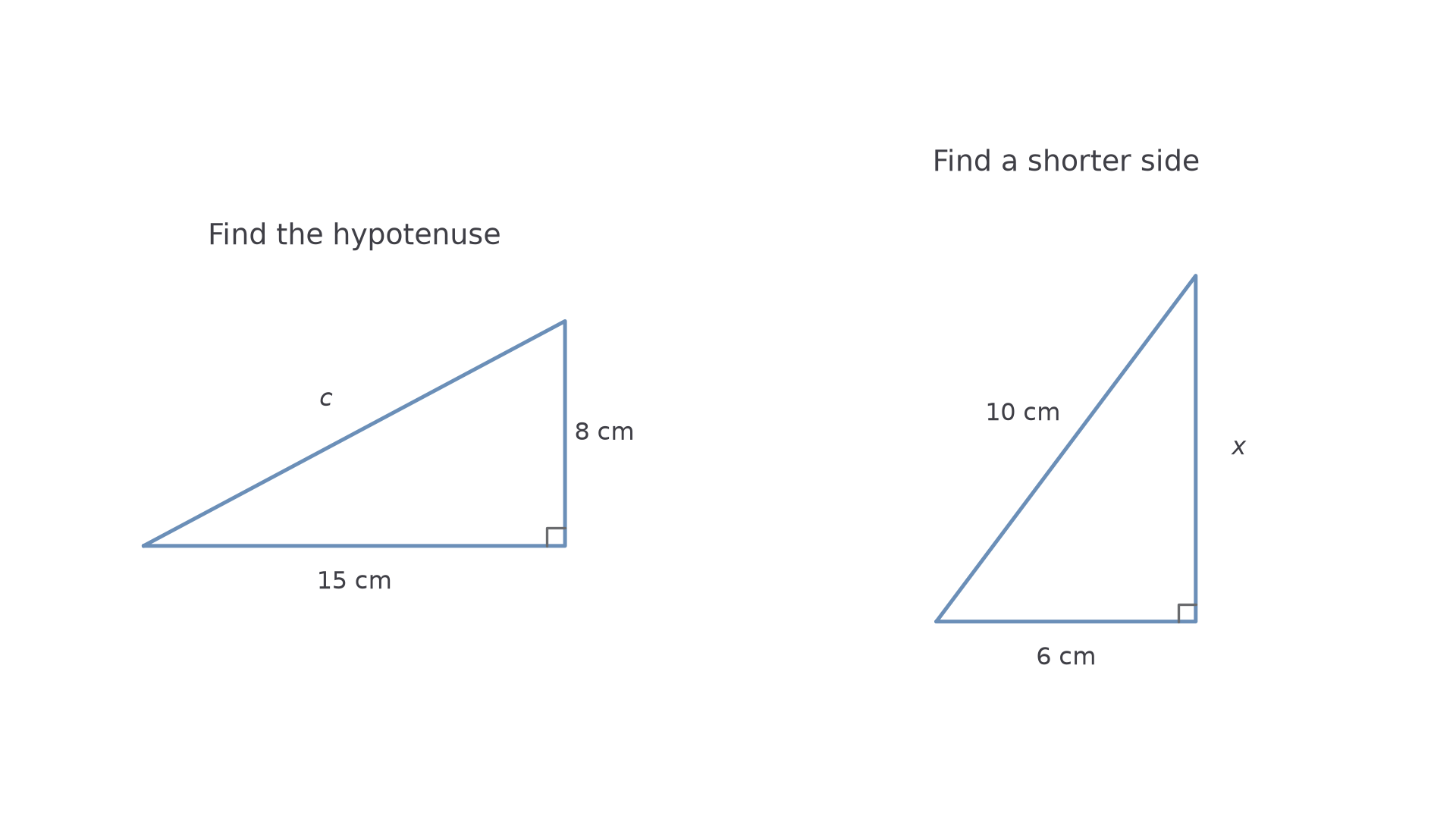
[DIAGRAM: asset_name: Choosing the missing side; asset_slug: pythagoras_missing_lengths; caption: The side opposite the square corner is the hypotenuse.; description: Left: a right triangle has perpendicular sides fifteen and eight centimetres and hypotenuse c. Right: a right triangle has hypotenuse ten centimetres, one shorter side six centimetres and the other shorter side x. Right angles are marked.]
Continue this lesson.
You’re previewing NovaLearn without an account. Create a free account to read the rest.
Create free account