C5.5; E5.5 - Compound areas and perimeters
A shape made by joining or cutting familiar shapes still has an area and one outside boundary to follow. You will split compound shapes into useful pieces, find missing lengths, and combine straight edges with circular arcs while keeping exact answers.
Decomposing and subtracting areas
Cut a rectangular corner from a sheet. Its area decreases, but must its perimeter decrease too? Keep that question in mind as you first work out how much material remains.
A compound shape is formed from simpler shapes. You can find its area by adding non-overlapping pieces that exactly fill it, or by subtracting missing pieces from a larger shape. The cuts used to split the shape are imaginary: they do not add or remove surface.
You already know
A rectangle has area , a triangle , and a circle . Work in one length unit before calculating areas. Add square units to square units.
For an L-shape, a surrounding rectangle often makes subtraction shorter. Alternatively, draw a horizontal or vertical line to split the L into two rectangles. Find each missing length by comparing aligned distances: an outside width of with a corner removed leaves .
[DIAGRAM: asset_name: Two L-shaped areas; asset_slug: compound_area_subtraction; caption: A surrounding rectangle makes the missing corner easy to subtract.; description: Two right-angled L-shapes each have outer width 12 and height 8 centimetres and top-right removed width 4 centimetres. The first missing corner has depth 3 centimetres and the second depth 5 centimetres. Dashed edges complete the surrounding rectangles and dimension arrows identify both removed corners. The drawn lengths agree exactly with the labels.]
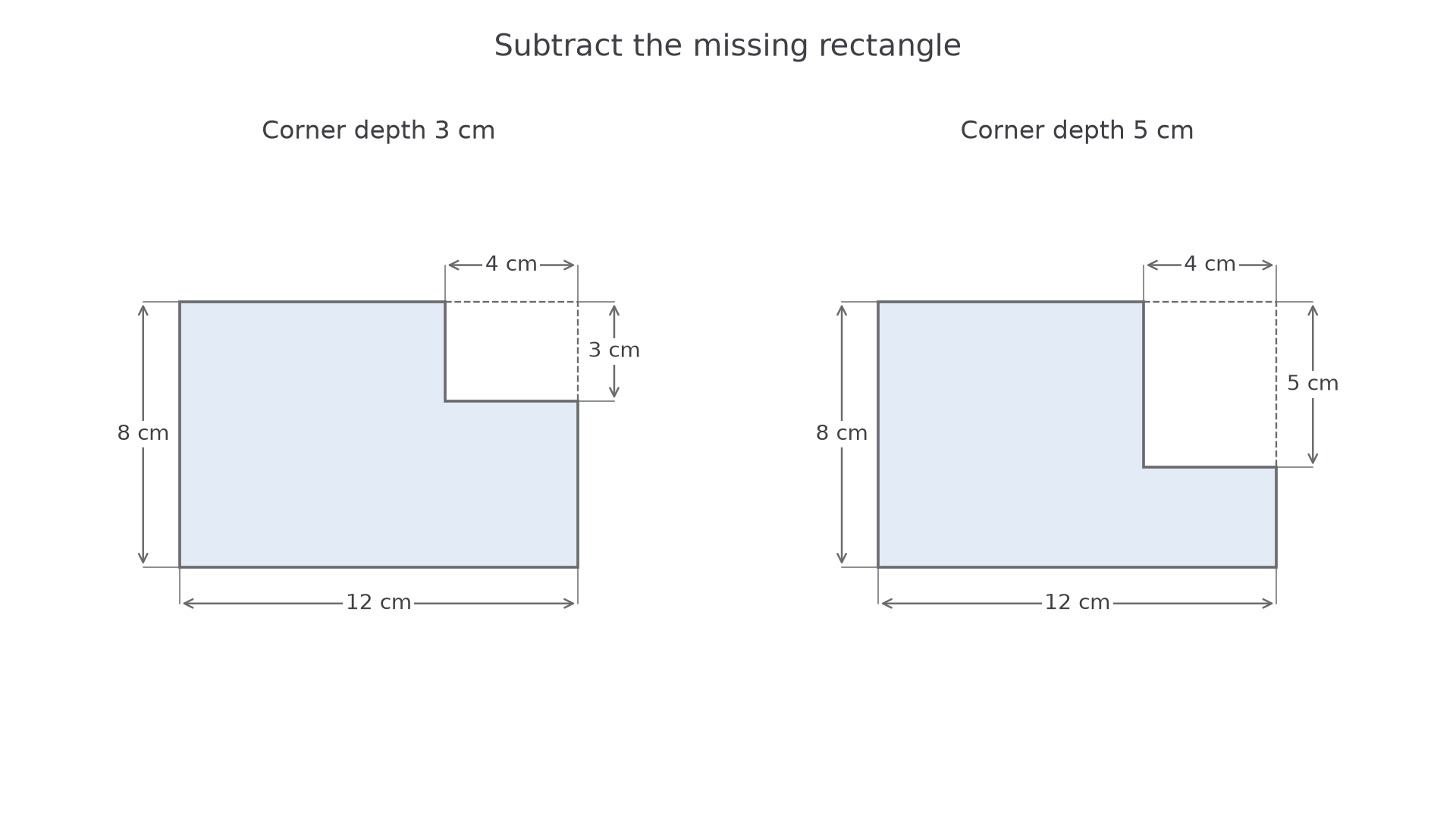
Worked example 1: subtracting a corner
Question. A by rectangular sheet has a by rectangle removed from its top-right corner. Find the remaining area.
Plan. Subtract the missing corner from the whole rectangle.
Answer. .
Check. Split the L vertically. The left rectangle has width and height ; the lower-right rectangle has width and height . Their areas add to .
Change only the removed corner's depth from to . The larger cut should leave a smaller area.
Worked example 2: a deeper cut
Question. A by rectangular sheet has a by rectangle removed from its top-right corner. Find the remaining area.
Plan. Keep the same surrounding rectangle and subtract the new missing area.
Answer. .
Check. Adding the remaining rectangles gives . The extra removed strip has area , matching the drop from to .
The additive checks work because their two rectangles meet along a line without overlapping surface.
Watch out
Adding the areas of two overlapping rectangles counts their overlap twice. Split into pieces that meet only along their edges, or subtract the overlap once.
Describe the surrounding rectangle and the missing part explicitly in your working.
Tracking the outside perimeter
For perimeter, trace the outside boundary continuously until you return to your starting point. A line used to split an area into pieces lies inside the shape, so it is not included.
If you add two rectangle perimeters when the rectangles share an edge, that common edge has been counted twice, once for each rectangle. Subtract twice its length to leave the outer perimeter. Tracing the outside directly usually avoids this correction.
A rectangular corner cut gives a useful surprise. It removes one horizontal and one vertical boundary length, then exposes equal horizontal and vertical lengths inside the old rectangle. The total perimeter is unchanged. A notch in the middle of an edge behaves differently: travelling in and out adds two extra depths.
[DIAGRAM: asset_name: Corner cut compared with an edge notch; asset_slug: compound_outside_boundary; caption: Moving the same cut-out changes the outside journey without changing the removed area.; description: A 12 by 8 centimetre rectangle with a 4 by 3 top-right corner removed is compared with the same rectangle with a 4 centimetre deep and 3 centimetre high notch in the middle of its right edge. For the notch, the right-edge segments above and below are 2 and 3 centimetres. All outside edges are solid, construction lines are dashed, and missing side lengths are labelled with subtraction expressions.]
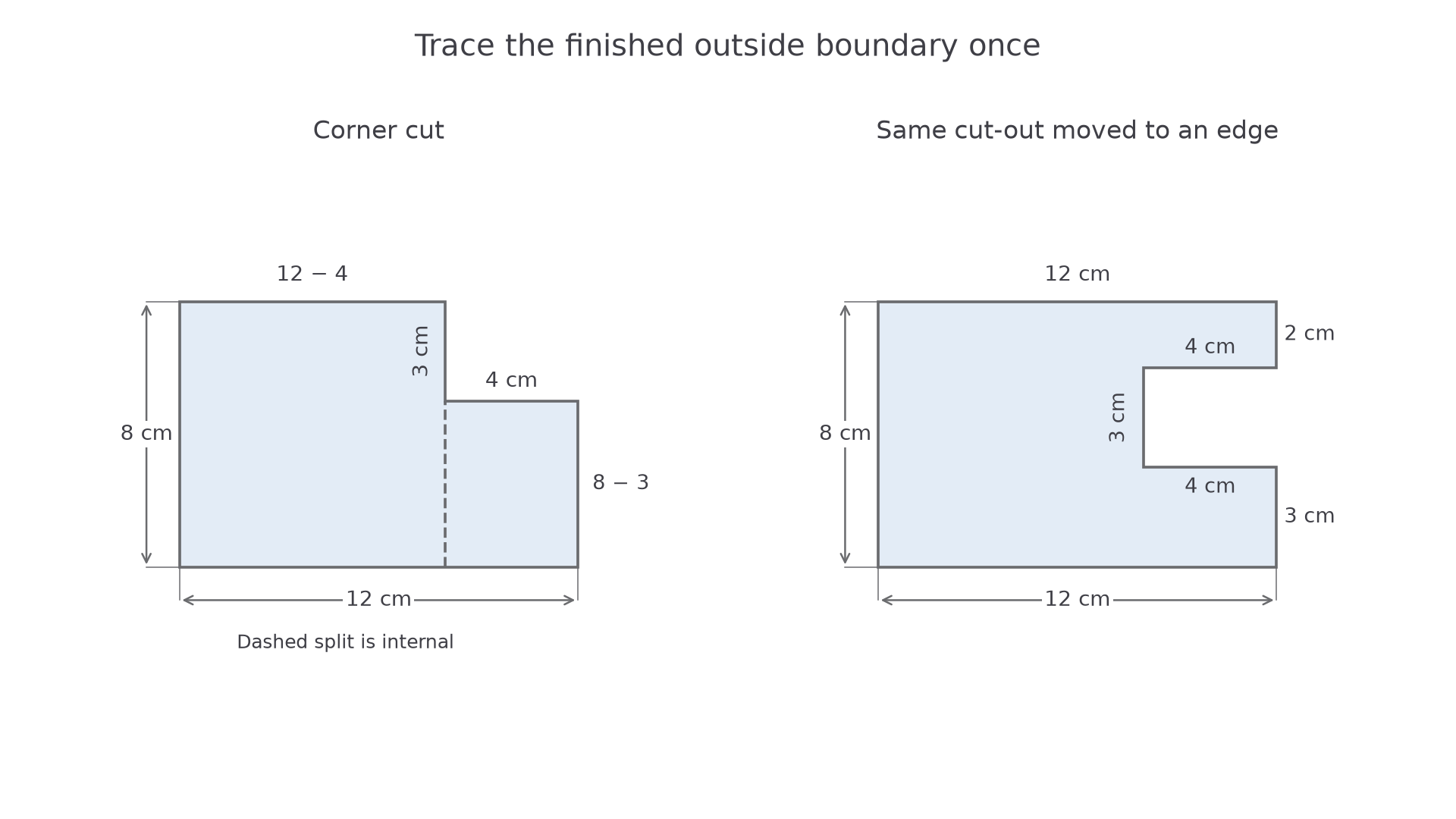
Worked example 3: perimeter after a corner cut
Question. A by rectangle has a wide, high rectangle removed from its top-right corner. Find the remaining perimeter.
Plan. Find the shortened sides, then trace all six outside edges.
Answer. .
Check. The original rectangle's perimeter was . The cut replaces of old boundary with the same lengths in new positions.
Move only the same cut-out from the corner to the middle of the right edge. The area removed stays the same; the boundary route changes.
Continue this lesson.
You’re previewing NovaLearn without an account. Create a free account to read the rest.
Create free account