E6.2 - Elevation, depression and shortest distance
A sight line can tell you the height of an inaccessible object, provided you measure its angle from the right reference. You will interpret elevation and depression, connect right-angled triangles, and find the shortest distance from a point to a straight line. This lesson is for Extended.
Angles from the horizontal
Two people look along the same sight line in opposite directions. Why can one person's angle of elevation equal the other person's angle of depression? The reference lines through their eyes are different lines, but both are horizontal.
Imagine looking straight ahead, then lifting your gaze towards the top of a tower. The turn upwards starts at the horizontal through your eye, not at the vertical tower or the ground below your feet.
Elevation and depression
An angle of elevation is the angle measured upwards from the horizontal to a sight line. An angle of depression is the angle measured downwards from the horizontal to a sight line.
The horizontal is drawn through the observer. An angle measured from a vertical is not the angle of elevation or depression.
Horizontal lines are parallel. A sight line crossing two of them forms equal alternate angles, so reversing the view changes elevation to depression without changing the angle's size.
[DIAGRAM: asset_name: Elevation and depression share a sight line; asset_slug: elevation_depression; caption: Parallel horizontals give equal elevation and depression angles.; description: An exact rising sight line joins a lower observer A to a higher point B. Dashed horizontal lines through A and B are parallel. The 37 degree angle above the lower horizontal and the 37 degree angle below the upper horizontal are marked, with a separate vertical reference at A.]
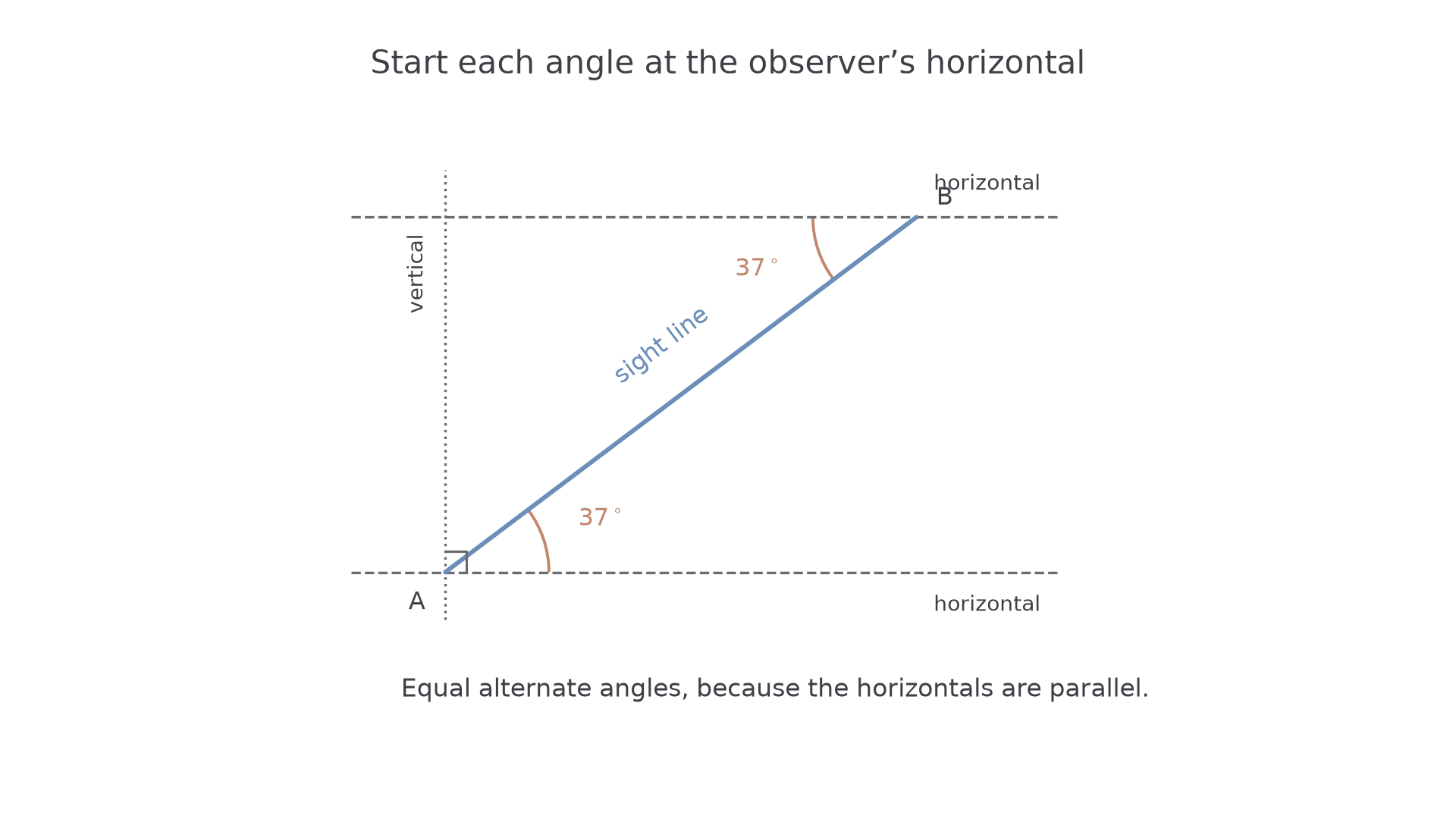
Worked example 1: reversing an upward view
Question. From a point , the angle of elevation of is . Find the angle of depression of from , and the angle between and the upward vertical at .
Plan. Use parallel horizontals for the reversed view, then a right angle for the vertical reference.
Answer. The depression is ; the angle with the upward vertical is .
Check. The two angles at add to . A line closer to horizontal than vertical should make the smaller angle with horizontal.
Now the first observer looks downwards. Only the direction of the view changes; the horizontal reference remains essential.
Worked example 2: reversing a downward view
Question. From , the angle of depression of is . Find the angle of elevation of from , and the angle between and the downward vertical at .
Plan. Transfer the angle to the parallel horizontal through , then find its complement at .
Answer. and , respectively.
Check. . Reversing the sight line again restores the original depression of .
Watch out
“An angle of from the vertical is a depression of ” uses the wrong starting line. The depression would be .
Elevation and depression problems
A height problem begins with a right-angled triangle between the sight line, the horizontal through the eye and a vertical height difference. That height difference may be less than the object's total height.
You already know
In a right-angled triangle, . Here the opposite side is the vertical difference between eye and target; the adjacent side is the horizontal separation.
Sketch the observer's eye first. Draw a horizontal to the object's vertical, then label only the sides belonging to that triangle. For a downward view, the vertical difference is still a positive length. Add or subtract it from the observer's level as the context requires.
For instance, a lookout's eye is above level ground. A point on that ground has an angle of depression of . If its horizontal distance is , the downward triangle gives , so to significant figures. The positive vertical difference is , even though the sight line goes downwards. As a check, a run of about and a drop of give an angle close to from the horizontal.
Worked example 3: adding the eye height
Question. An observer stands on level ground from a vertical tower. Their eye is above the ground. The angle of elevation of the top is . Calculate the tower's height.
Plan. Find the height above eye level using tangent, then add the eye height. Use degree mode.
Answer. The tower is high, to significant figures.
Check. The height above the eye is about . Its ratio to is about , giving an angle close to , and adding restores the total height.
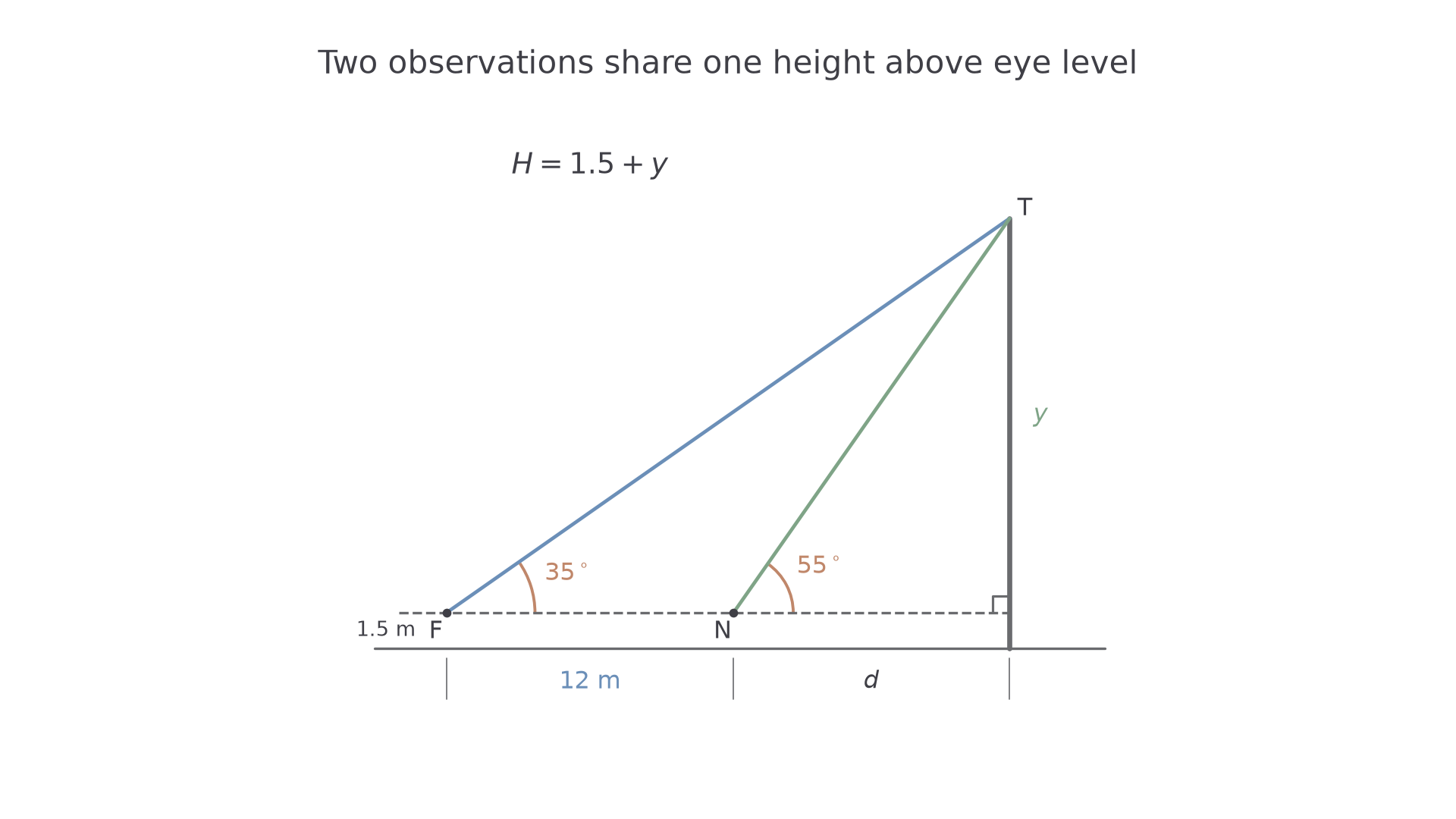
What if the distance to the tower cannot be measured? Add one observation from a known distance farther away. Both triangles share the same vertical height difference, so two tangent equations can determine it.
[DIAGRAM: asset_name: Two observations of one tower; asset_slug: linked_observations; caption: Moving 12 metres away changes the angle but leaves the height above eye level unchanged.; description: To-scale side view of a vertical tower with top T. Two eyes F and N at the same height 1.5 metres are on one horizontal line, F 12 metres farther from the tower than N. Elevation angles are 35 degrees at F and 55 degrees at N. The nearer horizontal distance is d and the tower height above the eye line is y.]
Continue this lesson.
You’re previewing NovaLearn without an account. Create a free account to read the rest.
Create free account