C4.7; E4.7 - Right angles in circles
A circle can guarantee a right angle without a protractor. You will use a diameter to identify an angle in a semicircle, use the right angle between a tangent and its radius, and combine these facts with triangle angles while giving precise reasons.
A right angle in a semicircle
Fix and at the ends of a diameter, then move around one semicircular arc. The triangle changes shape. Does its angle at change too? Surprisingly, that angle stays at , provided is a different point on the circumference.
Angle in a semicircle
If is a diameter and is another point on the circle, then
The right angle is at the circumference, opposite the diameter. The reason is “angle in a semicircle”.
Not given in the List of formulas: learn this circle theorem.
Why? Join the centre to . The two smaller triangles have equal radii as sides, so each has two equal base angles. Call these base angles and . The large triangle's three angles are , and . Their total gives , so . The moving point changes and , but not their sum.
[DIAGRAM: asset_name: A diameter fixes the opposite right angle; asset_slug: semicircle_right_angles; caption: C moves, but angle ACB stays a right angle because AB is a diameter.; description: Three exact circles have horizontal diameter AB through centre O and a point C on the upper circumference. The interior angle CAB is respectively 32, 57 and 41 degrees. Angle ACB is marked as a right angle and ABC is labelled x, y or z. In the first circle dashed radius OC illustrates the two isosceles triangles.]
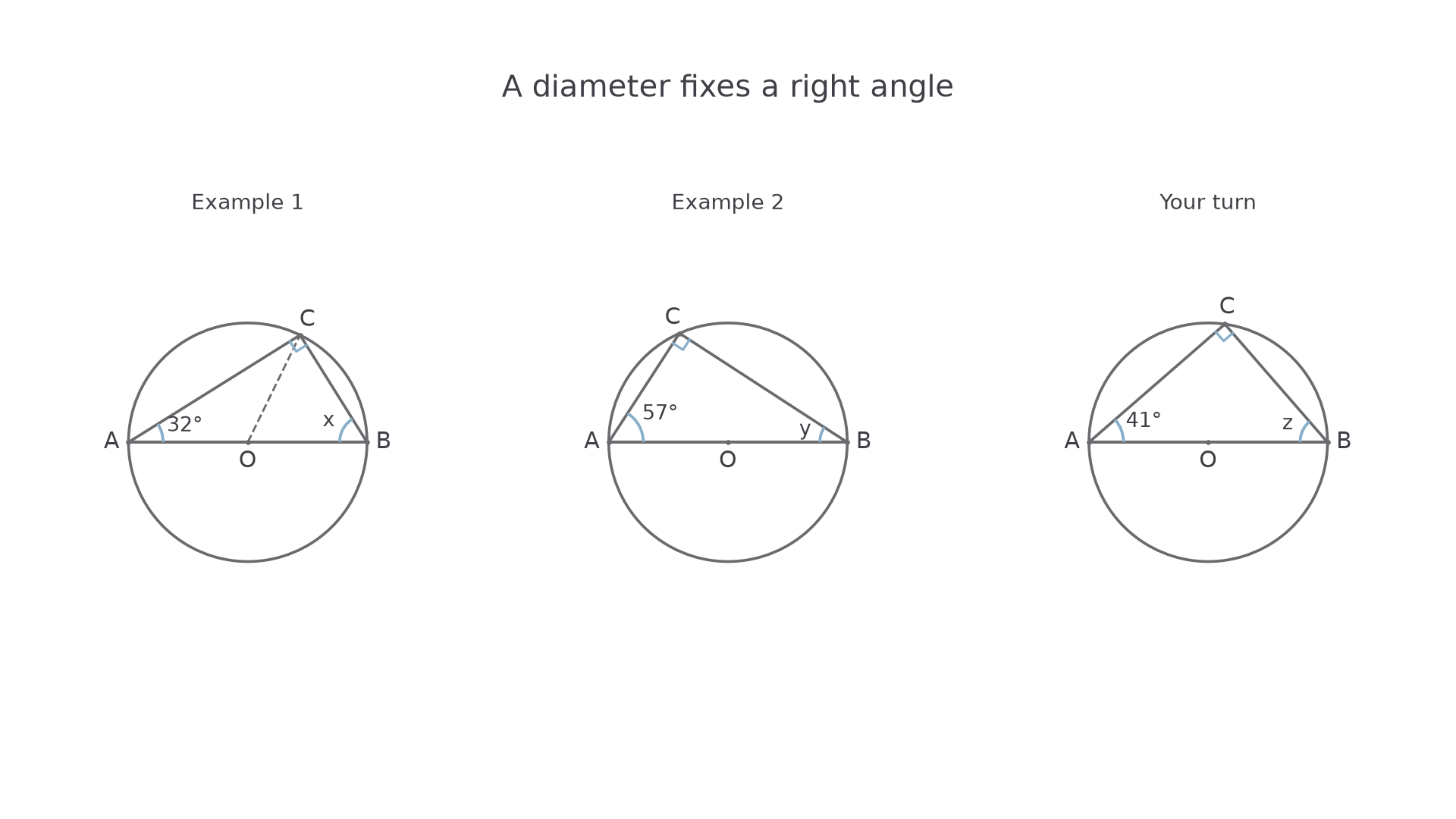
Worked example 1: an angle beside a diameter
Question. is a diameter, lies on the circle, and . Calculate , giving geometric reasons.
Plan. Establish the right angle at , then complete the triangle.
Answer. .
Check. The two acute angles in this right-angled triangle add to .
Move so that the given angle changes. The diameter and the right angle remain.
Worked example 2: a different point on the arc
Question. is still a diameter and still lies on the circle, but . Find , with reasons.
Plan. Keep the semicircle right angle and subtract the new known angle.
Answer. .
Check. . Increasing the angle at by has decreased the angle at by .
The word diameter makes the angle exact. A drawing that merely looks right-angled is weaker evidence.
Watch out
“A triangle inside a circle is right-angled” is false. You need one side to be a diameter, not just a chord. The right angle is opposite that diameter, not at its midpoint.
Use the diameter condition in your written reason.
A tangent meets its radius at a right angle
A tangent touches the circle at one point. Join that point of contact to the centre. That particular radius is perpendicular to the tangent: the angle is , whichever way the diagram is turned.
Tangent and radius
If a line is tangent to a circle with centre at , then
The radius must meet the tangent at its point of contact. A radius to another point on the circle does not give this conclusion.
Not given in the List of formulas: learn this circle theorem.
A line touching a circle is different from a line cutting through it. The right-angle fact supplies exact information from the word tangent; it does not come from estimating a nearly square-looking corner.
[DIAGRAM: asset_name: Radius and tangent form a right angle; asset_slug: tangent_radius_triangles; caption: The right angle is at T, where radius OT meets the tangent TP.; description: Three circles with centre O have tangent TP at T and an external point P on that tangent. OP forms a triangle with radius OT and tangent segment TP. Angle TOP is respectively 35, 62 and 47 degrees. The angle at T is marked right and OPT is labelled x, y or z. The circle, tangent and triangle coordinates agree exactly with each given angle.]
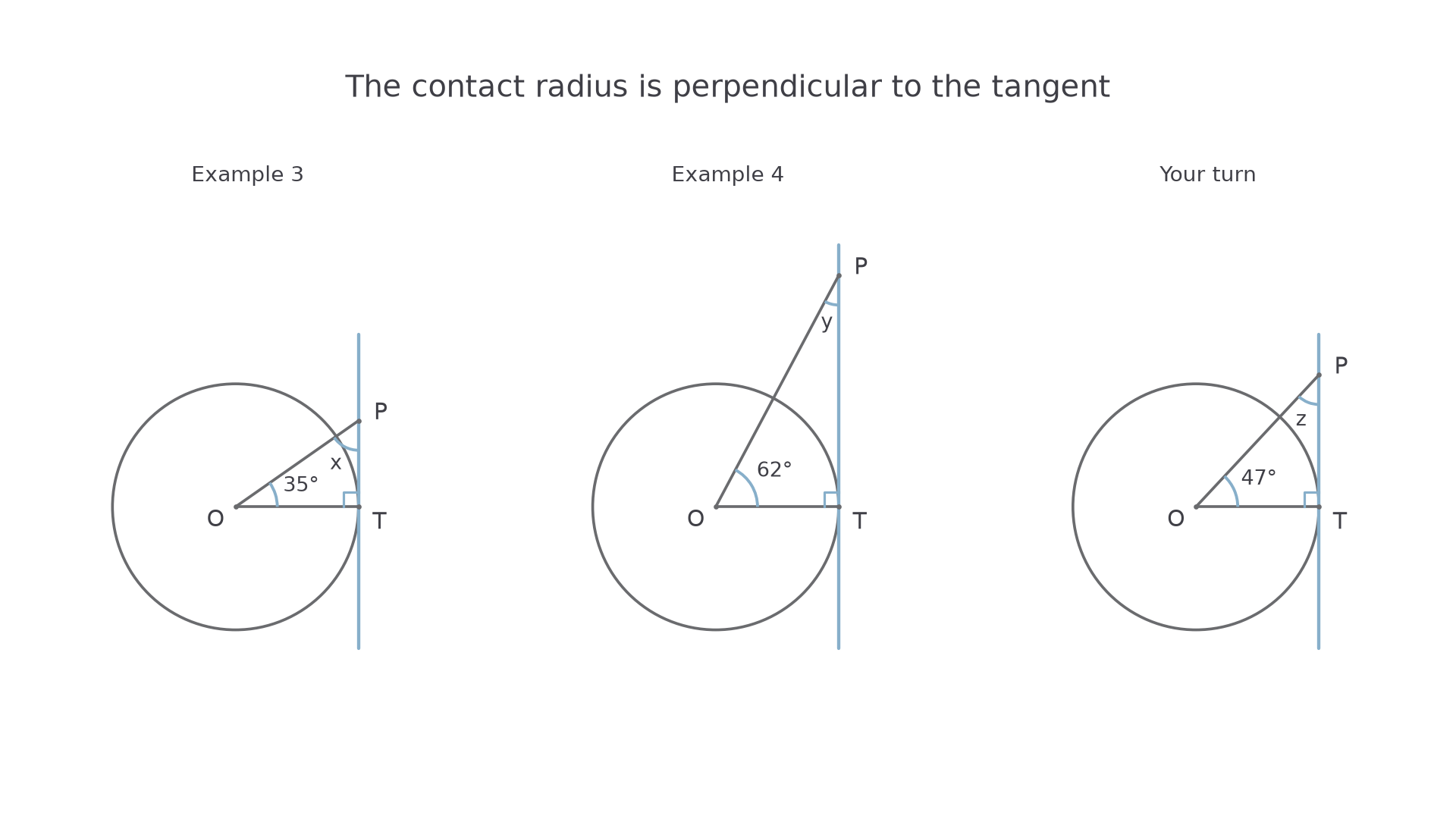
Worked example 3: a triangle outside the circle
Question. is tangent at to a circle with centre , and . Find , giving reasons.
Plan. Use the tangent–radius right angle at , then use triangle .
Answer. .
Check. , so the two non-right angles complement one another.
Continue this lesson.
You’re previewing NovaLearn without an account. Create a free account to read the rest.
Create free account