E5.5 - Frustums and similar solids
A frustum is the part left when a parallel cut removes the top of a cone or pyramid. In this Extended E5.5 lesson, you will reconstruct the missing full solid by similarity, subtract volumes, and identify the curved or flat surfaces exposed by the cut.
Recovering full-solid dimensions
If a cone's removed top has one third of the full cone's radius, has one third of the volume been removed? The length ratio is only the beginning. First recover the original cone above the frustum.
You already know
A cut parallel to the base leaves a frustum after the smaller top cone or pyramid is removed. Similar solids have one common length factor; areas use its square and volumes its cube. Heights measured from an apex are corresponding lengths.
Draw the removed top back in, even if the question shows only the retained part. In an axial section of a right circular cone, the parallel cut produces a smaller triangle similar to the whole axial triangle: the apex angle is common and the cut is parallel to the base. Radii and perpendicular heights therefore share the same ratio. A right pyramid works similarly in a section through corresponding base points and its apex.
[DIAGRAM: asset_name: Restoring the missing cone; asset_slug: frustum_full_dimensions; caption: Corresponding heights run from the same apex; the frustum height is their difference.; description: Two exact axial sections of right circular cones have base radius six centimetres and retained frustum height eight centimetres. The first cut radius is two centimetres and labels full height H and removed-top height h. The second cut radius is three centimetres. The removed tops are dashed, cuts are parallel to the bases, and the retained frustums are pale blue.]
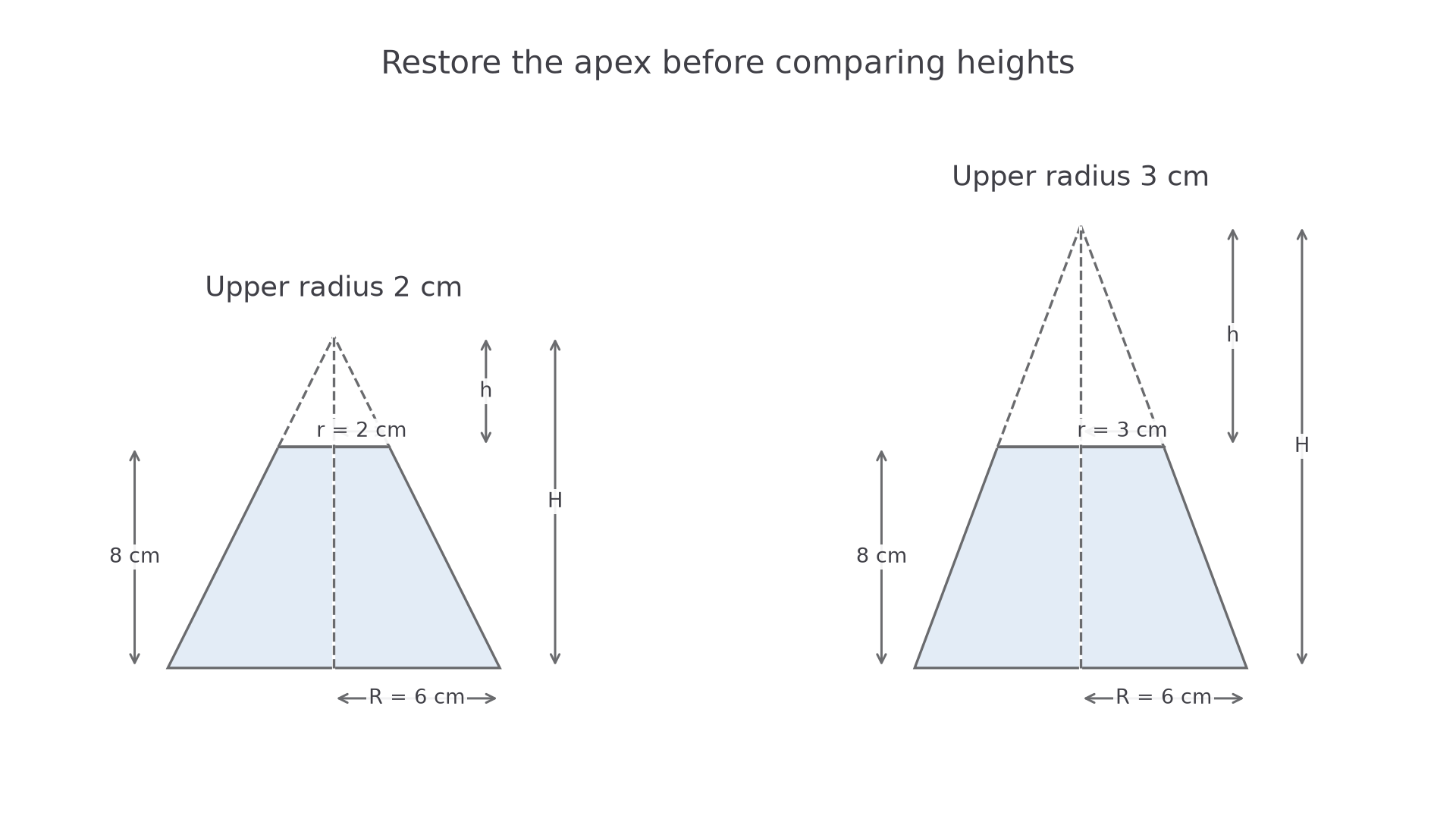
Corresponding lengths in a frustum
For a right conical frustum with lower radius , upper radius , full-cone height , removed-cone height , and frustum height ,
where and . Corresponding full and small slant heights have the same ratio too. A pyramidal frustum uses corresponding base side lengths instead of radii.
Not given as frustum formulas in the List of formulas: derive the relationships using similarity.
The heights and start at the apex. The frustum height starts at the cut, so is generally not .
Worked example 1: the top is one third as wide
Question. A right conical frustum has lower radius , upper radius , and perpendicular height . Find the full cone's height and the removed cone's height.
Plan. Express the smaller height as one third of the full height, then use their difference.
Answer. Full height ; removed height .
Check. , and . Both the physical height difference and similarity ratio hold.
Change only the upper radius to . The removed top is now half the full cone's linear size.
Worked example 2: the top is half as wide
Question. A right conical frustum has lower radius , upper radius , and perpendicular height . Find the full and removed cone heights.
Plan. Use the new radius ratio and the same height difference.
Answer. Full height ; removed height .
Check. The two heights differ by , and the removed cone's height and radius are both half the full values. The heights happen to be equal above and below the cut only in this half-scale case.
Watch out
“Small height divided by frustum height equals the radii ratio” matches the wrong segments. Compare small apex-to-cut height with full apex-to-base height. Then use the retained height as a difference.
Reconstruct the missing apex before calculating the new heights.
Subtracting similar volumes
A frustum's volume is the full cone or pyramid volume minus the removed top's volume. The full height includes both pieces; using the frustum height in the full-cone formula would describe a different cone.
For a small-to-full length factor , the removed volume is of the full volume. The retained fraction is therefore . If , only of the full volume is removed; the retained fraction is . A small-looking top really does contain little of the whole cone.
Worked example 3: subtracting two cones
Question. A right cone has radius and perpendicular height . A parallel cut removes a top cone with radius and perpendicular height . Find the frustum volume in terms of .
Plan. Calculate both cone volumes using their own radii and perpendicular heights, then subtract.
Answer. .
Check. The length factor is , so , agreeing by the volume-ratio route.
Change only the base shape from a circle of diameter to a square of side . Keep the full height , small height , and small-to-full length factor .
Continue this lesson.
You’re previewing NovaLearn without an account. Create a free account to read the rest.
Create free account