C1.1; E1.1 - Factors, multiples and primes
Some numbers can be arranged into several different rectangles; others allow only one row. You will use exact division to find factor pairs, distinguish prime and composite numbers, and decide whether a number is a multiple of another.
Factor pairs
You have square tiles. How many different rectangles can you make using every tile, if turning a rectangle does not count as a new arrangement? The possible side lengths reveal a useful structure inside the number .
For example, rows of tiles use exactly tiles because . A row length of leaves tiles over, so is not a factor of .
Factor and factor pair
A factor of a positive integer is a positive integer that divides it exactly, with no remainder. A factor pair is a pair of positive integers whose product is that number. For example, and form a factor pair of .
[DIAGRAM: asset_name: Rectangles from factor pairs; asset_slug: factor_pair_rectangles; caption: Twenty-four tiles make four rectangles, counting rotations as the same arrangement.; description: Four exact tile arrays labelled one by twenty-four, two by twelve, three by eight and four by six. Each array contains twenty-four equal squares. The caption identifies the corresponding factor pairs.]
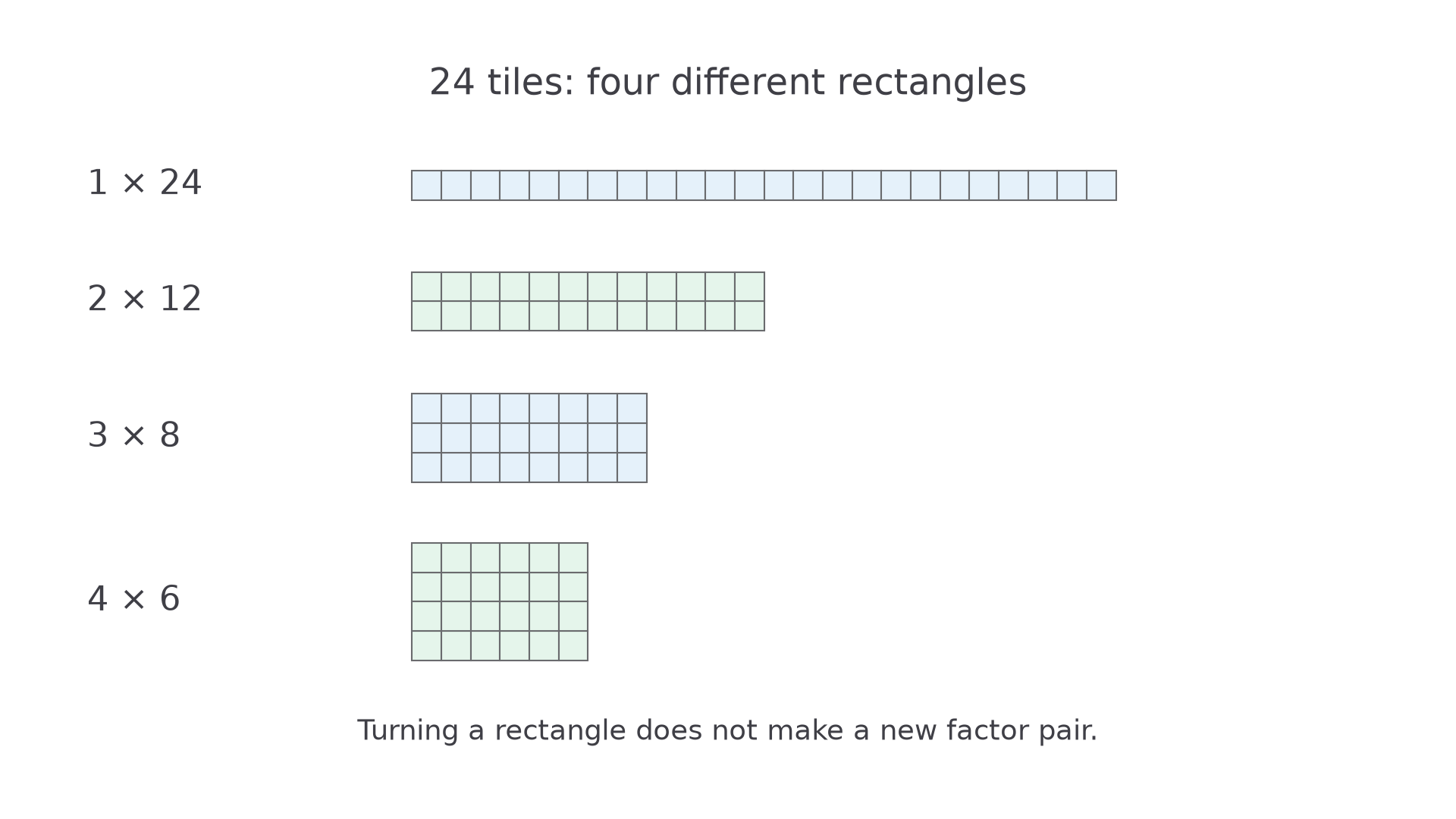
Test possible divisors in order, starting at . Every successful division gives two factors at once. Once the smaller member of the next pair would be greater than the larger member, you have already found the pairs in the opposite order. You can stop without testing every number up to .
Worked example 1: finding every factor
Question. Write down all the factors of .
Plan. Find factor pairs in order, then list each distinct factor once.
Answer. .
Check. Pair the ends of the list: , , , . Every product is , and all smaller possible divisors before the pairs reverse were tested.
Change the number to . This time a pair has equal members, which changes how many distinct factors it contributes.
Worked example 2: an equal factor pair
Question. Write down all the factors of .
Plan. Test the smaller member of each possible pair, stopping when the two members meet.
Answer. .
Check. Each listed number divides exactly. Any larger first member would have a partner smaller than , and those possibilities have already been checked.
A number such as is a square number: a whole number multiplied by itself. The middle factor appears only once in the factor list, even though it appears twice in its pair.
Watch out
The calculation does not give all the factors. It gives one factor pair. To list all factors, include every exact pair, including and the number itself.
Prime and composite numbers
A row of tiles can only form the rectangle . In contrast, tiles can form or . The distinction depends on the number of factors, not on how large or awkward the number looks.
Prime and composite numbers
A prime number is a positive integer with exactly two distinct positive factors: and itself. A composite number is a positive integer greater than that is not prime; it has more than two positive factors. For example, is prime, while is composite.
The number has only one positive factor, , so it is neither prime nor composite. Zero and negative integers are also outside these definitions.
The number has precisely the factors and , so it is prime. Every other positive even integer is greater than and has as an extra factor. Therefore is the only even prime. Being odd does not guarantee that a number is prime: and are odd composite numbers.
To decide whether is prime, test possible small factors. Neither nor divides it exactly. A pair with both members at least would have product at least , too large. Any remaining factor pair would therefore have a smaller partner that has already been tested. The only pair is , so is prime.
Here are the primes below , found using the same definition:
Key idea
To prove that a number greater than is composite, one factor other than and itself is enough. To establish that it is prime, rule out every possible extra factor pair.
Multiples and divisibility
Factors look inside a number; multiples are made by taking whole groups of a number. The same multiplication links both ideas: because , and are factors of , and is a multiple of each.
Multiple and divisible
A multiple of an integer is the result of multiplying it by an integer. The positive multiples of begin . An integer is divisible by a nonzero integer when the division gives an integer with no remainder.
Zero is a multiple of every integer, because multiplying by gives . When asked for the “lowest common multiple” later, you will look for a positive multiple. For a positive number, there are finitely many positive factors, but its positive multiples continue without end.
Useful divisibility checks follow from place value. A whole number is divisible by if its units digit is or ; by if its units digit is or ; and by if its units digit is . Each ten is already divisible by and by , so the units decide the remainder.
A whole number is divisible by if its digit sum is divisible by , and similarly for . Why? Each ten is , each hundred is , and each higher place value is a multiple of plus . Replacing place values by therefore leaves the same remainder on division by , and also by . For example, ; the digit sum is , so is divisible by .
Worked example 3: testing a multiple by exact division
Question. Is a multiple of ? Show how you decide.
Plan. Divide into groups of and look for a remainder.
Answer. Yes. is a multiple of .
Check. , so the division is exact.
Increase the number by , keeping the proposed factor unchanged. The remainder now decides the answer.
Worked example 4: one extra object changes divisibility
Question. Is a multiple of ? Show how you decide.
Plan. Use the nearest known multiple and identify what is left over.
Answer. No. is not a multiple of .
Check. The next multiple is . The number lies strictly between consecutive multiples and .
Return to the tiles: the four factor pairs of give four rectangles. Its eight distinct factors do not give eight different rectangles, because turning into keeps the same arrangement.
Watch out
is a factor of ; is a multiple of . Reversing the words reverses the relationship. “ is a factor of ” is false.
Quick Recap
- Factors divide a positive integer exactly; factor pairs multiply to it.
- A prime has exactly two distinct positive factors. The number is neither prime nor composite, and is the only even prime.
- A multiple is made by whole-number groups; a remainder means the division is not exact.
- “Factor of” and “multiple of” describe opposite directions of the same multiplication relationship.
The tiles make four different rectangles: , , and , counting turns as the same arrangement.