E2.13 - Inverse and composite functions
Two function machines can be connected, or one machine can be reversed. You will find inverse rules, choose restrictions that make reversing possible, and form and simplify composite functions in the correct order. This lesson is for Extended.
Reversing a function
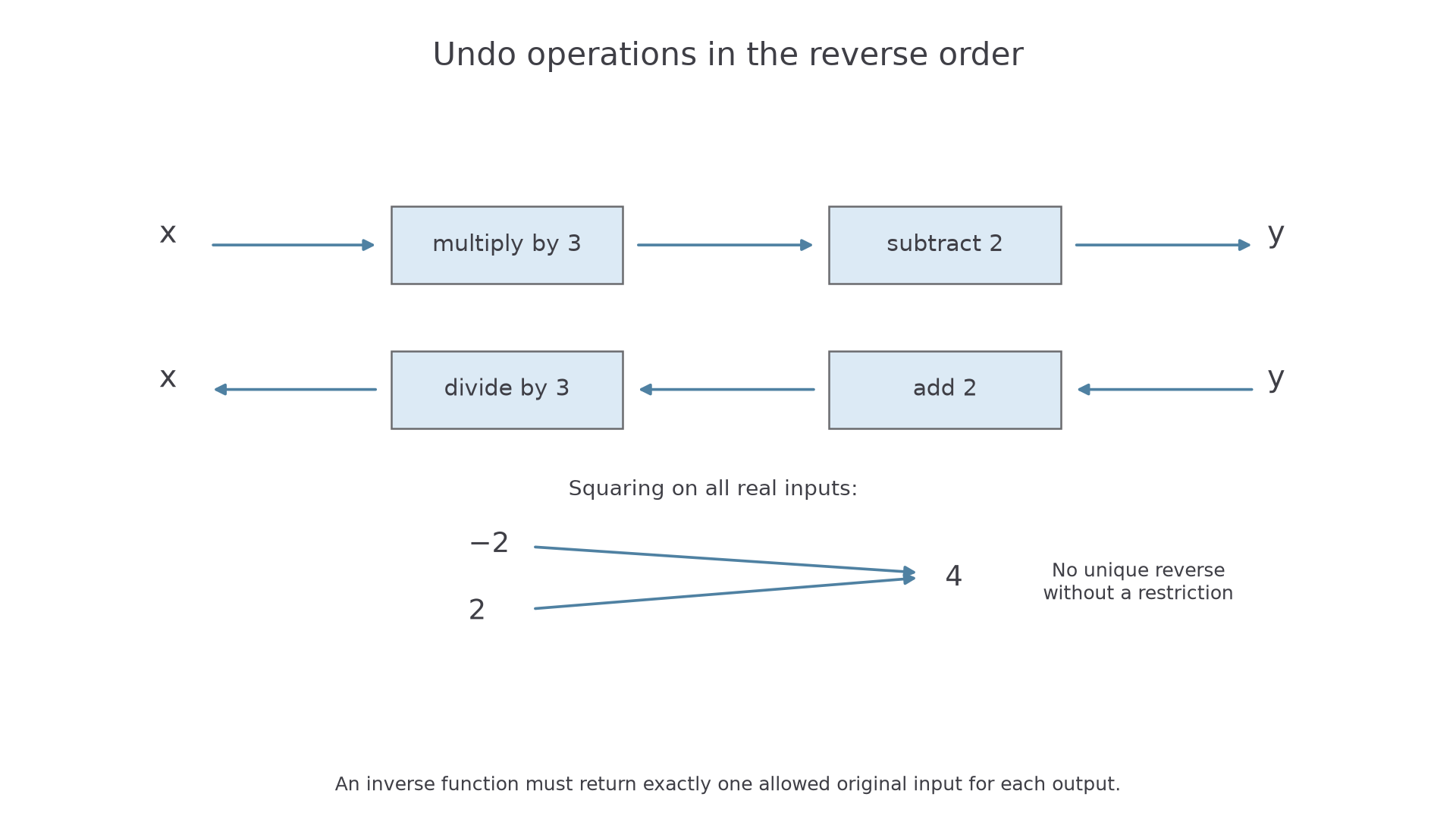
Can every function machine run backwards? The rule “multiply by 3, then subtract 2” is reversible: add 2, then divide by 3. A squaring machine on all real inputs is different. Output 4 could have come from 2 or , so reversing would not give a unique output.
Inverse function
An inverse function, written , undoes : if , then . An inverse function requires to be one-to-one on its domain: different allowed inputs must give different outputs. The inverse's inputs are the original range, and its outputs are the original domain. The notation does not mean .
To find an inverse algebraically, write , make the old input the subject in terms of , then use as the inverse's input letter. Renaming that final letter changes no calculation. For a non-one-to-one rule, an explicitly restricted domain can choose one branch.
[DIAGRAM: asset_name: Forward and inverse function machines; asset_slug: inverse_machines; caption: Reversing a chain reverses both the operations and their order.; description: A top chain takes input x through multiply by three and subtract two to output y. A bottom chain starts from y, adds two and divides by three to recover x, with arrows in the opposite overall direction. A small squaring mapping shows negative two and two both reaching four, with a note that an unrestricted reverse would have two possible outputs.]
Worked example 1: reversing a linear rule
Question. Find for , with all real inputs.
Plan. Undo subtraction first, then undo multiplication.
Answer. , with all real inputs.
Check. and . More generally, , confirming that the two operations undo each other.
Change only the input term from to , with the domain restricted to . The extra squaring operation needs a carefully chosen reverse.
Worked example 2: reversing a restricted square
Question. Find the inverse of for , and state the inverse's domain.
Plan. Undo subtraction and multiplication, then select the non-negative root required by the original domain.
Answer. , with domain , the original function's range.
Check. and . At the endpoint, and . A negative root would return an input forbidden by the stated original domain.
If the original restriction were , the inverse would instead be . With no restriction on the original square, there would be no inverse function. On a graph, reflecting a one-to-one function in swaps each pair's coordinates and gives its inverse graph.
Watch out
Reversing “multiply, then subtract” means “add, then divide”. Applying inverse operations in the original order does not undo the chain. Check by sending an allowed input forward and back.
Reverse this new linear machine.
Forming a composite in the right order
A composite function feeds one function's output into another. If and , starting with 3 and applying then gives . Applying then gives . The same machines in a different order can produce a different result.
Composite notation
The function next to the input acts first: means apply , then . It is not the product . Replace the entire input of the outer function with the inner function's output, using brackets.
For a numerical input, work through the machines numerically. For an expression, substitute the whole expression into the outer rule. Both methods must give the same output when you test an allowed number.
Worked example 3: add, then square
Question. For and , find and simplify , then find .
Plan. Use as the complete input of the squaring rule.
Answer. , and .
Check. The separate machine chain gives , then . It agrees with the expanded rule.
Continue this lesson.
You’re previewing NovaLearn without an account. Create a free account to read the rest.
Create free account