E6.4 - Trigonometric graphs and equations
A turning radius connects triangle ratios to repeating graphs. You will recognise sine, cosine and tangent through a full turn and use their signs and symmetries to find every solution of a simple trigonometric equation. This lesson is for Extended; all angles are in degrees.
Sine and cosine through a full turn
Why can one sine equation have two different angle answers? Imagine a point moving anticlockwise around a circle of radius 1, starting at . Its angle is measured from the positive horizontal axis. In the first quarter-turn, its horizontal and vertical coordinates are the familiar adjacent and opposite reaches of a unit hypotenuse.
We extend the ratios through the whole turn by defining the moving point to have coordinates . Coordinates can be negative: left means negative cosine, below means negative sine. At the point is ; at it is . No negative triangle lengths are needed.
[DIAGRAM: asset_name: Extending sine and cosine around a unit circle; asset_slug: full_turn_circle; caption: Sine is the signed vertical coordinate; cosine is the signed horizontal coordinate.; description: An equal-scale unit circle on numbered horizontal and vertical axes marks the four cardinal points at zero, ninety, one hundred eighty and two hundred seventy degrees. Points at thirty and one hundred fifty degrees share vertical coordinate one half, while their horizontal coordinates have opposite signs. Projection lines show that shared height. An anticlockwise arrow indicates increasing angle.]
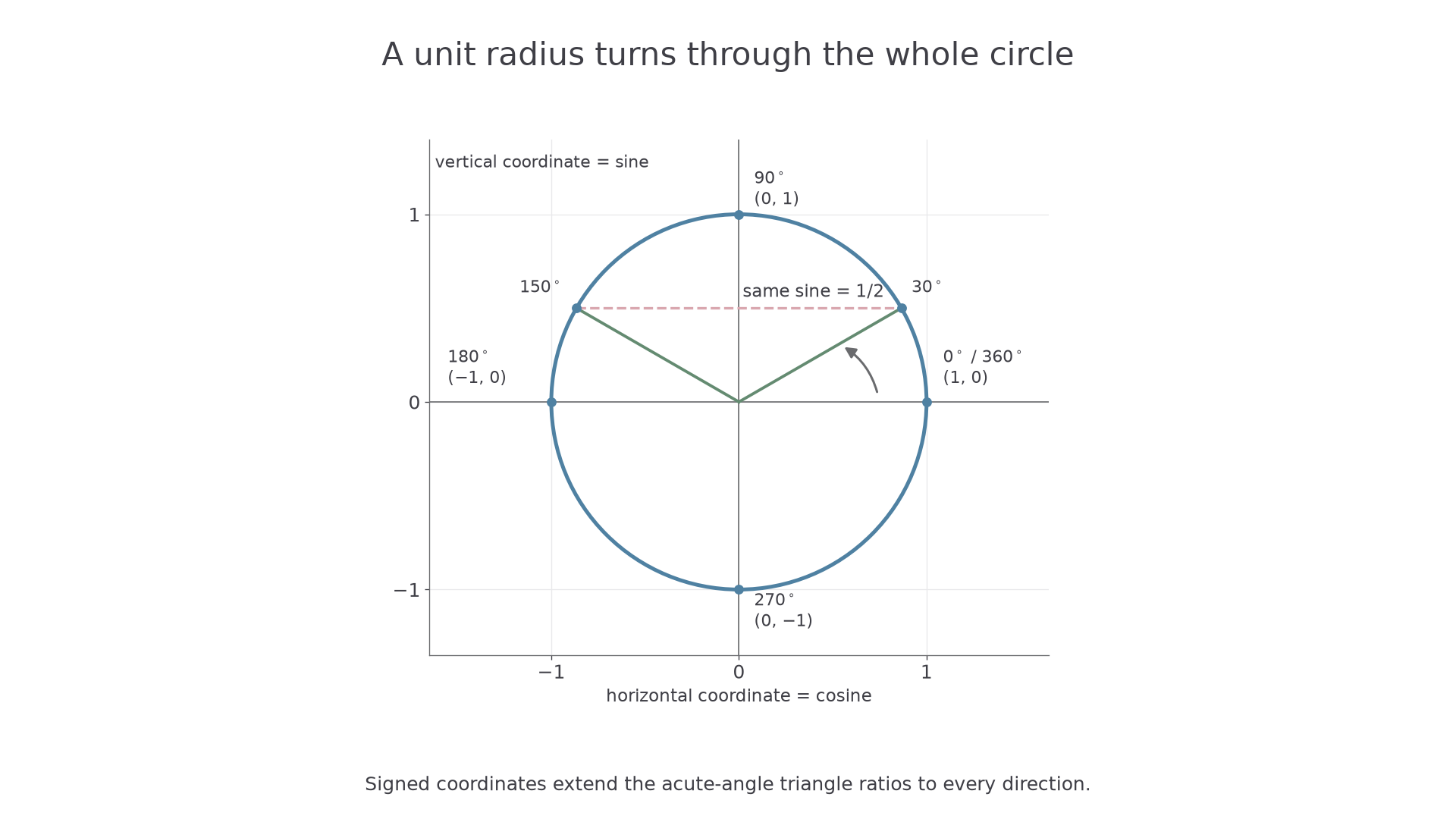
Key sine and cosine values
Both outputs lie between and 1 inclusive, and repeat after . These graphs and values are not given in the List of formulas.
On a graph, the horizontal coordinate is now the angle, rather than the moving point's horizontal reach. The vertical coordinate is the chosen ratio. Keep those two pictures distinct.
[DIAGRAM: asset_name: Sine and cosine over one full turn; asset_slug: sine_cosine_graphs; caption: Both waves repeat after 360 degrees, but they start at different heights.; description: Two numbered grids plot y equals sine x and y equals cosine x from zero to three hundred sixty degrees, with ticks every ninety degrees and vertical ticks at negative one, zero and one. Each smooth curve marks its five cardinal values. Sine starts at zero and initially rises; cosine starts at one and initially falls.]
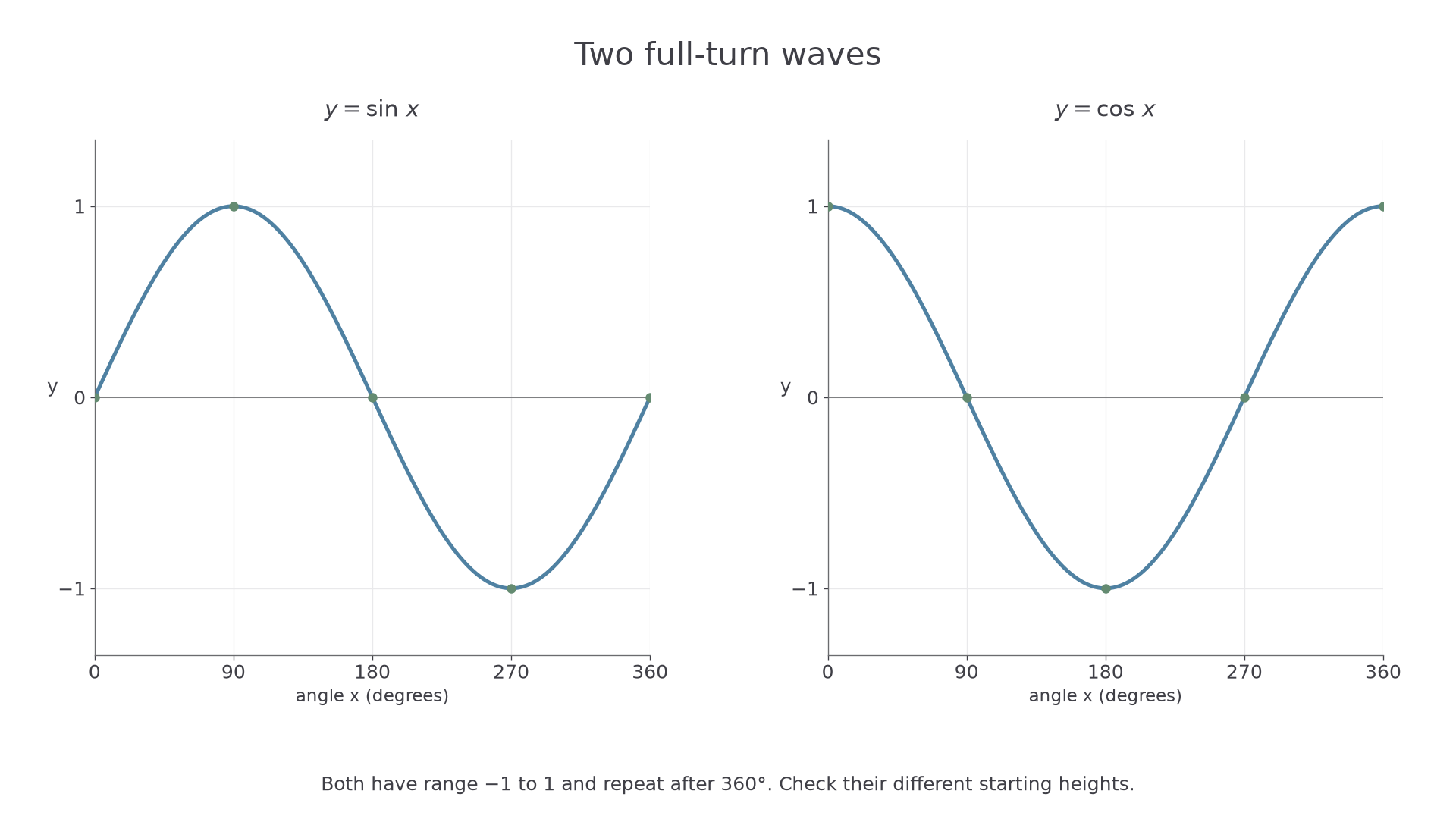
Worked example 1: sketching sine
Question. Sketch for , labelling its zeros and extreme values.
Plan. Plot the five quarter-turn values and join them with a smooth wave.
Answer. The left graph shows the required wave: positive for and negative for .
Check. The known value sits on the first rising section. The reflected circle point at has the same height, so the falling positive section must pass through .
Change only the plotted ratio to cosine. Its initial height changes because horizontal reach starts at 1.
Worked example 2: sketching cosine
Question. Sketch on the same angle interval, labelling its zeros and extreme values.
Plan. Track the signed horizontal reach at each quarter-turn.
Answer. The right graph begins at 1, falls to and returns to 1. It is negative between and .
Check. . The circle point reflected across the horizontal diameter has angle and the same horizontal coordinate, so the final rising section also has height there.
The circle gives the other-angle rules. For an acute reference angle , sine is positive at and , and negative at and . Cosine is positive at and , and negative at and . These are reflected coordinate values, not extra calculator buttons.
Watch out
The statement “sine increases with the angle” only held across the first quarter-turn. Through a full turn, its graph rises and falls. Use the whole graph when solving equations.
Read a different pair of full-turn values here.
Tangent and its asymptotes
Tangent is wherever cosine is non-zero. Its sign is positive when sine and cosine have the same sign, and negative when their signs differ. Its magnitude is not restricted to 1: dividing by a small non-zero horizontal reach can give a very large value.
Tangent's vertical asymptotes
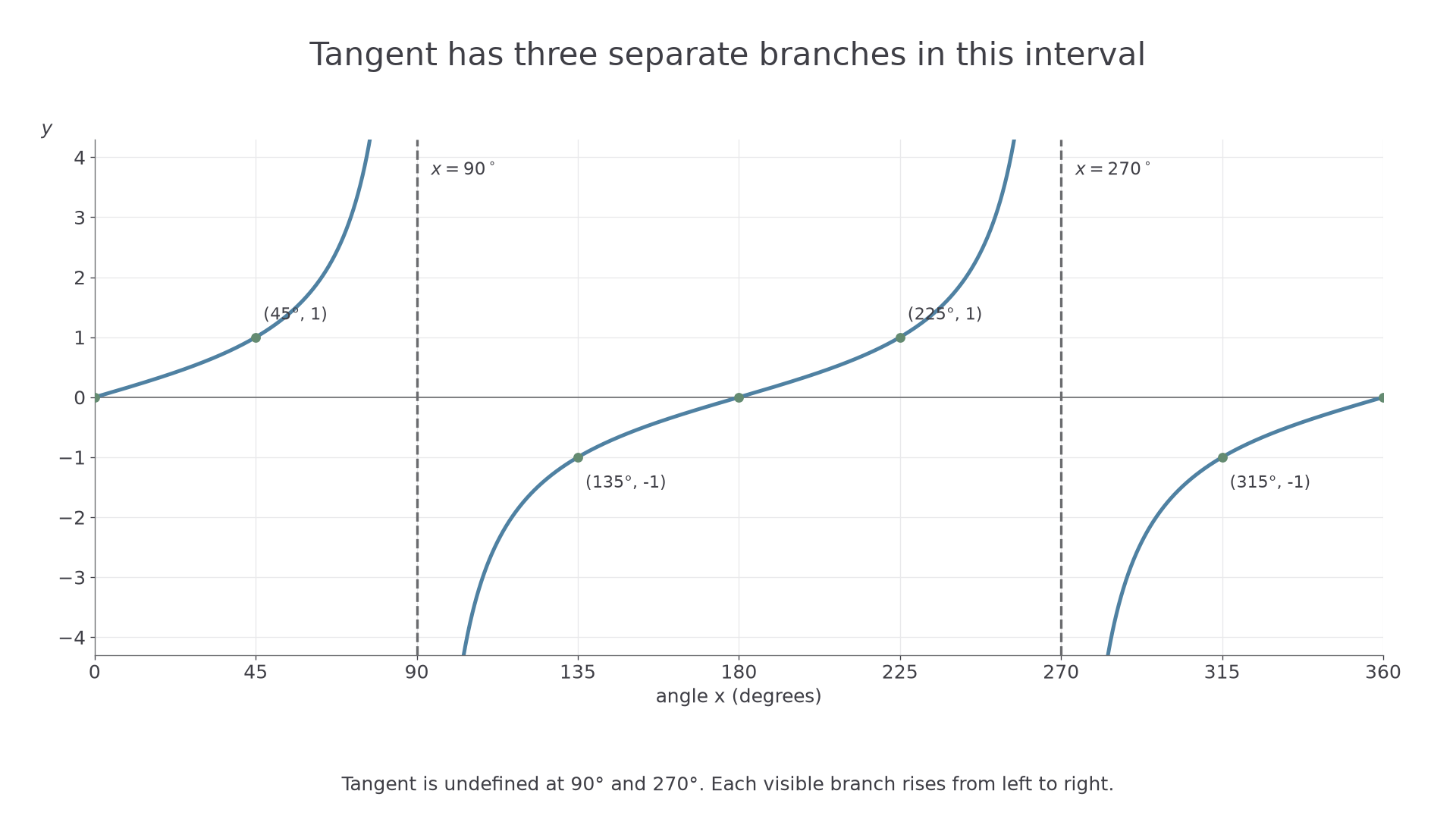
is undefined at and , where . Its graph has vertical asymptotes at these angles. The branches approach the lines with unbounded outputs; do not join across them or put a point “at infinity”. Tangent repeats after .
The repeat follows from the circle: a half-turn negates both coordinates, so their quotient stays the same. Over to , tangent is zero at , and each branch rises from left to right. Just left of it grows positively without bound; just right it is negative without bound. The same pattern occurs at .
[DIAGRAM: asset_name: Tangent's separate increasing branches; asset_slug: tangent_graph; caption: Broken vertical lines mark undefined inputs, not parts of the curve.; description: A numbered grid plots tangent x from zero to three hundred sixty degrees with vertical range negative four to four. Separate increasing branches stop at the window edges near broken asymptotes at ninety and two hundred seventy degrees. Zeros at zero, one hundred eighty and three hundred sixty degrees and values one at forty-five and two hundred twenty-five degrees and negative one at one hundred thirty-five and three hundred fifteen degrees are marked.]
Continue this lesson.
You’re previewing NovaLearn without an account. Create a free account to read the rest.
Create free account