E4.4 - Explaining triangle similarity
Two triangles can have the same shape even when they overlap or face different ways. You will match their vertices, show similarity using geometric reasons, and use the resulting correspondence to calculate lengths.
Matching vertices and angles
A small triangle sits inside a larger one. Both point upwards, so should you match their left-hand corners? Sometimes, but page position is no proof. What would still work if one triangle were turned over? Equal angles identify the matching corners.
You already know
Similar shapes have equal corresponding angles and proportional corresponding lengths. In , is the vertex. Keep that middle letter in view when matching angles.
Writing records a correspondence: , , . The order matters. It then tells you that , , and .
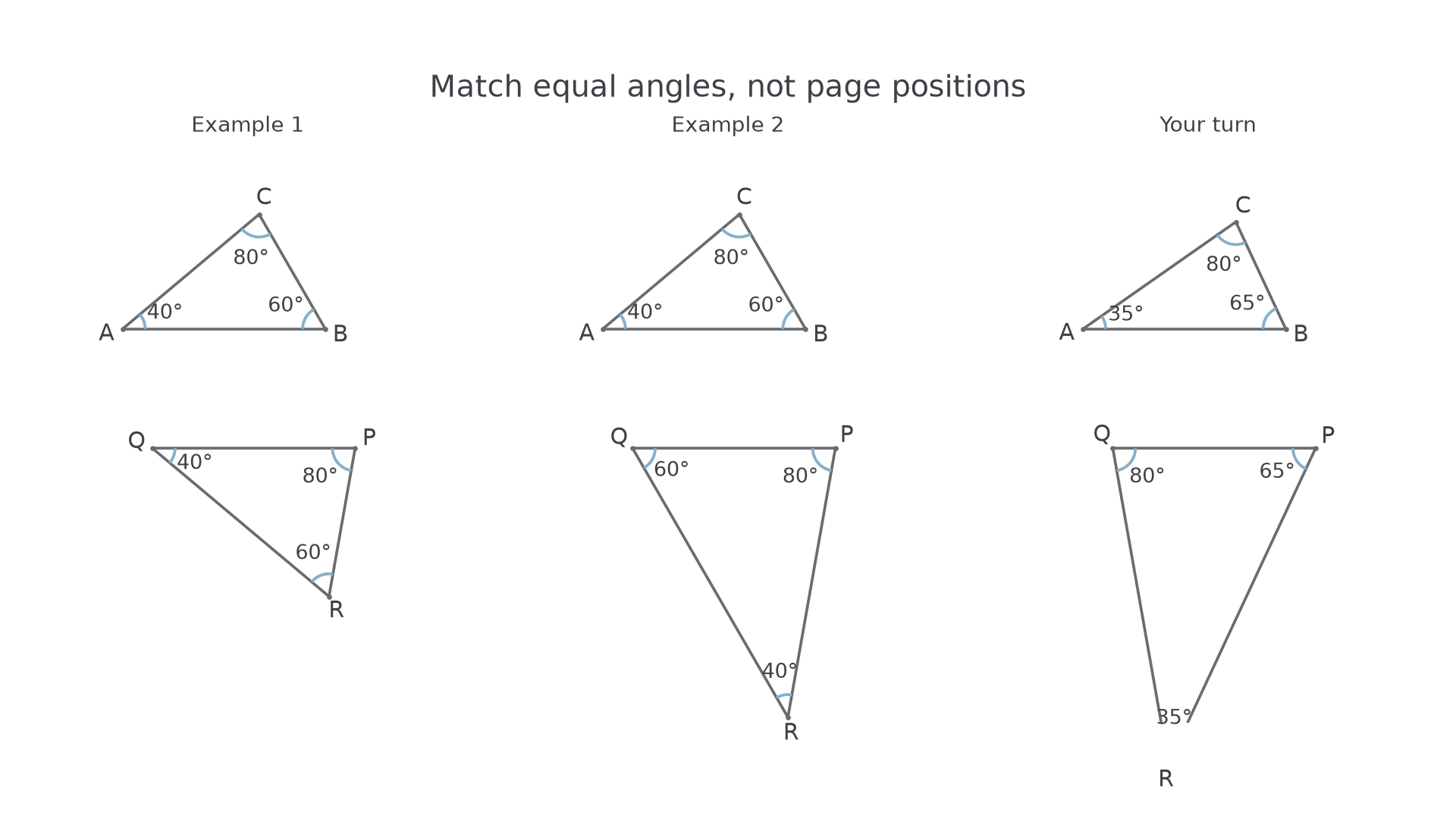
[DIAGRAM: asset_name: Match corners by angles; asset_slug: triangle_correspondence; caption: Equal angles identify corresponding vertices even when the triangle is turned.; description: Three pairs of exact triangles show ABC with angles 40, 60, 80 degrees and PQR with angles 80, 40, 60 in the first pair; ABC again with 40, 60, 80 and PQR with 80, 60, 40 in the second; ABC with 35, 65, 80 and PQR with 65, 80, 35 in the third. Every vertex and angle is labelled and the second triangle is oriented differently.]
Worked example 1: recording a correspondence
Question. Triangles and are similar. Their angles are , , , and , , . Complete , and name the side corresponding to .
Plan. Match equal angles, then read the matching endpoints of the required side.
Answer. , and corresponds to .
Check. The remaining side joins the and corners; so does . All three pairings are consistent.
Change only which of and carries each angle. The written order must respond to the labels.
Worked example 2: the labels change
Question. Keep , , . Now , , . Complete , and name the side corresponding to .
Plan. Rebuild the angle correspondence rather than copying the previous order.
Answer. , and corresponds to .
Check. Reading the correspondence backwards gives , , , exactly the stated angles.
Use the same correspondence in every ratio; a new side does not create a new vertex match.
Watch out
“Both sides are on the left” does not establish correspondence. Match endpoints using equal angles or the stated similarity order. Equal angles alone do not make the triangles congruent: size can still differ.
Use the fresh angle labels in the third pair.
Geometric reasons for triangle similarity
You do not need to measure every angle to show that two triangles are similar. If two corresponding angle pairs are equal, the third pair must be equal too: each triangle's total is . This is the angle–angle, or AA, similarity test.
AA similarity
Two triangles are similar if two angles in one equal two corresponding angles in the other. State the equal angle pairs, give their geometric reasons, then conclude similarity in a matching vertex order.
Why does this settle the shape? Once two angles are fixed, the directions of the triangle's sides relative to one another are fixed. Changing its size moves the third side parallel to itself; it cannot create a different set of proportions. One equal angle alone leaves many possible shapes.
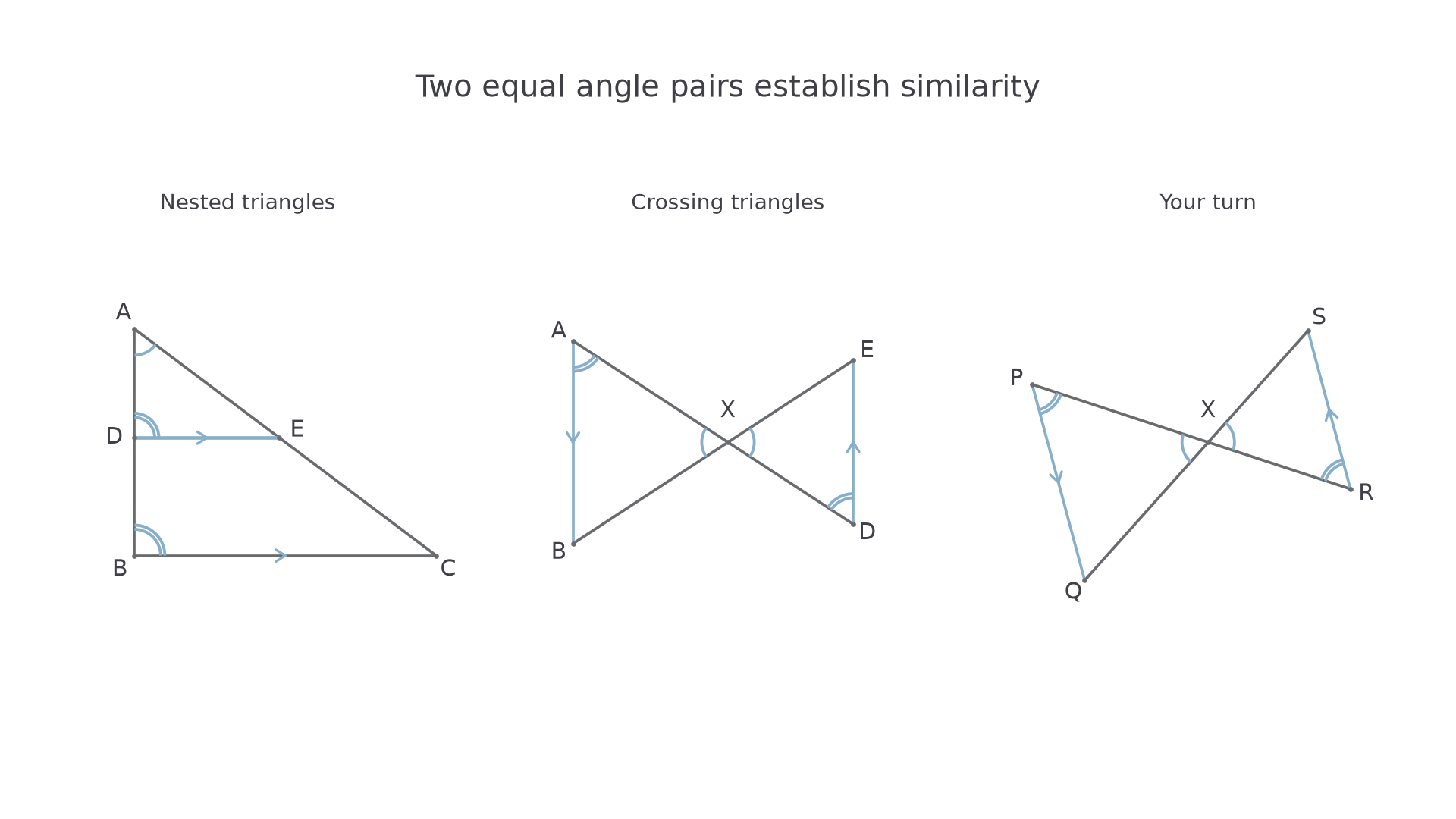
[DIAGRAM: asset_name: Parallel lines give a similarity argument; asset_slug: similarity_geometric_reasons; caption: A nested pair uses corresponding angles; a crossing pair uses alternate and vertically opposite angles.; description: The first panel shows D on AB and E on AC inside triangle ABC, with DE parallel to BC, marked by matching arrows. The second shows straight lines AXD and BXE crossing at X, with AB parallel to DE, forming opposite triangles AXB and DXE. The third fresh crossing diagram has P X R and Q X S collinear, with PQ parallel to RS. Single and double equal-angle arcs distinguish the two angle groups, and all named vertices are placed in the intended sectors.]
Worked example 3: a triangle inside a triangle
Question. lies on , lies on , and . Show that .
Plan. Use the shared angle at and one corresponding angle from the parallel lines.
Answer. The triangles are similar by AA, with , , .
Check. The unused pair also matches: , corresponding angles in the same parallel lines. The vertex order agrees with all three pairs.
Continue this lesson.
You’re previewing NovaLearn without an account. Create a free account to read the rest.
Create free account