C4.5; E4.5 - Line and rotational symmetry
A shape can look unchanged after a fold or a turn, but these are different kinds of symmetry. You will recognise both, find rotational order, and use symmetry to explain equal lengths and angles in familiar shapes.
Lines of symmetry
Why does a rectangle match itself after a half-turn even though folding it along a diagonal usually fails? A fold and a turn move points differently. Start by imagining a mirror placed along a line on the shape.
Line of symmetry
A line of symmetry divides a plane shape into two parts that match exactly when one part is reflected across the line. You could fold along the line and make the two halves coincide.
Matching points lie the same perpendicular distance from the line, on opposite sides. Points on the line stay in place.
The fold must match the whole boundary, not just one pair of corners. A diagonal of a non-square rectangle matches two corners but sends a long side towards a short side, so it fails.
[DIAGRAM: asset_name: Mirror lines in familiar shapes; asset_slug: mirror_lines_families; caption: A mirror line must match every side and vertex.; description: Nine exact panels show an equilateral triangle with three mirror lines, a non-equilateral isosceles triangle with one, a scalene triangle with none, a square with four, a non-square rectangle with two, a non-square rhombus with two diagonal mirror lines, a general parallelogram with none, a non-rhombus kite with one and an isosceles trapezium with one. Dashed blue lines are true mirror lines.]
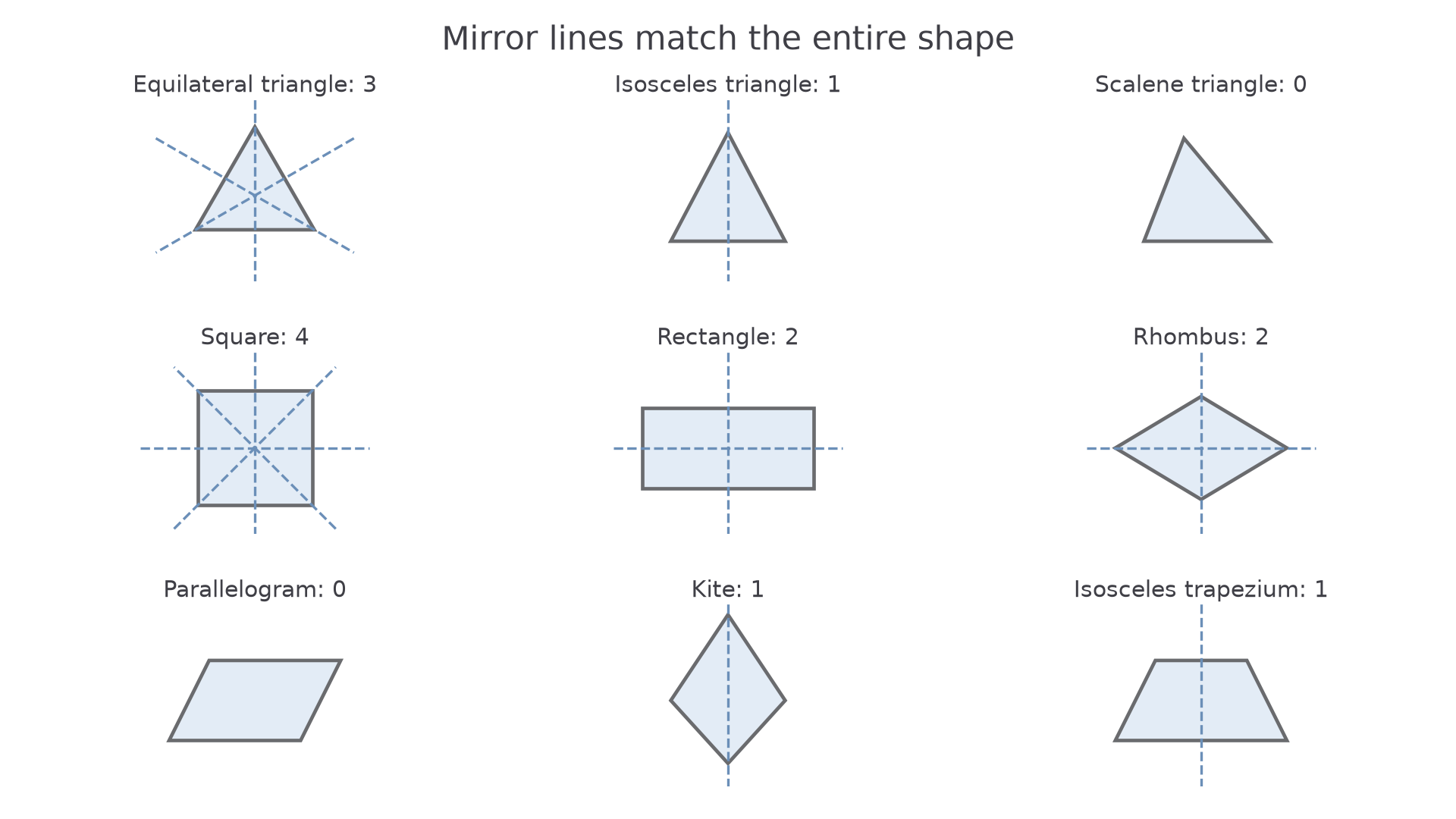
These counts describe the specified shapes; special cases can gain symmetry. For example, a general trapezium need have no line of symmetry, while an isosceles trapezium, whose non-parallel sides are equal, has one through the midpoints of its parallel sides. A regular polygon with sides has mirror lines. In an odd-sided regular polygon each joins a vertex to the midpoint of the opposite side; in an even-sided one some join opposite vertices and others join opposite side midpoints.
Watch out
“Every diagonal is a line of symmetry” is false. Both diagonals work in a rhombus, but neither works in a non-square rectangle. Test the reflection of the entire shape.
Choose the statement that distinguishes a general family from its special cases.
Rotational symmetry and order
Keep a shape flat on the page and turn it about a fixed centre. Count the positions in one full turn where its outline exactly matches its starting outline. Include the match at the completed full turn, but do not count the starting position again.
Order of rotational symmetry
The order of rotational symmetry is the number of matching positions in a full turn. Order means that only the full turn works. For a shape of finite order , the smallest positive matching turn is .
A non-square rectangle matches after and , so its order is . A square also matches after and , so its order is . A non-square rhombus and a general parallelogram have order ; a non-rhombus kite and a trapezium with exactly one parallel pair have order . An equilateral triangle has order , while other isosceles and scalene triangles have order .
[DIAGRAM: asset_name: Equal turns of regular polygons; asset_slug: regular_polygon_turns; caption: Each smallest matching turn moves a vertex to the next vertex.; description: A regular pentagon and regular decagon have their centres marked. Curved arrows mark a 72 degree turn and a 36 degree turn respectively, taking one highlighted vertex to its neighbour.]
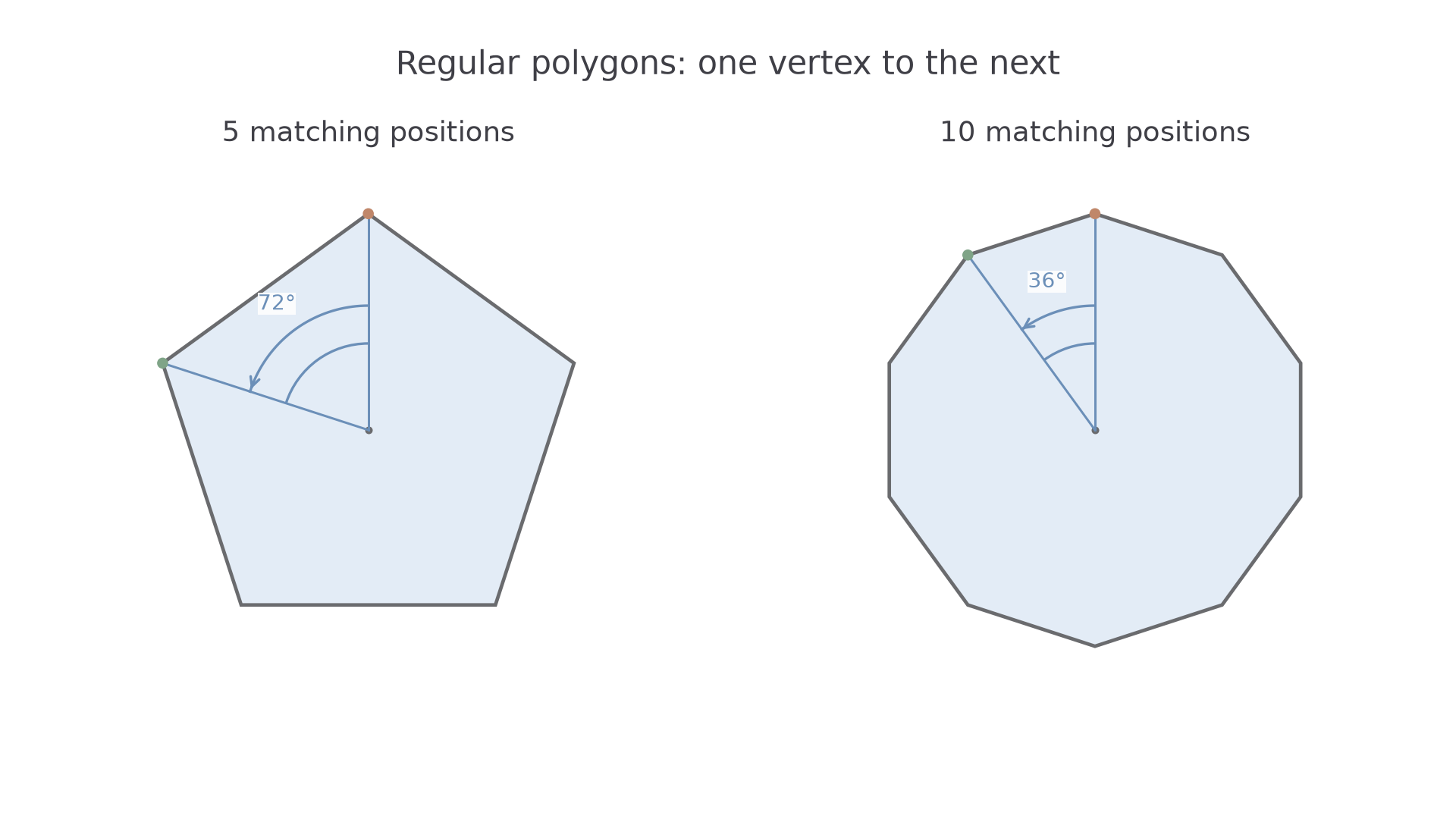
Worked example 1: a regular pentagon
Question. Find the rotational order and smallest matching turn of a regular pentagon.
Plan. Move one vertex to the next; regularity makes all five positions equivalent.
Answer. Order ; smallest turn .
Check. The matches occur at : five positions, with no starting position counted twice.
Change only the number of equal sides. The same vertex-to-vertex reasoning applies.
Continue this lesson.
You’re previewing NovaLearn without an account. Create a free account to read the rest.
Create free account