C1.1; E1.1 - Prime factorisation
Different factor pairs can lead to the same set of prime building blocks. You will break a positive integer into prime factors using a tree or repeated division, then write repeated factors compactly using powers.
Prime factors from a factor tree
If one person starts as and another starts it as , will they finish with different prime factors? The starting choices differ, but both routes must preserve the product at every step.
You already know
A prime number has exactly two distinct positive factors. A factor pair multiplies to the original number. For example, , but neither nor is prime.
A factor tree splits a number into a factor pair. Each composite factor splits again; a prime is a stopping point. Use pairs greater than , so that each split makes the numbers smaller. The final numbers at the branch ends multiply to the starting number because every split replaces a number by an equal product.
Product of prime factors
A product of prime factors writes an integer greater than as prime numbers multiplied together. Every factor in the final product must be prime. For example, ; is an equal product, but is not yet a product of prime factors.
[DIAGRAM: asset_name: Two factor trees for seventy-two; asset_slug: two_factor_trees; caption: Different first splits give the same prime factors, including repeated copies.; description: Two exact factor trees for seventy-two. The left splits into eight and nine, then eight into two and four, four into two and two, and nine into three and three. The right splits into six and twelve, six into two and three, twelve into three and four, and four into two and two. Prime branch ends are highlighted in pale green. Each tree yields three twos and two threes.]
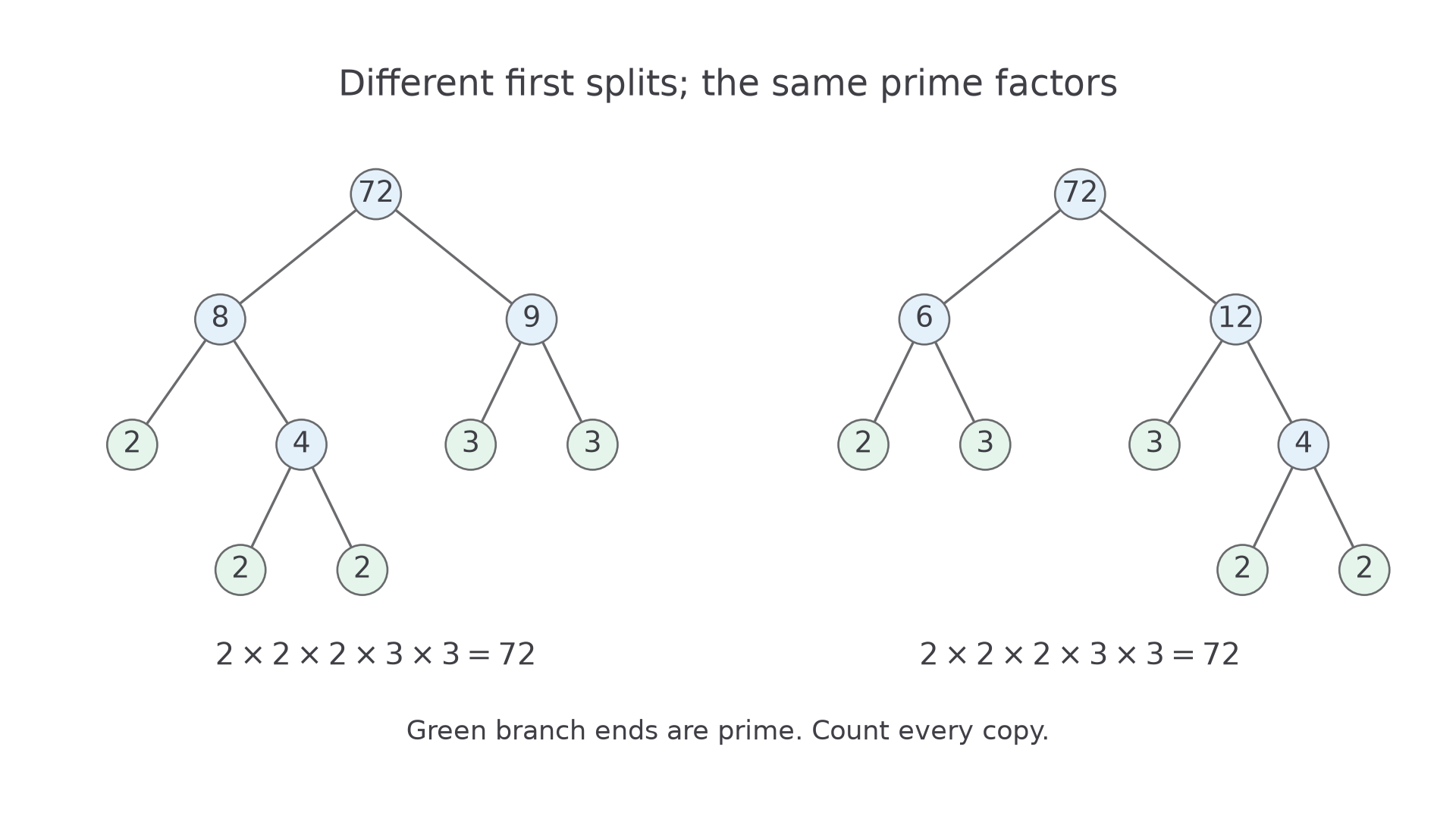
Worked example 1: starting with eight times nine
Question. Express as a product of prime factors, starting with .
Plan. Split each composite branch until every branch end is prime.
Answer. .
Check. and , so the final product is . Each of and is prime.
Keep and change only the first split. This checks whether the result depends on your starting choice.
Worked example 2: starting with six times twelve
Question. Express as a product of prime factors, starting with .
Plan. Split and , and continue until only prime branch ends remain.
Answer. , the same prime factors as before.
Check. Group the factors another way: .
This agreement is a general property: for an integer greater than , a complete prime factorisation is unique apart from the order of its factors. A prime such as already has a one-factor prime factorisation, . The number has no prime factors; do not put at the end of a prime-factor product.
Watch out
Do not multiply every number written in the tree. Intermediate numbers such as , and have already been replaced by their branches. Read only the prime branch ends, including every repeated copy.
Repeated division into primes
You can find prime factors without drawing a branching tree. Divide by a prime factor, keep that prime, then divide the quotient again. Stop when the quotient becomes . This builds a single chain of exact divisions.
Start with the smallest suitable prime. If divides the current number exactly, use it and test again. Once no longer divides, try , then , then the next primes as needed. Skipping is safe: any number divisible by would already be divisible by .
Worked example 3: keeping a divisor while it still works
Question. Express as a product of prime factors using repeated division.
Plan. Divide by the smallest prime available at each stage, recording every divisor.
Answer. .
Check. Rebuild in reverse: , then , , and .
Change the starting value to . The first quotient is now odd, so keeping as the next divisor would fail.
Worked example 4: moving to the next prime
Question. Express as a product of prime factors using repeated division.
Plan. Use once, then choose primes that divide each new quotient exactly.
Answer. .
Check. and , giving .
Why keep the divisors? Each line says the number before division equals the prime divisor times the next number. Reading back through the chain multiplies all the saved primes by the final , reconstructing the original integer.
Watch out
A quotient in the middle of the chain need not be prime. The divisors you record must be prime. For example, dividing by is exact, but you would still need to replace by .
Writing repeated prime factors as powers
Repeated factors can be shortened without changing their meaning. For example, can be written . The small raised counts three factors of ; it does not mean .
Power notation
In a power such as , the base is and the index is . A positive whole-number index tells you how many copies of the base are multiplied together. Thus , and .
For a prime factorisation, collect equal primes together and count their copies. A prime used once is normally written without an index: write , rather than . This is only a compact record of repeated multiplication; you do not need rules for combining general powers yet.
Worked example 5: counting repeated copies
Question. Write using powers, and work out its value.
Plan. Count the copies of each prime, then evaluate each repeated product.
Answer. .
Check. Expand the powers again: . There are exactly the original five prime factors.
Replace one factor of by a factor of . The number of factors stays five, but the two indices change.
Worked example 6: changing one prime factor
Question. Write using powers, and work out its value.
Plan. Recount each prime instead of keeping the indices from the previous example.
Answer. .
Check. Replacing one in the previous product by divides its value by , then multiplies by : .
The opening factor trees both finish at . You can choose the first split to make the arithmetic convenient, then use the prime product to check the result. In the next lesson, keeping track of repeated copies will help you find common factors and common multiples.
Watch out
: the left side is , while the right side is . The index counts factors, not equal groups being added.
Quick Recap
- Split composite factors until every branch end is prime.
- Different valid factor trees give the same prime factors, apart from their order.
- Repeated division records the prime divisors and ends at .
- A positive whole-number index counts repeated factors: means three factors of .
The two starting routes for agree: each gives .