C5.3; E5.3 - Circle area and circumference
Doubling a circular mat's radius doubles the distance round it, but uses four times as much material. You will calculate circumference and area, distinguish radius from diameter, keep exact answers in terms of , and recover a circle's size from either measure.
Circumference and diameter
If a circle's radius doubles, do both its boundary length and its area double? Start by imagining a thread wrapped once round its edge. Straightening the thread measures the circle's circumference.
You already know
A radius joins the centre to the circle. A diameter crosses the centre from one side of the circle to the other, so . A chord that misses the centre is not a diameter.
For every circle, circumference divided by diameter is the same constant, . Its decimal expansion begins and never terminates or repeats. The circumference is therefore a little more than three times the diameter.
[DIAGRAM: asset_name: Radius diameter and circumference; asset_slug: radius_diameter_circumference; caption: The diameter contains two radii; the circumference follows the curved boundary.; description: A circle has a horizontal diameter labelled 7 centimetres, centre O, a radius in a separate direction labelled 3.5 centimetres, and an outside arrow identifying the full circumference. The radius ends exactly on the circle and the diameter passes through its centre.]
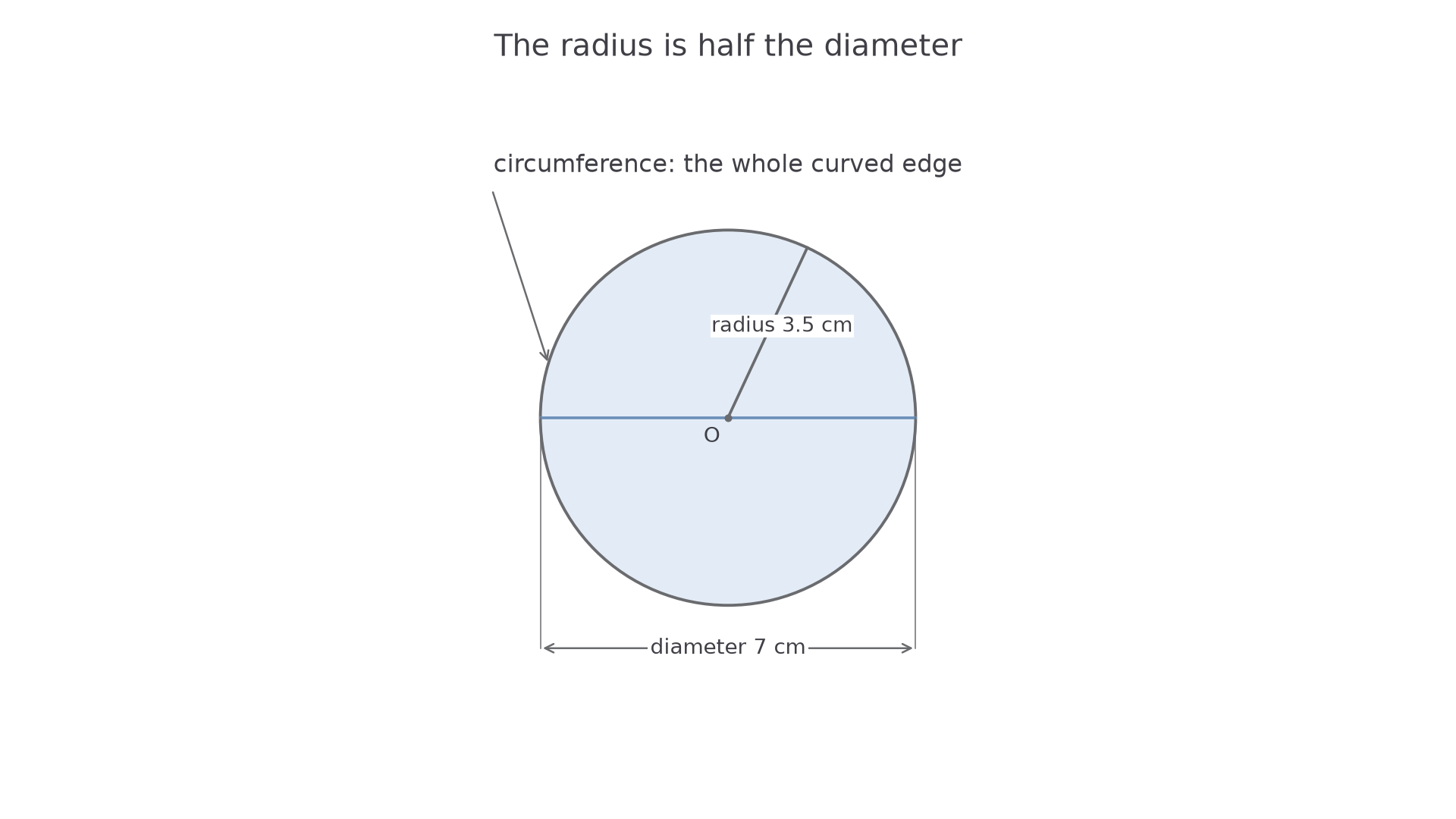
Circumference
For a circle of positive radius and diameter ,
Circumference uses the same length unit as the radius or diameter.
is given in the List of formulas.
An answer such as is exact: it retains the precise constant . Replacing with a finite decimal approximation makes the answer approximate. On a calculator paper, use the calculator's key and round only at the end when a decimal is required.
Worked example 1: circumference from a radius
Question. Find the exact circumference of a circle of radius .
Plan. Double the radius, then multiply by .
Answer. .
Check. The diameter is ; a circumference just over agrees with .
Describe the same circle using its diameter instead. Only the type of supplied length changes.
Worked example 2: circumference from a diameter
Question. Find the exact circumference of a circle of diameter .
Plan. Multiply the diameter directly by .
Answer. .
Check. Halving the diameter gives radius . Using gives the same .
The two calculations agree because they describe the same circle with different measurements.
Watch out
is wrong when is the diameter. Either use directly or halve the diameter before using .
Give the next circumference exactly, without replacing .
Area and radius
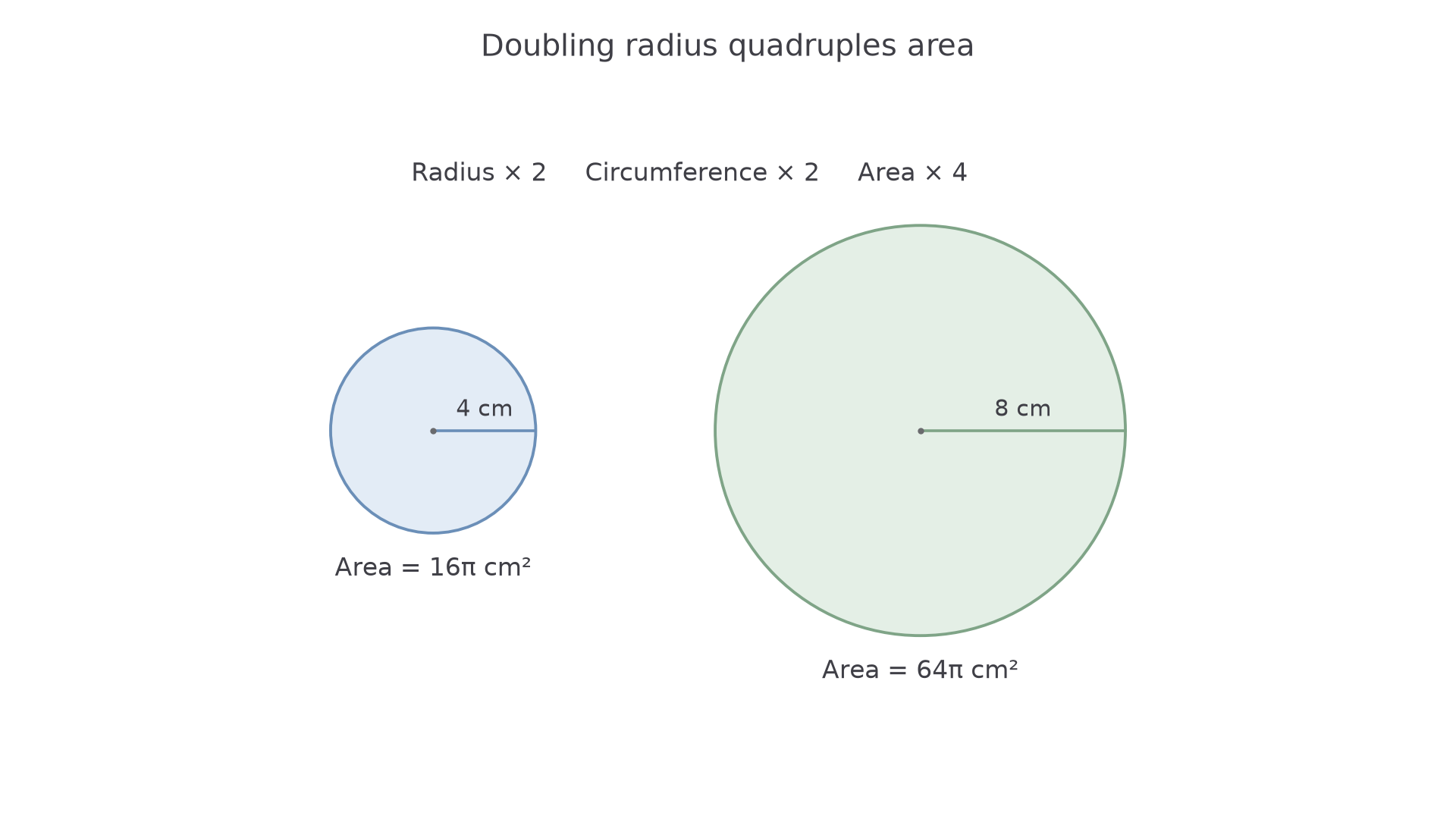
Area measures the surface inside the circle. Its formula contains the radius squared, so changing a radius has a different effect on area than on circumference.
To picture why, cut a circle into many thin equal wedges and alternate them pointing up and down. Their curved edges form two increasingly straight rows. The arrangement approaches a rectangle of height and width half the circumference, . Its area is therefore . More, thinner wedges make the picture closer; cutting and rearranging do not change the total area.
Circle area
For a circle of positive radius ,
Square the radius before multiplying by . If is in centimetres, is in square centimetres.
Given in the List of formulas.
If a diameter is given, find first. The expression would give four times the correct area.
[DIAGRAM: asset_name: Doubling a circle radius; asset_slug: doubled_circle_radius; caption: Doubling every length makes four times the area.; description: Two exact circles are drawn at the same scale with radii 4 and 8 centimetres. Their areas are labelled 16 pi and 64 pi square centimetres. A radius line reaches the boundary in each; captions distinguish circumference factor 2 from area factor 4.]
Continue this lesson.
You’re previewing NovaLearn without an account. Create a free account to read the rest.
Create free account