C1.9; E1.9 - Rounding and estimation
A rounded answer should keep the information the problem needs. You will round to decimal places, significant figures and named place values, make quick estimates, and decide whether a practical answer needs rounding up or down. This lesson is for Core and Extended.
Decimal places and significant figures
A calculation says that pupils need buses with seats each. Would reporting buses solve the problem? Before choosing a practical answer, distinguish two ways to round a number.
Decimal places and significant figures
Decimal places count digits after the decimal point. For example, has three decimal places.
Significant figures count from the first nonzero digit, including later zeros. Thus has three significant figures: . The zeros before locate its size; they do not count. The written value has three significant figures and two decimal places.
To round, locate the last digit you will keep, then inspect the next digit. If the next digit is to , keep the retained digit unchanged. If it is to , increase the retained digit by one, carrying if necessary. Remove later decimal digits; replace later whole-number places with zeros so the place value stays correct. For negative values, apply this rule to the magnitude and restore the minus sign.
For example, to the nearest thousand is : the hundreds digit is , so round the thousands digit up. Do not write , because that loses the thousands place.
[DIAGRAM: asset_name: Rounding to the nearest thousand; asset_slug: rounding_thousand; caption: 5684 is above the midpoint 5500, so it is nearer to 6000 than 5000.; description: An accurately scaled number line from 5000 to 6000, with the midpoint 5500 marked and a point at 5684. The two halves have pale blue and pale sage shading. A labelled arrow links 5684 to its nearest thousand 6000.]
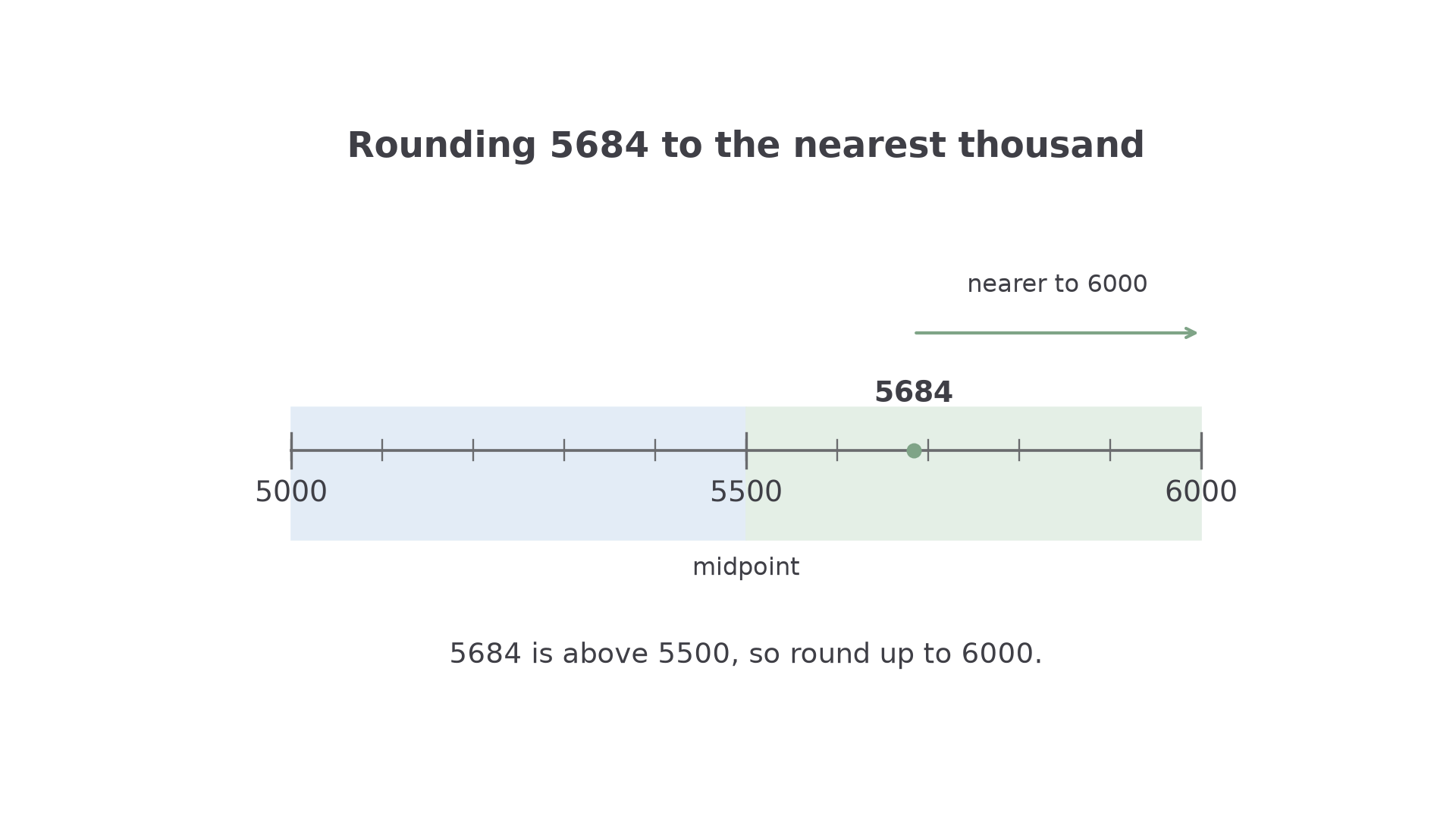
At an exact halfway value, this rule rounds the magnitude up: to the nearest thousand is .
Worked example 1: rounding to decimal places
Question. Write correct to decimal places.
Plan. Keep through the thousandths place and inspect the next digit.
Answer. .
Check. is from , but from , so is nearer.
Keep the number and the requested count , but change decimal places to significant figures. Counting now starts at the first nonzero digit.
Worked example 2: rounding to significant figures
Question. Write correct to significant figures.
Plan. Count as the first three significant digits and inspect the following .
Answer. .
Check. The rounding step is . The value is from , nearer than .
Watch out
to significant figures is not : that has only two significant figures. Also, keep a final zero when it communicates requested accuracy: to decimal places is .
Count from the first nonzero digit, then inspect the next one.
Estimating calculations
An estimate replaces awkward numbers with nearby convenient values before calculating. It gives a quick idea of the size of an answer. If told to round each number to one significant figure, do exactly that; otherwise, choose values that make the arithmetic manageable and stay close to the originals.
The approximation symbol means “is approximately equal to”. Rounding inputs changes the calculation, so an estimated answer is not an exact equality. Estimation is useful before using a calculator: it can reveal a misplaced decimal point.
Worked example 3: estimating a product divided by a number
Question. By writing each number correct to significant figure, estimate
Plan. Round each input separately, then simplify the easier calculation.
Answer. An estimate is .
Check. The numerator is about , and five groups of about make . An answer such as would have the wrong scale.
Change only the denominator from to . It is ten times smaller, so the estimated quotient should be ten times larger.
Worked example 4: a smaller denominator
Question. By writing each number correct to significant figure, estimate
Plan. Use the same rounded numerator, but now round the denominator to .
Answer. An estimate is .
Check. is ten times the previous estimate , matching the factor-of-ten change in the denominator.
An estimate need not lie above the exact answer or below it: different inputs may round in different directions. It checks plausibility, rather than proving a precise limit.
Watch out
Rounding to significant figure gives , not . Significant figures start at its first nonzero digit. Do not round every number to the nearest whole number.
Make the inputs easy before calculating.
Choosing sensible accuracy
The required accuracy depends on what the answer represents. A measurement might sensibly be ; a number of buses must be a whole number. Sometimes you must round up to provide enough, while sometimes you must round down because only complete groups count.
When an exam question specifies accuracy, follow it. On Cambridge calculator papers, non-exact numerical answers are normally given to significant figures, and angles in degrees to decimal place, unless a different accuracy is requested. An exact answer such as does not need shortening merely because it has more than three significant figures. Keep the full unrounded value during a chain of calculations, then round the final answer.
For a money amount, use the currency's normal smallest unit when appropriate: a calculated price of dollars is written \7.80$. For a count, ask whether a remaining fraction requires an extra whole item or cannot form a complete group.
Worked example 5: enough capacity
Question. There are pupils. Each bus has pupil seats. Work out the smallest number of buses needed.
Plan. Divide to find the number of busloads, then allow a whole bus for any pupils left over.
Answer. buses.
Check. Six buses leave spare seats. Five buses would leave pupils without seats.
Keep the same division, but change what a remainder means. This time a partial group cannot be counted.
Worked example 6: complete groups only
Question. A club has counters. Each complete game set needs counters. Work out the greatest number of complete sets it can make.
Plan. Count only whole groups of ; leftover counters do not make another complete set.
Answer. complete sets.
Check. Six sets would need counters, two more than the club has.
Watch out
“Round every practical answer to the nearest whole number” is unsafe. Enough buses requires rounding up; complete sets requires rounding down. Decide from the situation before rounding.
The opening busloads therefore means whole buses, not buses.
Quick Recap
- Decimal places count from the decimal point; significant figures count from the first nonzero digit.
- Inspect the next digit to round, keeping place-value zeros and any zero needed to show the requested accuracy.
- Estimate by replacing inputs with convenient nearby values before calculating.
- Keep full working accuracy, then give a final answer that fits both the instruction and the context.
The opening journey needs buses: a fraction of a busload still needs a whole bus.