C4.1, C4.2; E4.1, E4.2 - Solids and their nets
A flat drawing can describe a three-dimensional object, or even fold into one. You will recognise solids and their faces, edges and vertices, then draw and interpret nets with the matching lengths that make them fit together.
Faces, edges and vertices of solids
Why can six squares fold into a cube in one arrangement, but fail in another? The number of pieces matters, but so does where their edges meet. Start by imagining the solid that the pieces must make.
Face, surface, edge and vertex
A solid is three-dimensional. Its surface is its outside boundary. A face is a flat part of that boundary; a curved surface is not a flat face. An edge is where two boundary surfaces meet. A vertex is a corner or pointed apex; on a solid with polygonal faces, edges meet at each vertex. The pointed tip of a cone is also called a vertex.
On a cube, each face is a square, each edge is a straight segment, and three edges meet at each vertex.
A cube has six equal square faces. A cuboid has six rectangular faces, with opposite faces equal. A cube is a special cuboid whose three dimensions are equal. Drawings often show only three faces at once: hidden faces still count.
[DIAGRAM: asset_name: Faces edges and vertices; asset_slug: solid_faces_edges_vertices; caption: Hidden edges and faces still belong to the solid.; description: Exact perspective wireframes of a cube cuboid triangular prism and square-based pyramid show dashed hidden edges, one highlighted flat face, and the face edge and vertex counts for each solid.]
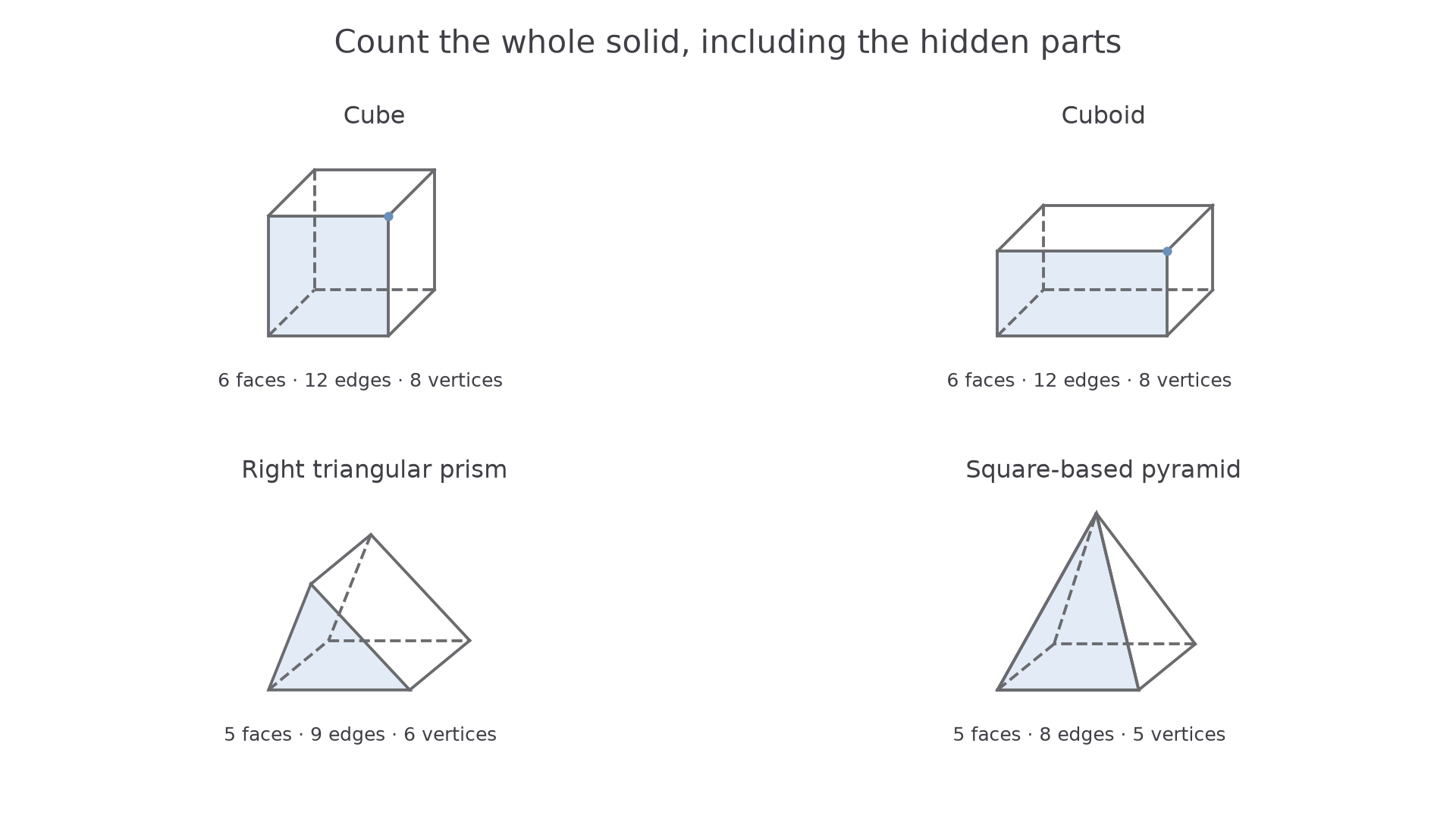
Count systematically rather than counting only the visible lines. For a cuboid, there are four vertices on the top and four below. There are four edges around the top, four around the bottom, and four joining them. A right triangular prism has two triangular ends joined by three rectangular faces. A square-based pyramid has one square base and four triangular faces meeting at an apex.
| Solid | Flat faces | Edges | Vertices |
|---|---|---|---|
| Cube | squares | ||
| Cuboid | rectangles | ||
| Right triangular prism | triangles and rectangles | ||
| Square-based pyramid | square and triangles |
A cylinder has two flat circular faces, one curved surface, two circular edges and no vertices. A cone has one flat circular face, one curved surface, one circular edge and one apex. A sphere has one continuous curved surface, no flat faces, no edges and no vertices. Distinguish a circular edge, where surfaces meet, from an arbitrary circle drawn on a sphere: that drawing does not create an edge.
Watch out
“A cylinder has three flat faces” confuses a face with a curved surface. Its two ends are flat; the surface joining them is curved.
Think about the whole object, including the back.
Prisms, pyramids and curved solids
Look at the end shape and how it continues through the object to distinguish a prism from a pyramid. Turning the object does not change its mathematical name.
Prism and pyramid
A prism has two equal, parallel polygonal ends and the same cross-section all the way between them. A cross-section is the shape made by a flat cut; here take cuts parallel to the ends. In a right prism, the side faces joining the ends are rectangles.
A pyramid has a polygonal base and triangular side faces that all meet at one apex. It is named after its base: a triangular-based pyramid and a square-based pyramid have different numbers of faces.
A triangular prism keeps a triangular cross-section. A cuboid is a rectangular prism, and a cube is a square prism. In contrast, a slice through a pyramid parallel to its base gets smaller as it approaches the apex. A triangular face by itself therefore does not identify a pyramid: a triangular prism has triangular faces too. Check how all the faces join.
[DIAGRAM: asset_name: Prisms pyramids and curved solids; asset_slug: prism_pyramid_curved_solids; caption: A prism keeps its end shape; a pyramid narrows to one apex.; description: A triangular prism has two equal triangular ends and a matching interior cross-section. A square-based pyramid narrows from a square base to an apex. Separate cylinder cone and sphere drawings label circular ends, curved surfaces and the cone apex.]
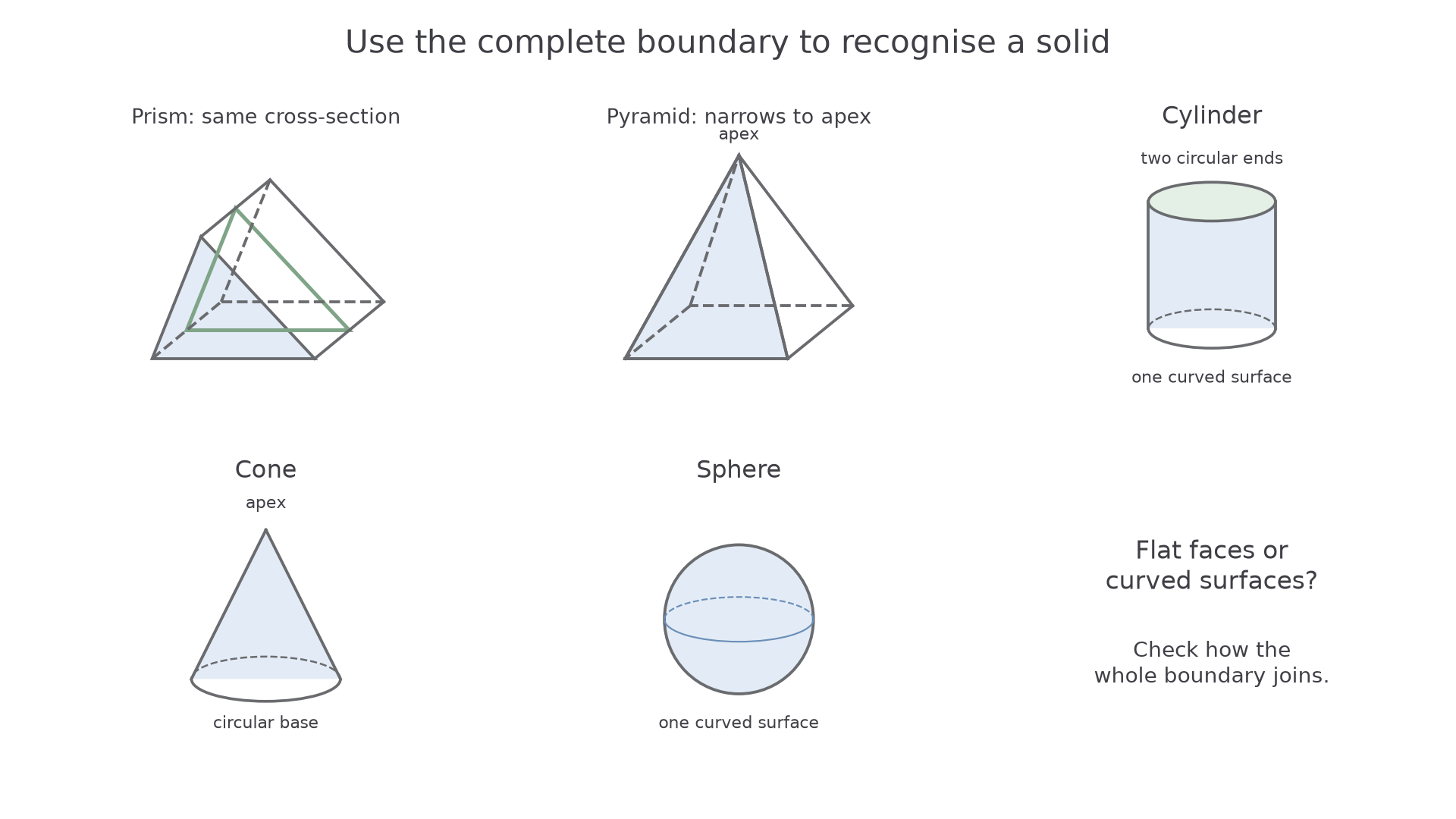
A cylinder keeps a circular cross-section between its two circular ends, but it is not a polygonal prism. A cone narrows from a circular base to one apex; its side is curved, unlike the triangular faces of a pyramid. A sphere has every point on its surface the same distance from its centre. Its roundness has no preferred base, edge or apex.
To describe dimensions, label lengths on the actual features: the distance between a prism's ends is its length, and a cylinder's height is the perpendicular distance between its circular ends. A pyramid's perpendicular height runs from its apex to its base, while a sloping edge runs to a base vertex. Those are different measurements; a net shows the sloping edges directly, but does not usually show the perpendicular height of the folded pyramid.
Key idea
Prisms keep an equal polygonal cross-section. Pyramids have flat triangular sides meeting at an apex. Cylinders, cones and spheres include curved surfaces.
Use the complete surface description to identify the object.
Continue this lesson.
You’re previewing NovaLearn without an account. Create a free account to read the rest.
Create free account