C5.2; E5.2 - Perimeters and areas of polygons
Two shapes can reach the same height and stretch across the same base yet cover different amounts of space. You will find areas and perimeters of rectangles, triangles, parallelograms and trapezia, choose perpendicular heights, and work backwards to missing dimensions.
Rectangles and triangles
A rectangle and a triangle both have base and perpendicular height . Must their areas be equal? Counting the space inside, rather than the distance round the edge, will settle it.
Area and perimeter
Area is the amount of flat surface inside a boundary, measured in square units. Perimeter is the total distance round the boundary, measured in length units.
For a chosen base, the perpendicular height is measured at to that base. It is the distance to the opposite side of a rectangle or the opposite vertex of a triangle, possibly using an extended base line.
A rectangle with centimetre squares along each row and rows contains squares. For any rectangle, multiplying length by width counts its unit squares, including fractional rows or columns.
[DIAGRAM: asset_name: Rectangle and triangle on the same base; asset_slug: rectangle_triangle_area; caption: Equal base and perpendicular height do not give equal areas for different shape types.; description: A rectangle of base 8 centimetres and height 5 centimetres appears beside a triangle with base 8 centimetres and perpendicular height 5 centimetres. A dashed copy of the triangle completes a parallelogram of twice its area; right-angle markers identify the heights.]
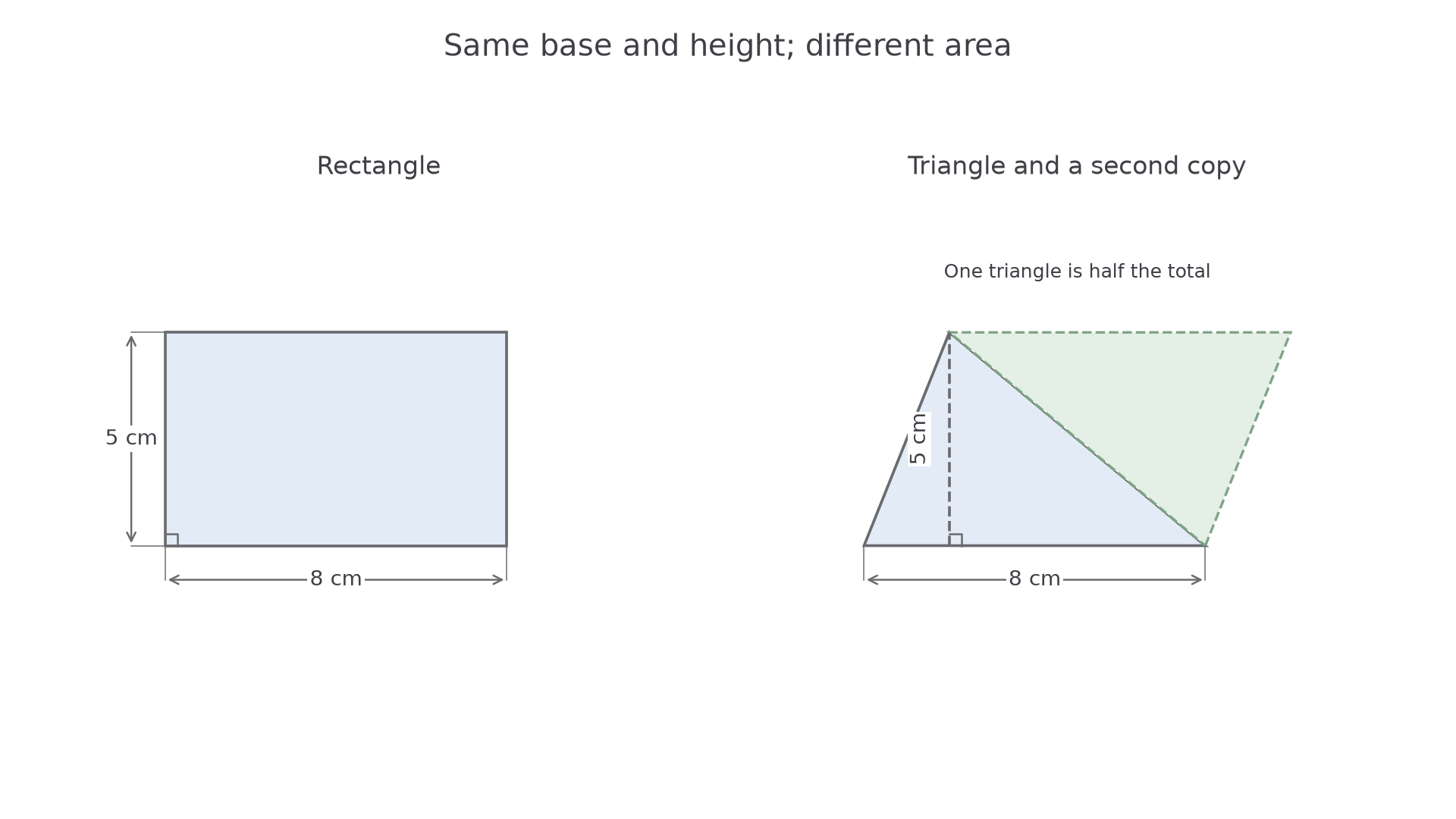
Two identical copies of any triangle fit together to make a parallelogram with the same base and height. Cutting and sliding the end of that parallelogram makes a rectangle without changing its area. One triangle therefore covers half of . Tilting the triangle does not remove the factor of one half.
Rectangle and triangle areas
For positive base and perpendicular height ,
Use the same length unit for and ; the result uses its square unit.
Triangle area is given in the List of formulas. Rectangle area is not given: learn it.
Apply the formulas to the opening pair, keeping the base and height fixed.
Worked example 1: counting a rectangle's area
Question. Find the area of a rectangle with length and width .
Plan. Multiply the number of unit squares in a row by the number of rows.
Answer. .
Check. Split it into two by rectangles. Their areas are .
Change only the shape to a triangle; keep the base and perpendicular height. This isolates the effect of the factor of one half.
Worked example 2: the same base and height
Question. Find the area of a triangle with base and perpendicular height .
Plan. Find the area for the full base-height product, then take half.
Answer. .
Check. Two copies cover a parallelogram of area . One copy must have area .
An obtuse triangle may have its height outside the triangle. The perpendicular distance is still used; a sloping side is a height only when it is perpendicular to the chosen base.
Watch out
is generally wrong. A height must meet the base line at . Look for the right-angle mark before substituting.
Use the perpendicular measurement supplied in the next task.
Parallelograms and trapezia
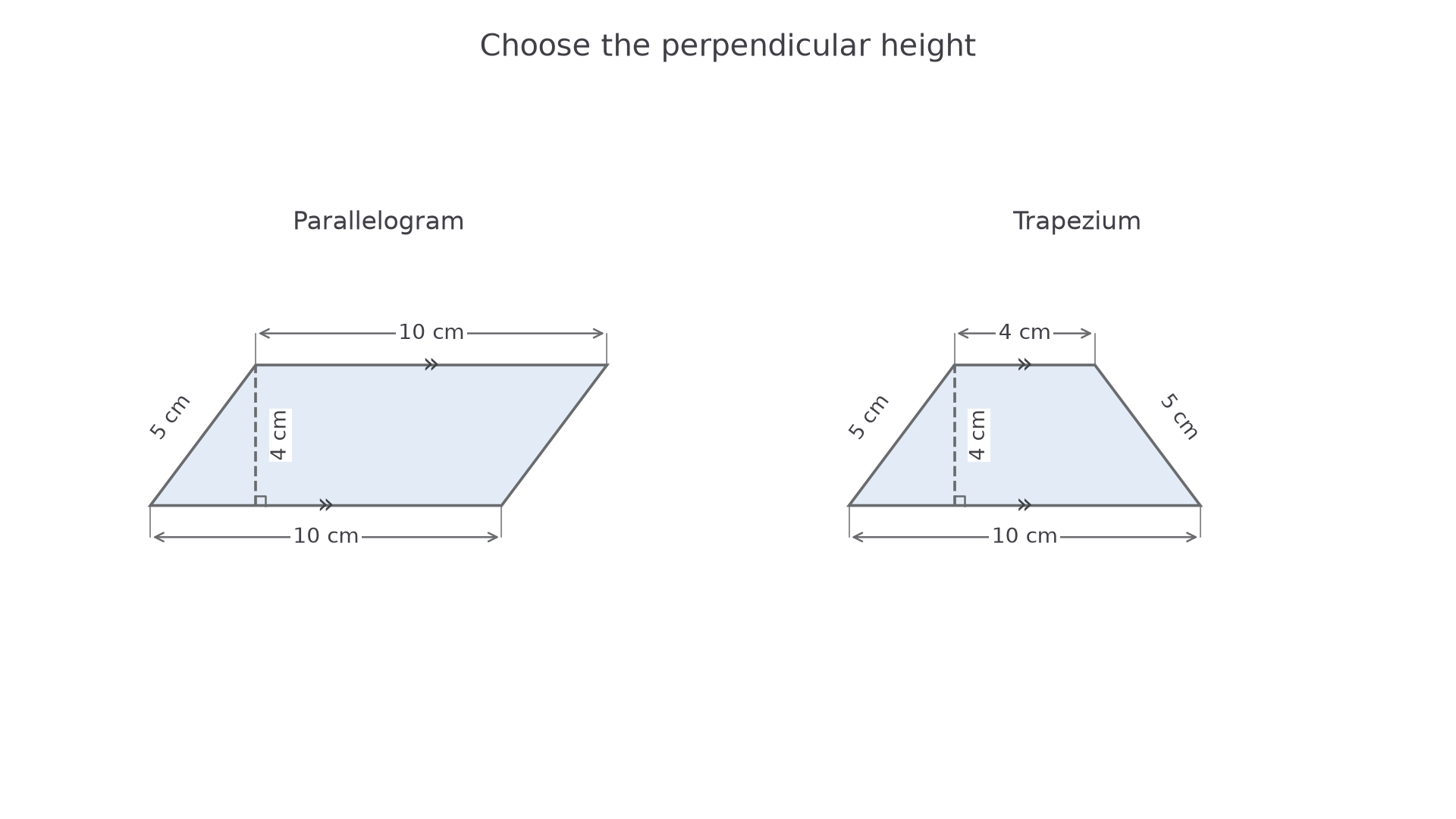
A sloping boundary does not automatically reduce area. For a parallelogram, sliding a triangular piece from one end to the other makes a rectangle with the same base and perpendicular height. No surface is lost or added, so its area is .
A trapezium has two parallel sides of different lengths in the cases here. Call their lengths and . Turn a second identical trapezium through half a turn and join the copies along a non-parallel side. Together they make a parallelogram of base and height . Each trapezium has half that area.
[DIAGRAM: asset_name: Parallel sides and perpendicular heights; asset_slug: parallelogram_trapezium_area; caption: The perpendicular gap is the height; a sloping edge is a different measurement.; description: A parallelogram has base and top 10 centimetres, perpendicular height 4 centimetres and sloping side 5 centimetres. A trapezium has parallel sides 10 and 4 centimetres, height 4 centimetres and equal non-parallel sides 5 centimetres. Dashed perpendicular heights and right-angle squares are shown; matching arrows identify parallel sides.]
Parallelogram and trapezium areas
For the trapezium, and are the parallel side lengths. In both formulas, is their perpendicular separation. All dimensions are positive and in the same unit.
Not given in the List of formulas: learn these formulas.
Another way to read the trapezium formula is “average parallel-side length multiplied by height”. A cross-section gradually grows from one parallel side to the other, so that average is a useful way to remember the result.
Worked example 3: area without the sloping side
Question. A parallelogram has base , perpendicular height and sloping side . Calculate its area.
Plan. Use the base and its perpendicular height; the sloping side is not needed for area.
Answer. .
Check. Cutting the left triangular end and sliding it right produces a by rectangle, with the same area.
Continue this lesson.
You’re previewing NovaLearn without an account. Create a free account to read the rest.
Create free account