E3.3, E3.4 - Gradient, midpoint and distance
Two coordinates can tell you a line's direction, a segment's centre and its length without a drawn grid. You will calculate gradient for E3.3 and use averages and Pythagoras to find midpoint and distance for E3.4. These methods also work when points lie in different quadrants.
Gradient from two points
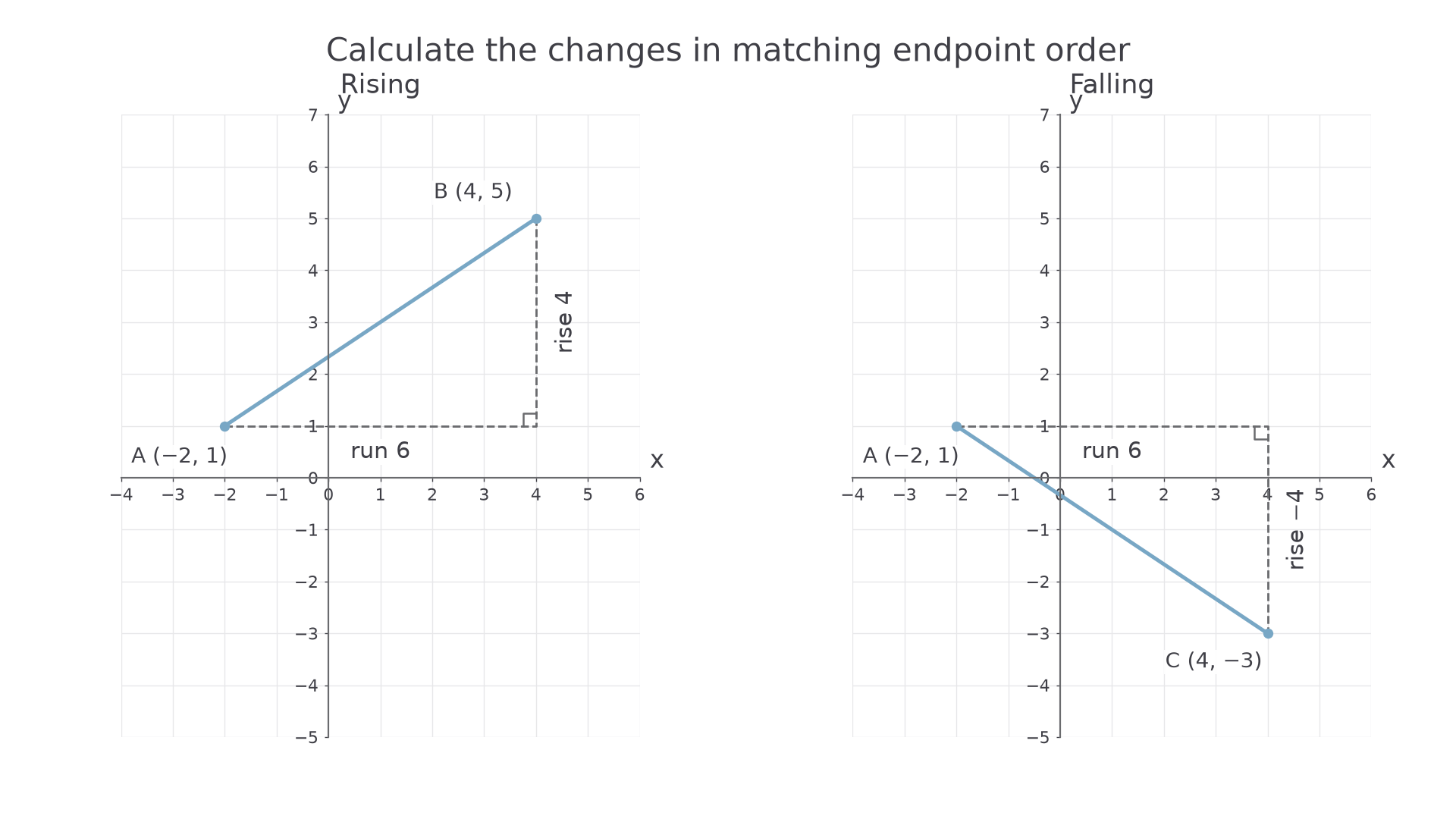
Can the same two points give a negative gradient when read one way and a positive gradient when read backwards? Take and . From to , the horizontal change is and the vertical change is . Reading backwards reverses both changes, so their ratio stays the same.
You already measured rise divided by run on a grid. Coordinates supply those changes exactly: subtract the starting coordinate from the finishing coordinate separately in each direction.
[DIAGRAM: asset_name: Coordinate changes give gradient; asset_slug: coordinate_gradient_changes; caption: Reversing the direction reverses both changes, leaving the gradient unchanged.; description: Two equal-scale numbered coordinate grids. The left shows A at negative two comma one and B at four comma five with run six and rise four. The right shows A at negative two comma one and C at four comma negative three with run six and rise negative four. Horizontal and vertical legs are dashed.]
Gradient from two points
For distinct points and with ,
Use the same endpoint order in the numerator and denominator. Not given in the List of formulas: learn it.
A zero numerator gives gradient zero: the line is horizontal. A zero denominator gives a vertical line with undefined gradient, not gradient zero. If both coordinate differences are zero, you have named the same point twice; one point alone does not determine a line.
Worked example 1: a rising segment
Question. Calculate the gradient of the line through and .
Plan. Calculate both changes from to , then divide vertical by horizontal.
Answer. The gradient is .
Check. A run of with this gradient gives rise ; starting at height reaches height , as required.
Change only the second point's vertical coordinate from to . The horizontal change is unchanged, but the line now falls.
Worked example 2: a falling segment
Question. Calculate the gradient of the line through and .
Plan. Keep the endpoint order, including when subtracting a negative number.
Answer. The gradient is .
Check. Read backwards from to : . Both changes reverse, so the result agrees.
Watch out
mixes the endpoint orders and gives the wrong sign. Choose a starting point once, then use “finish minus start” for both coordinates. Bracket negative coordinates.
The opening question has a reassuring answer: direction of travel changes the signs of the rise and run together, so it cannot change the gradient.
Midpoint coordinates
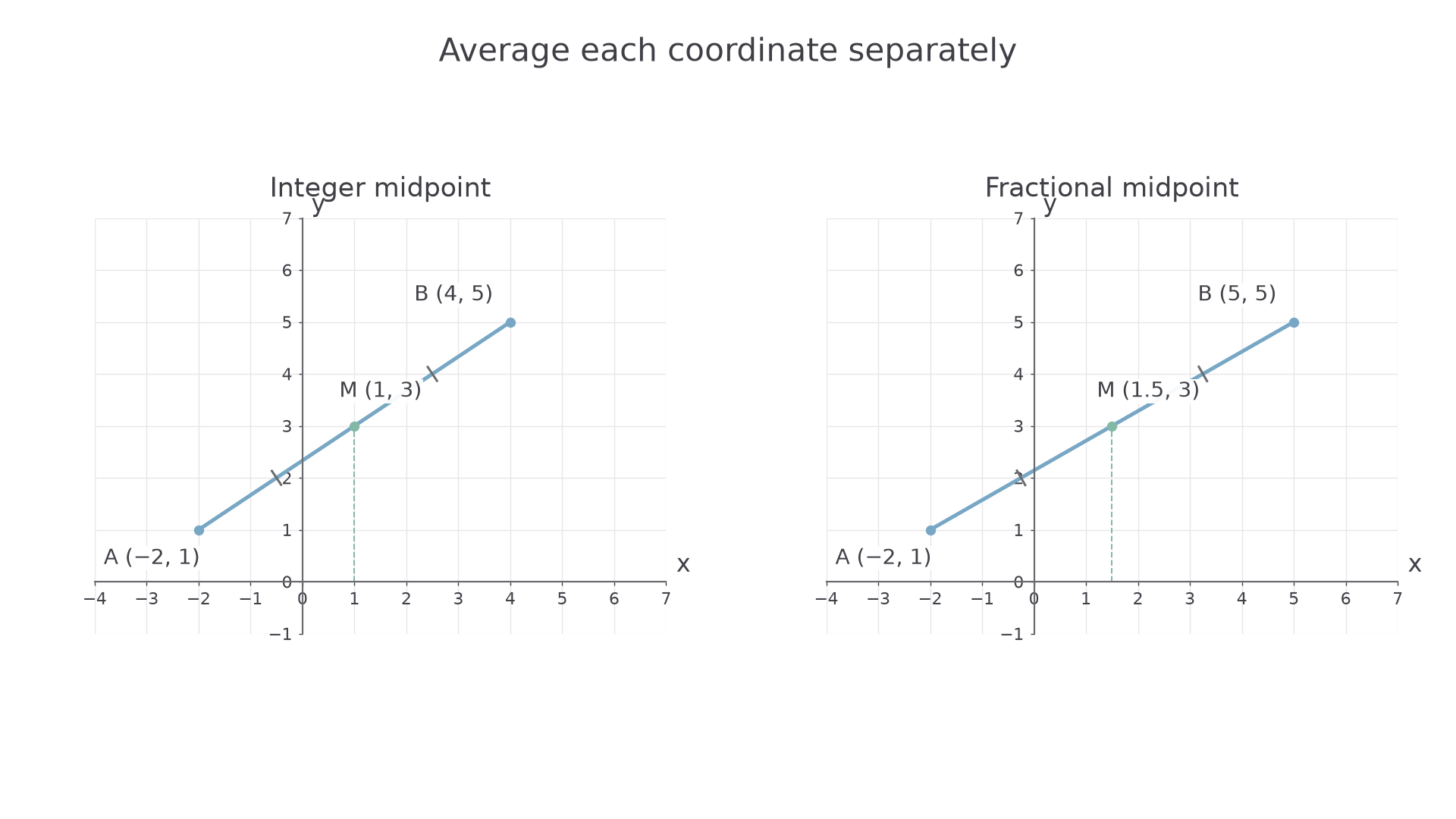
The midpoint lies halfway along a segment. To get halfway from to , move half of the horizontal change and half of the vertical change. That gives .
This is the same as averaging the two horizontal coordinates and averaging the two vertical coordinates. For the first coordinate, . The same calculation applies vertically. Keep the coordinate pairs in their separate columns: averaging an -coordinate with a -coordinate has no halfway meaning.
[DIAGRAM: asset_name: Halfway in both directions; asset_slug: coordinate_midpoints; caption: The midpoint halves the horizontal and vertical changes together.; description: Two equal-scale numbered grids show A at negative two comma one and B at four comma five. M at one comma three is halfway along AB. In the second grid the endpoint B has moved to five comma five and the midpoint is one point five comma three. Equal segment halves are marked within each grid.]
Midpoint
The midpoint of the segment joining and is
This also works for horizontal and vertical segments. Not given in the List of formulas: learn it.
The average lies between the two values, unless they are equal. A midpoint can have fractional coordinates even when both endpoints have integer coordinates. If the endpoints coincide, the same formula returns that point, the midpoint of a segment of length zero.
Worked example 3: an integer midpoint
Question. Find the midpoint of the segment from to .
Plan. Average corresponding coordinates independently.
Answer. .
Check. From to is three right and two up; from to is also three right and two up. The two halves have the same direction and length.
Continue this lesson.
You’re previewing NovaLearn without an account. Create a free account to read the rest.
Create free account