C2.7; E2.7 - Patterns and linear sequences
A pattern can tell you what comes next or let you jump straight to a distant term. You will connect number and shape patterns, distinguish a term's position from its value, and derive rules for sequences with a constant difference.
Term-to-term patterns
One square needs four matchsticks. Two squares joined along an edge need seven, and three need ten. How many would a row of one hundred squares need? Counting every stick would work, but a rule can do the counting for you.
A sequence is an ordered list of values called terms. A term-to-term rule tells you how to move from one term to the next. For the matchsticks, , add three each time: every new square shares one side and contributes three new sticks.
Linear sequence
A linear sequence has a constant difference between consecutive terms. In an arithmetic sequence this fixed amount is the common difference. It may be positive, negative or zero. For example, has common difference .
Subtract the preceding term from the following term to find a difference. Check more than one gap rather than assuming a pattern from the first two terms alone. A short list can fit many rules; use the stated pattern or intended consistent rule.
Worked example 1: a growing pattern
Question. The sequence continues by a constant difference. Write down the next two terms and its term-to-term rule.
Plan. Find the repeated difference, then apply it twice.
Answer. The next terms are ; the rule is “add three”.
Check. Working backwards, and , returning to the supplied final term.
Keep the first term and step size, but reverse the direction of the step. A decreasing sequence can pass through zero into negative values.
Worked example 2: a decreasing pattern
Question. The sequence continues by a constant difference. Write down the next two terms and its term-to-term rule.
Plan. Check that the difference is negative three, then subtract three twice.
Answer. The next terms are ; the rule is “subtract three”.
Check. Adding three twice takes back through to .
Sequences can share a step without sharing their values. Compare with : both add three, but each term of the second is one greater than the corresponding term of the first. The starting value matters as well as the difference.
Watch out
“Subtract three” does not mean every term is negative. It describes the change. Starting at four gives , including positive and negative terms.
Position-to-term rules
A position-to-term rule uses a term's position to calculate its value directly. Position one means the first term; it does not mean the term's value is one. In , the third term has position and value .
Let be the position, starting with . For the row of joined squares, the picture reveals three horizontal-or-vertical groups of sticks and one extra end stick.
[DIAGRAM: asset_name: Matchstick rows and their positions; asset_slug: matchstick_linear_sequence; caption: Each extra square adds three sticks. A row of n squares has n top sticks, n bottom sticks and n plus one vertical sticks.; description: The first four rows of adjacent unit squares are shown at positions one to four, with four, seven, ten and thirteen sticks respectively. Top and bottom edges are pale blue, vertical edges are sage, and the extra left end is clay. Labels distinguish position from number of sticks. A counting statement below gives top n plus bottom n plus vertical n plus one equals three n plus one.]
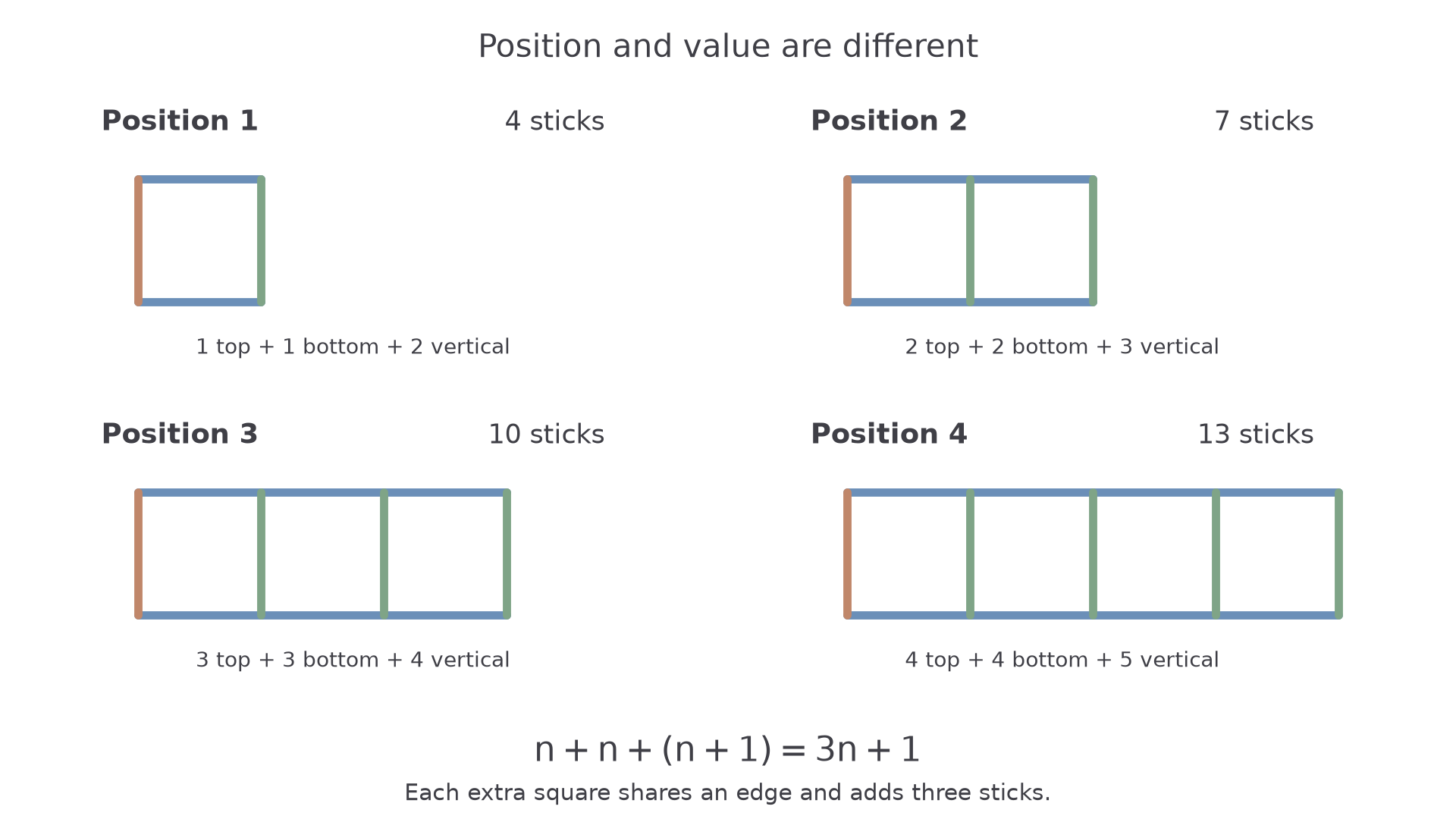
There are top sticks, bottom sticks and vertical sticks. Adding them gives . Equivalently, begin with four sticks and add three for each of the remaining squares: .
Matchstick row rule
For adjacent squares in this pattern, each new square sharing exactly one full side,
Not given in the List of formulas: derive it from the pattern.
The rule gives access to any term without writing all the earlier terms. Substitute the position for , not the previous term's value.
Worked example 3: a position beyond the picture
Question. How many matchsticks are needed for the eighth row of the pattern?
Plan. Substitute position into the position-to-term rule.
Answer. matchsticks.
Check. Count by orientation: eight top sticks, eight bottom sticks and nine vertical sticks give .
Continue this lesson.
You’re previewing NovaLearn without an account. Create a free account to read the rest.
Create free account