C3.1; E3.1 - Coordinates in four quadrants
A pair of numbers can locate one point precisely, but their order matters. You will use Cartesian coordinates to plot and read positions on scaled axes and to complete shapes, developing the two-dimensional coordinates in C3.1 and E3.1.
Axes and ordered pairs
Do and name the same point because they contain the same two numbers? Imagine giving directions: four steps across and two up need not end where two across and four up end. We need an agreed order.
Two perpendicular number lines make Cartesian axes. The horizontal line is the -axis; the vertical line is the -axis. They meet at the origin, labelled , with coordinates . Read the numbers on each axis before using its scale.
Ordered pair
The coordinates form an ordered pair. The first number gives the horizontal position; the second gives the vertical position. Positive directions are right and up. Negative directions are left and down.
Start at the origin, move to the required horizontal position, then move vertically. The final point is fixed; the route is a way to find it. To read a point, trace vertically to the -axis for its first coordinate and horizontally to the -axis for its second.
[DIAGRAM: asset_name: The order of coordinates; asset_slug: coordinate_order; caption: Swapping the coordinates changes the point.; description: Numbered Cartesian axes with unit grid, origin O, point A at four comma two and point B at two comma four. Dashed projections show each horizontal and vertical coordinate.]
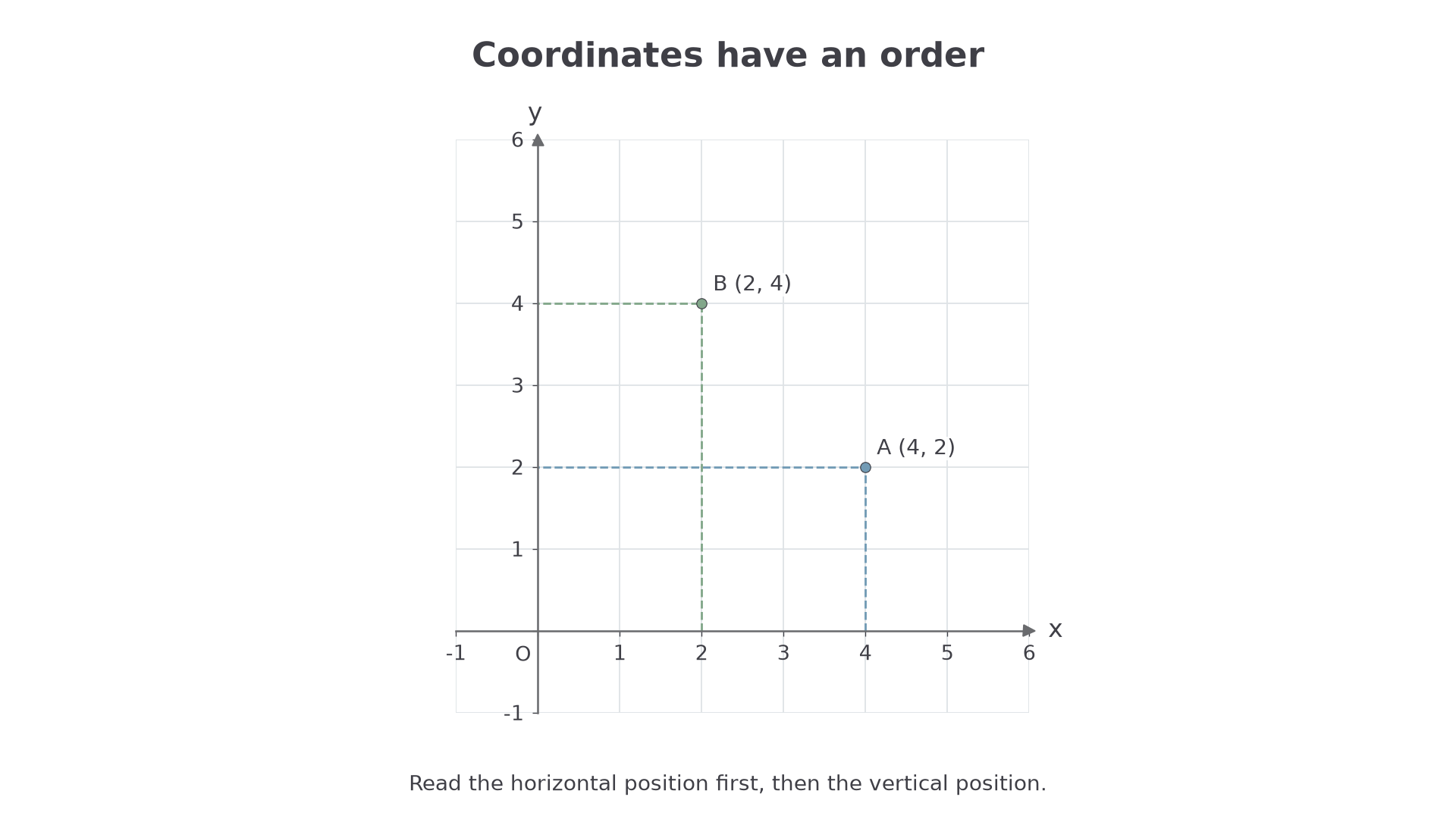
Worked example 1: across, then up
Question. Describe how to plot on axes with one unit per square.
Plan. Use the first number horizontally, then the second vertically.
Answer. Mark at the intersection of the vertical grid line through and the horizontal grid line through .
Check. Projecting back to the axes gives on the -axis and on the -axis.
Now swap only the order of the numbers. This changes which distance is horizontal.
Worked example 2: the numbers swapped
Question. Describe how to plot on the same axes.
Plan. Read the new first coordinate before moving vertically.
Answer. Mark two units right and four units up from the origin. It is a different point from .
Check. is higher than , but farther left. Both differences agree with the diagram.
Watch out
Reading vertically first would turn into . Write a coordinate pair in the order , even when you happen to reach the point by a different route.
Coordinates in all four quadrants
Negative coordinates let you locate points left of the origin or below it. Both signs matter independently: is left and up; is left and down.
The axes divide the plane into four quadrants. Starting at the top right and moving anticlockwise, quadrants I, II, III and IV have signs , , and . Points on an axis are in no quadrant. A point on the -axis has ; one on the -axis has .
[DIAGRAM: asset_name: Signs and separate axis scales; asset_slug: coordinate_quadrants; caption: Here one square represents two x-units but one y-unit.; description: Four numbered quadrants on Cartesian axes. Horizontal tick labels increase by two per square, vertical tick labels by one. P is negative six comma three and Q is negative six comma negative three.]
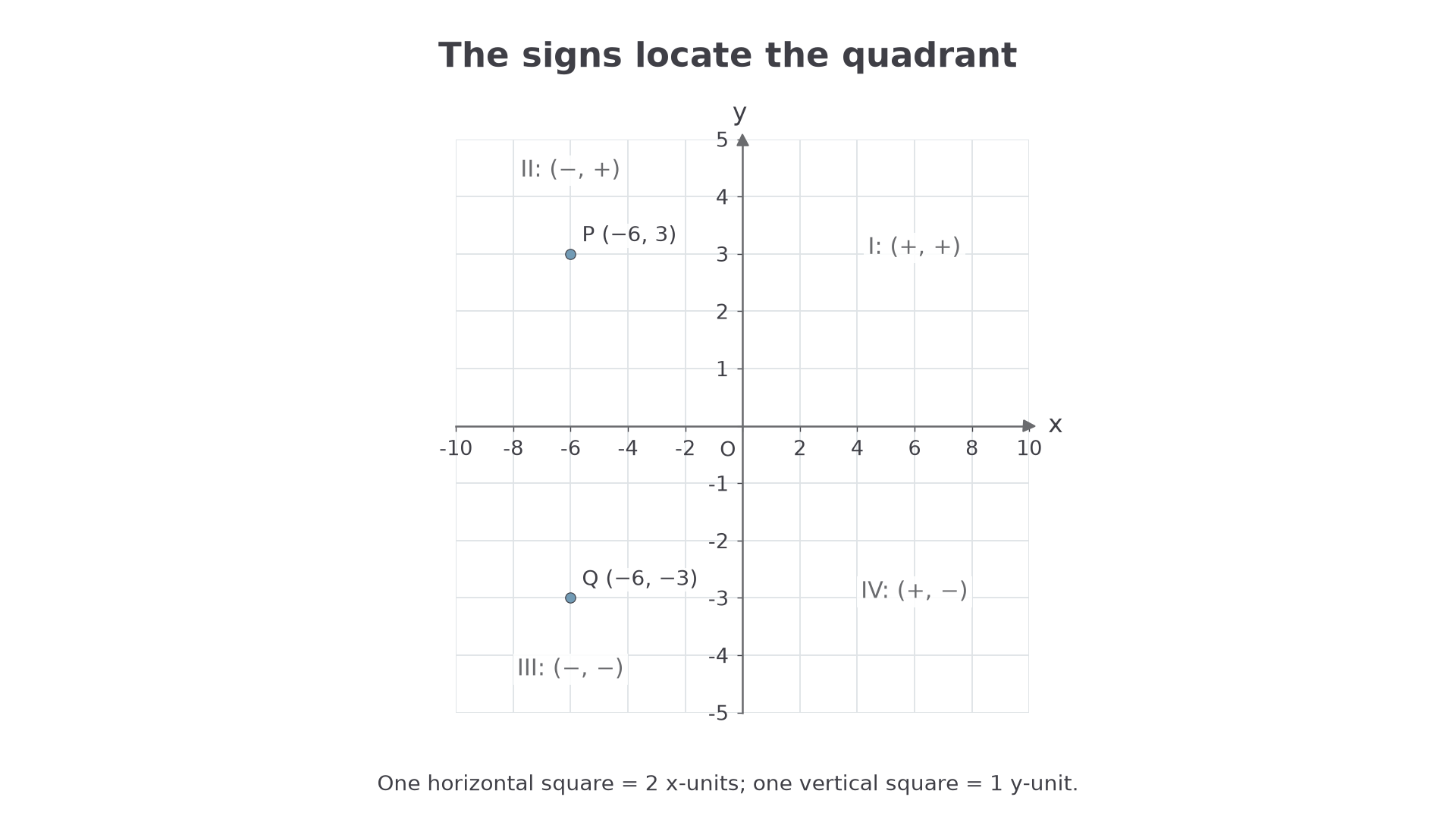
The two axes can use different scales. In this grid, consecutive vertical grid lines differ by in ; consecutive horizontal grid lines differ by in . Three squares left means , not .
Worked example 3: a negative horizontal coordinate
Question. On the displayed grid, is three squares left and three squares up from the origin. Read its coordinates and state its quadrant.
Plan. Convert the square counts using each axis's own scale.
Answer. , in quadrant II.
Check. Its horizontal projection meets the tick ; its vertical projection meets . The signs are left and up.
Keep the horizontal position and change only which side of the -axis the point lies on.
Continue this lesson.
You’re previewing NovaLearn without an account. Create a free account to read the rest.
Create free account