C8.3; E8.3 - Tree diagrams with replacement
A tree keeps track of successive results, even when their chances are unequal. This shared Core and Extended lesson uses independent trials and draws with replacement. You will label branches, multiply probabilities along a complete path and add the paths that make an event happen.
Branches, outcomes and probabilities
A bag contains three red counters and two blue counters. Draw twice, returning the first counter and mixing thoroughly before the second draw. Are the four colour sequences equally likely simply because a tree has four ends? The branches will explain why they are not.
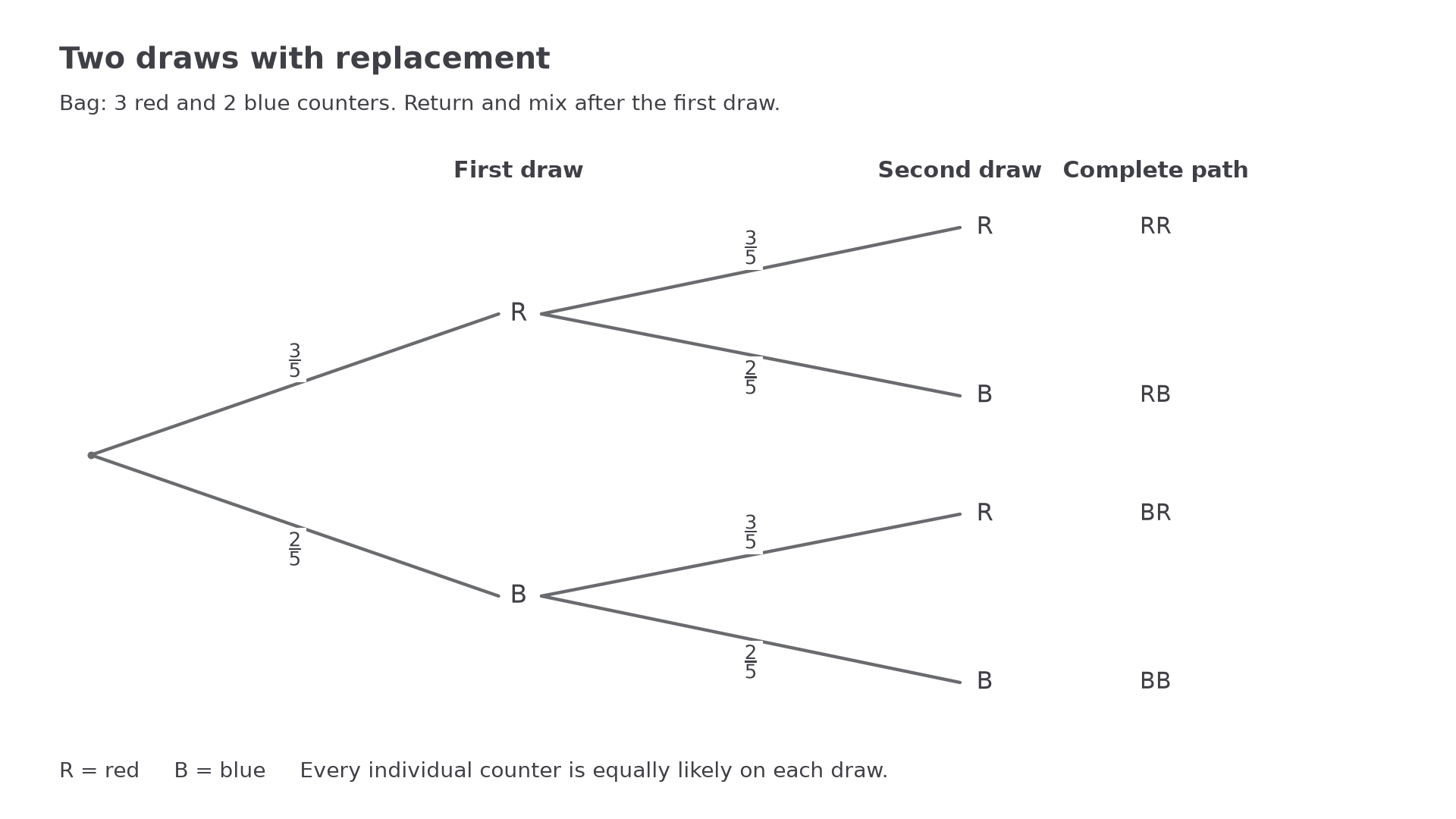
A tree diagram records stages from left to right. Each branch ends with an outcome label; its probability is written beside the branch. At every point where branches split, they must include all possible next outcomes without overlap, so the probabilities leaving that point add to one.
Independent trials and replacement
Two trials are independent when knowing the first result does not change the probabilities for the second. With replacement means returning the selected object before selecting again. In this bag, replacement and thorough mixing restore the same equal chance for each individual counter on the next draw.
The five counters are equally likely on each draw, but their colours are not: red has chance , blue . Write the same pair of probabilities after either first result, because the bag has been restored. Use for red and for blue; means red first, blue second.
[DIAGRAM: asset_name: A tree for two draws with replacement; asset_slug: replacement_tree_branches; caption: Outcome labels sit at branch ends; probabilities sit beside branches.; description: A two-stage tree for a bag of three red and two blue counters, with replacement and thorough mixing, has first-draw branches R with probability three fifths and B with probability two fifths. After either first result, the second-draw branches are R with probability three fifths and B with probability two fifths. The four complete paths are RR, RB, BR and BB.]
Worked example 1: labelling a replacement tree
Question. Complete the outcome and probability labels for two draws from the bag of three red and two blue counters, with replacement and thorough mixing. Every individual counter is equally likely on each draw.
Plan. Label red and blue at every split, count each colour out of five, and repeat those chances at the second stage.
Answer. Each split ends in and , with probabilities and respectively. The complete paths are .
Check. At all three splits, . Each first result has both possible second results, so all four colour sequences appear once.
Change only one counter from blue to red. The layout of the tree stays the same, while its branch probabilities change.
Worked example 2: changing the bag contents
Question. The bag now contains four red counters and one blue counter. Each draw again gives every counter equal chance, with replacement and thorough mixing. State all the branch probabilities on the two-draw tree.
Plan. Keep the four paths, but count the new colour frequencies out of five.
Answer. The first red branch and both second red branches have probability . The first blue branch and both second blue branches have probability . Outcomes remain .
Check. The probabilities at each split total . After a red result, returning that counter leaves all four reds and the one blue available again.
Independent trials need not have identical probabilities. A fair coin followed independently by a spinner can have different first-stage and second-stage chances. Independence means the second-stage chances do not depend on which first-stage result occurred.
Watch out
“There are two branches, so each probability is ” ignores their different numbers of counters. Branches name categories; they do not promise equal chances.
Use the new counts below, keeping replacement in mind.
Multiplying along a path
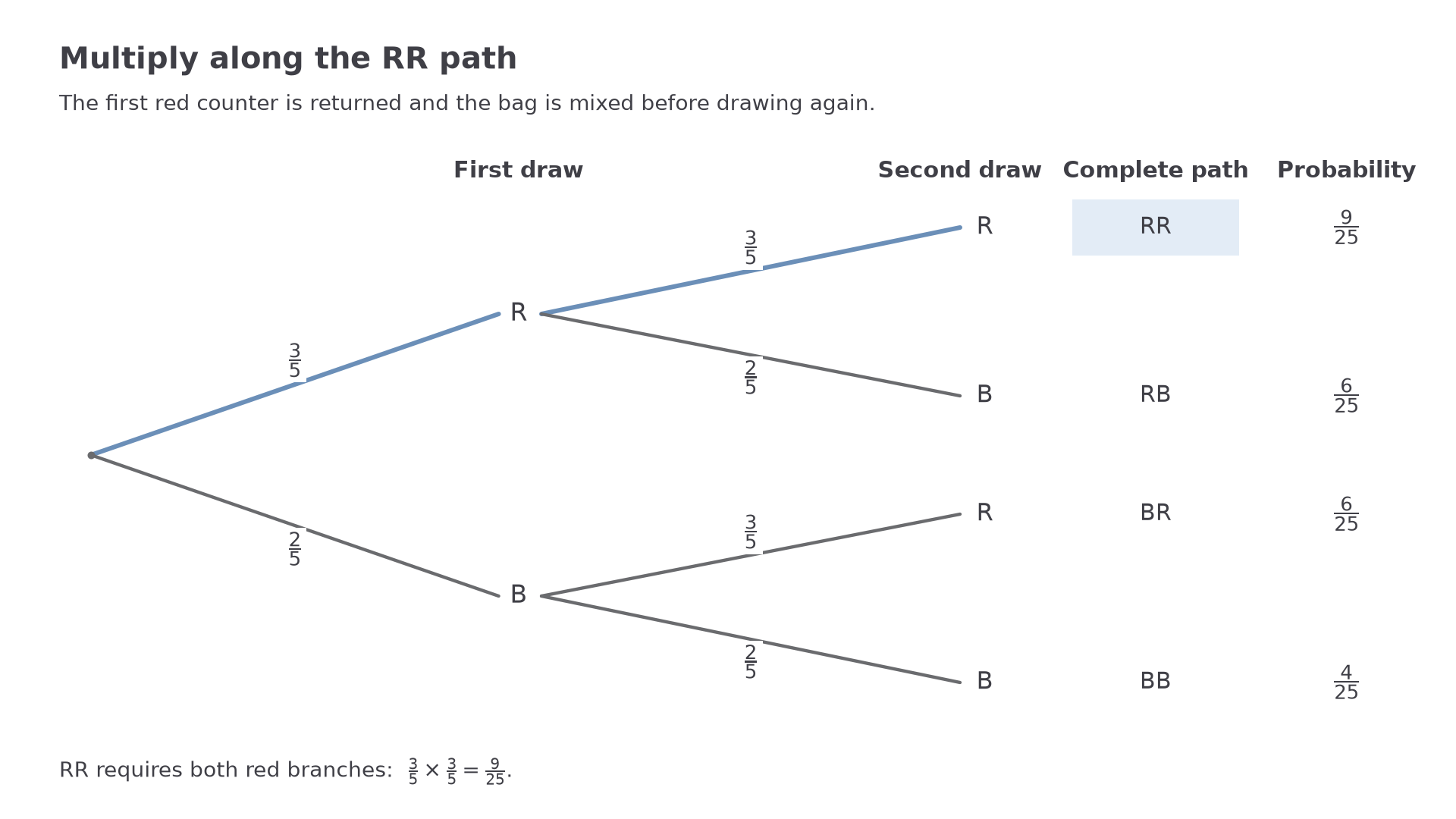
A complete path describes both results in order. To find its probability, take the stated fraction for the first branch and then the fraction of those cases following the second branch. Taking a fraction of a fraction is multiplication.
Return to three red and two blue counters, with replacement and thorough mixing. Imagine giving the individual counters different labels, even when their colours match. There are equally likely ordered pairs. Nine pairs have two red counters, because each of the three first reds can be paired with each of the three second reds.
[DIAGRAM: asset_name: Multiplying along a complete path; asset_slug: replacement_tree_path; caption: The RR path uses three fifths of three fifths, giving nine twenty-fifths.; description: The two-draw replacement tree has red probability three fifths and blue probability two fifths at every split. The two branches forming RR are highlighted blue. At the four path ends, probabilities are RR nine twenty-fifths, RB six twenty-fifths, BR six twenty-fifths and BB four twenty-fifths.]
Continue this lesson.
You’re previewing NovaLearn without an account. Create a free account to read the rest.
Create free account