E6.5 - Sine and cosine rules
A triangle need not contain a right angle for its sides and angles to be connected. You will choose between the sine and cosine rules, calculate with obtuse angles, and decide when the same given information describes two different triangles. This lesson is for Extended.
Using the sine rule
Can two triangles have two equal given sides and the same given angle, yet still be different? They can if the angle is not between those sides. First learn to match a side to its opposite angle; that pairing will explain both the method and its possible ambiguity.
In triangle , lower-case is the side opposite angle , is opposite , and is opposite . A side is opposite the vertex it does not touch.
[DIAGRAM: asset_name: Opposite pairs and perpendicular heights; asset_slug: triangle_rules; caption: Match each lower-case side with its opposite capital angle.; description: An acute labelled triangle ABC shows sides a opposite A, b opposite B and c opposite C, with a perpendicular height h to AB. A second panel reflects one radius-like side across the vertical through its base, showing equal heights for an acute angle theta and its obtuse supplement, while the horizontal projection changes sign.]
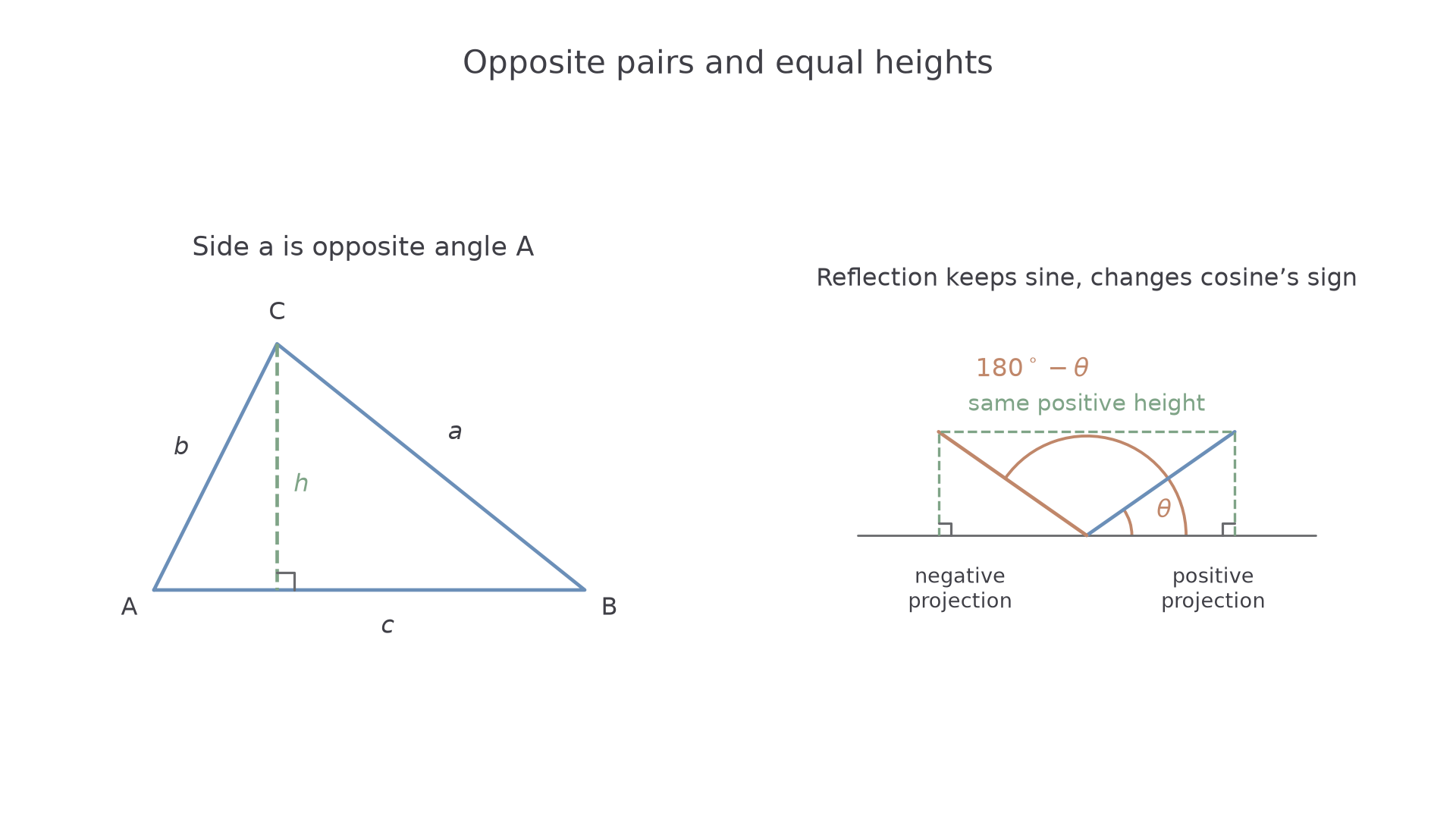
For an acute triangle, dropping height from gives . Dividing gives , and the third pair follows by choosing another height.
An obtuse angle needs a small extension of the acute ratios. A side of fixed length makes the same positive height at and , as the reflection in the diagram shows. We therefore use
The same height argument then works when a perpendicular meets an extended side.
Sine rule
For any non-degenerate triangle,
Each side must stay paired with its opposite angle. Every angle is strictly between and .
Given in the List of formulas.
Use the sine rule when you have a complete opposite side-angle pair and another side or angle. With two known angles, find the third using the angle sum if needed. With a known sine, an inverse-sine key gives the acute candidate first; check its supplement too.
Worked example 1: finding a side
Question. In triangle , , , and . Calculate .
Plan. Pair with and the known side with . Use degree mode.
Answer. , to significant figures.
Check. , so is the largest angle. Its opposite side should exceed , which it does. Substituting the unrounded gives both sine-rule ratios .
Now the unknown is an angle rather than its opposite side. The pairing remains the same, but the final operation changes.
Worked example 2: finding an angle
Question. In triangle , , , and . Calculate .
Plan. Isolate , then test both angle candidates against the angle sum.
The second candidate fails: .
Answer. , to decimal place.
Check. Since , its opposite angle must be smaller than . The accepted angle is smaller; the rejected candidate is not.
Watch out
crosses the pairs. Label opposite sides before substituting. Also, here means inverse sine, not the reciprocal .
Using the cosine rule
The sine rule cannot start if you know two sides and only the angle between them: no opposite pair is complete. The cosine rule uses exactly that information. It can also find an angle when all three sides are known.
For an acute angle , the horizontal projection of side onto side is , and its perpendicular height is . Pythagoras gives
For an obtuse , the projection points in the opposite direction, so its signed value is negative. If , reflection gives . The same expansion works with this negative projection. In particular, an obtuse angle has negative cosine.
Cosine rule
Here is the included angle between the known sides and , opposite . Equivalently,
Use positive side lengths of a genuine triangle; for three supplied sides, the two shorter sides must add to more than the longest.
Given in the List of formulas.
The supplied version can be relabelled: the squared side alone must always be opposite the angle used. At , cosine is zero and the rule reduces to Pythagoras.
Worked example 3: two sides and their included angle
Question. Two sides of a triangle are and . Their included angle is . Find the third side.
Plan. Use the cosine rule for the side opposite , then take the positive square root.
Answer. , or to significant figures.
Check. Drop a perpendicular from the endpoint of side onto side . The projection is , the height is , and the remaining base is . Pythagoras independently gives . The triangle inequalities also hold: .
Continue this lesson.
You’re previewing NovaLearn without an account. Create a free account to read the rest.
Create free account