C1.4, C1.5; E1.4, E1.5 - Fractions, decimals and percentages
A fraction, a decimal and a percentage can describe exactly the same amount. For Core and Extended, C1.4/E1.4 connects these representations and C1.5/E1.5 lets you compare their values. You will convert terminating decimals in both directions, interpret percentages above one hundred, and order a mixed list without judging by its appearance.
Fractions as decimals
Which is larger: , or ? The largest-looking written number need not represent the largest amount. Converting to one common form will answer the question.
A fraction means division: means . If its denominator can easily be made , or , an equivalent fraction gives the decimal directly. For example, . Otherwise, divide the numerator by the denominator, keeping track of remainders.
Terminating decimal
A terminating decimal has a finite number of digits after the decimal point. For example, terminates after two decimal places. Writing extra zeros, as , does not change its value.
The conversions here use terminating decimals. Some decimal expansions continue forever; recognising their behaviour comes later.
Worked example 1: dividing to get a decimal
Question. Write as a decimal.
Plan. Divide three units by eight, exchanging each remainder for ten smaller parts.
Why multiply each remainder by ten? One unit is ten tenths, one tenth is ten hundredths, and so on. You are changing the size of the pieces, not changing the amount still to divide.
Answer. .
Check. , so the decimal gives the correct numerator when multiplied by the denominator.
Keep the denominator and change only the numerator. Seven eighths is close to one, which will help check the new decimal.
Worked example 2: a larger numerator
Question. Write as a decimal.
Plan. Divide seven by eight using the same place-value steps.
Answer. .
Check. One eighth is , since . Seven eighths is one minus one eighth, and .
To go back from a terminating decimal to a fraction, use its place value, then simplify. For example,
Two decimal places mean hundredths, even when the first decimal digit is zero: . For a value above one, the fraction can be improper: .
Watch out
is wrong: the digits in a fraction are not decimal-place labels. Use division or equivalent fractions. A denominator of eight means eighths, not hundredths.
Percentages as hundredths
“Per cent” means “per hundred”. A percentage is another way to write a fraction with denominator one hundred: means . The symbol is part of the value, so and are very different numbers.
Percentage
A percentage expresses a number as a number of hundredths. One whole is . Half a whole is , and two wholes are .
Each grid below represents one whole split into one hundred equal cells. Thirty-seven shaded cells represent . A full grid and another thirty-seven cells represent .
[DIAGRAM: asset_name: Percentages below and above one whole; asset_slug: percentages_hundredths; caption: Thirty-seven hundredths is less than one whole; one hundred and thirty-seven hundredths is greater than one whole.; description: Two panels compare equal-size hundred-square grids. The first panel has one grid with thirty-seven blue cells labelled 37 percent equals 0.37. The second panel has two grids, the first entirely sage green and the second with thirty-seven sage green cells, labelled 137 percent equals 1.37. Each separate grid represents one whole.]
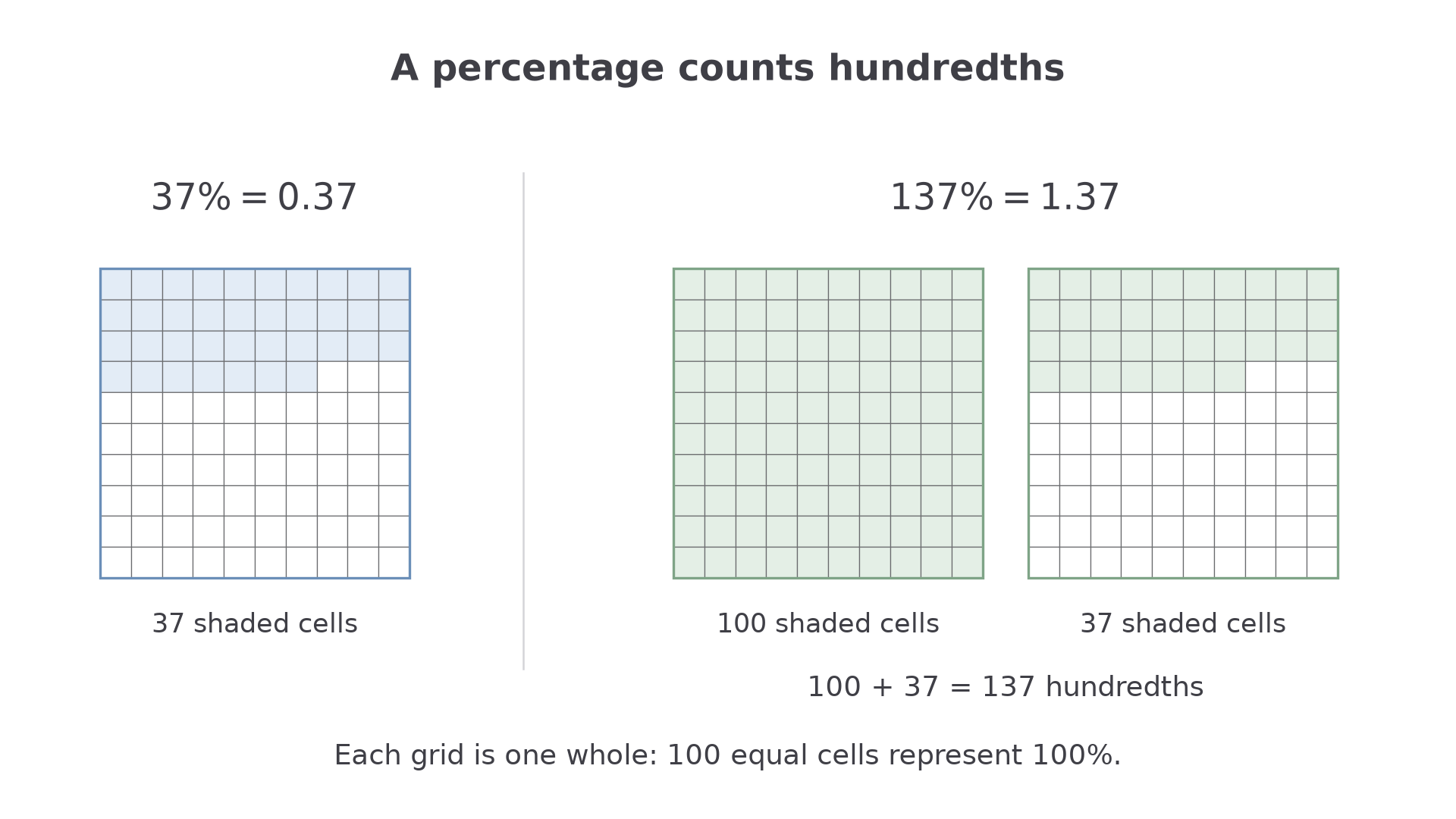
To convert a percentage to a decimal, divide the stated number by . To convert a decimal to a percentage, multiply by and attach the percentage symbol. These operations undo each other: , so .
Worked example 3: a percentage below one hundred
Question. Write as a decimal and as a fraction in its simplest form.
Plan. Interpret the percentage as hundredths, then write those hundredths in the two requested forms.
The fraction is already in its simplest form: has no common factor greater than one with .
Answer. and .
Check. , recovering the stated percentage number. Both forms represent less than one whole.
Now increase only the percentage by one hundred percentage points. This adds exactly one whole.
Worked example 4: a percentage above one hundred
Question. Write as a decimal and as a fraction in its simplest form.
Plan. Use the same hundredths definition even though the number exceeds one hundred.
The denominator's only prime factors are and ; neither divides , so the fraction is in its simplest form.
Answer. and .
Check. , so its percentage is , matching the two grids.
Percentages may also contain decimals. For example, . To write the last value as a fraction with whole-number numerator and denominator, use .
Watch out
is wrong. Seven tenths is seventy hundredths, so . Also, is a valid value: it means wholes, not an impossible percentage.
Converting and comparing representations
To compare different forms, convert them to a common form first. Decimals are convenient when they terminate; equivalent fractions with a common denominator are another valid choice. Keep exact values rather than rounding away a small difference.
You can also move directly from a fraction to a percentage by making the denominator : . In reverse, . When a denominator does not fit neatly into , divide to obtain a decimal, then multiply its value by .
Worked example 5: ordering three representations
Question. Write these numbers in order of size, starting with the smallest:
Plan. Convert each value to hundredths, then compare.
Answer. , with . The two equal values may appear in either order.
Check. In percentages the values are . Fifty-eight comes first, the two sixties tie, and sixty-two comes last.
Change only to . That value must move from the smallest position to the largest.
Worked example 6: changing one percentage
Question. Write these numbers in order of size, starting with the smallest:
Plan. Keep the known equivalence and convert the changed percentage.
Answer. , with the equal pair in either order.
Check. Using denominator , the values are . Their numerator order confirms the answer.
The opening comparison is now settled: is larger than both and . The written looked large only because its hundredths unit was hidden in the percentage symbol.
Exam tip
If asked to order a list, give the original representations in your final list. Your common-form calculations show the method, but replacing every entry by a decimal can hide which original number belongs where.
Quick Recap
- A fraction means numerator divided by denominator.
- A terminating decimal becomes a fraction over , , or another suitable power of ten; then simplify.
- Percentage means per hundred. Divide by to obtain a decimal, or multiply a decimal by to obtain its percentage number.
- Percentages above represent values above one whole.
- Convert to a common exact form before comparing.
Of the three opening values, is greatest: .