E4.4 - Area and volume scale factors
Doubling every length does more than double the material or capacity. In this Extended lesson, E4.4 connects corresponding lengths to areas, surface areas and volumes, and shows how to recover a length ratio from an area or volume ratio.
Why areas scale with the square
If a model's lengths are doubled, does its volume double too? We will answer that after seeing what doubling does to area. A by rectangle has area . Doubling both lengths gives : four times the area.
You already know
Similar shapes have equal corresponding angles and all corresponding lengths in one common ratio. The length scale factor from A to B is a length in B divided by its matching length in A. Keep that direction consistent.
[DIAGRAM: asset_name: Two length factors make an area factor; asset_slug: similar_area_grid; caption: Doubling both directions fits four original rectangles into the enlarged rectangle.; description: A four-by-three rectangle is compared with an eight-by-six rectangle divided into four congruent four-by-three rectangles. Corresponding horizontal and vertical lengths are labelled. Pale blue and sage distinguish original and enlarged boundaries; all dimensions are in centimetres.]
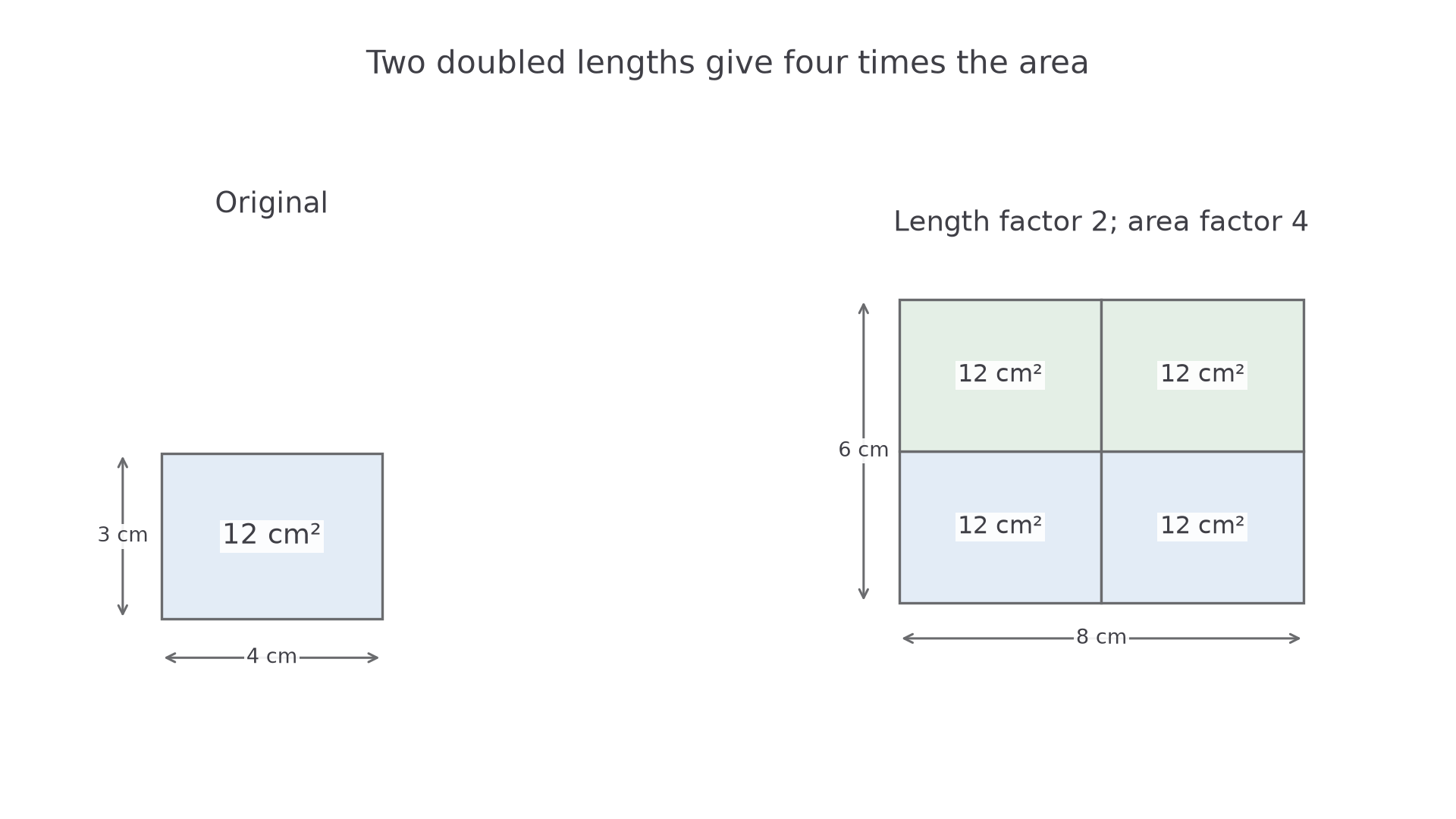
If every length is multiplied by , a rectangle's area becomes . A triangle works the same way: its base and perpendicular height both scale by , while the factor one half stays unchanged. Dividing other polygons into triangles gives the same result. For circles, .
Area scale factor
For similar shapes with length scale factor from A to B,
For similar solids, every corresponding surface piece scales by , so the total surface area does too.
Not given in the List of formulas: understand the two length factors.
Only one common length factor gives this rule. Increasing a rectangle's width alone by multiplies its area by , not ; it generally changes the shape rather than making a similar enlargement.
Worked example 1: enlarging an area
Question. Two similar shapes A and B have length scale factor from A to B. A has area . Find B's area.
Plan. Square the length factor before applying it to the area.
Answer. .
Check. A by rectangle has area ; scaling it to by gives . This concrete representative has the same area factor.
Change only the scale factor to . A factor below one makes both lengths smaller.
Worked example 2: reducing an area
Question. A similar copy B of a shape A has length scale factor from A. A's area is . Find B's area.
Plan. Square the reduction factor, then multiply the original area.
Answer. .
Check. The representative by rectangle becomes by , whose area is . The result is smaller than , as a reduction requires.
Watch out
“Lengths triple, so area triples” scales just one of the two length factors. For similar shapes, the area factor is . State that the shapes are similar before using the rule.
The same rule applies to the entire boundary of similar solids.
Why volumes scale with the cube
Volume has three length directions. A cube has volume ; doubling its edge gives a cube of volume . Two layers of four original cubes fit inside it: eight copies, not two.
[DIAGRAM: asset_name: Three length factors make a volume factor; asset_slug: similar_volume_blocks; caption: Two copies along each of three directions make eight original cubes.; description: An exact perspective cube with edge two centimetres is compared with a cube of edge four centimetres divided by three central planes into eight equal edge-two cubes. Pale fills and dashed hidden subdivisions show two positions across, two back and two up.]
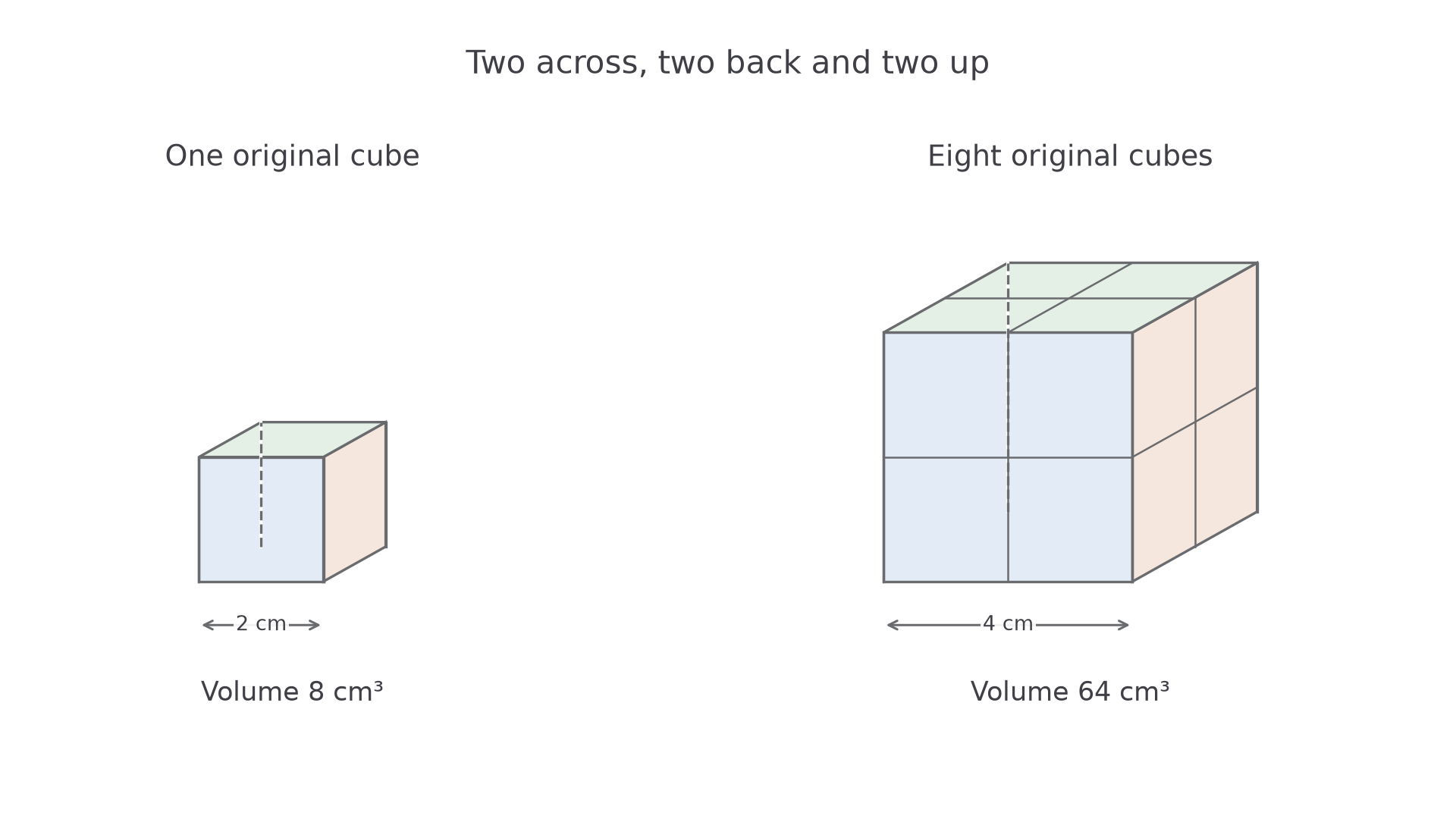
For a cuboid, scaling each dimension by gives . For a prism, the end area scales by and the length by , giving . Cone and sphere formulas also contain three multiplied lengths, so they give the same rule for similar solids.
Volume scale factor
For similar solids with length scale factor from A to B,
Here is corresponding surface area. In ratio form, lengths give areas and volumes .
Not given in the List of formulas: keep the square and cube relationships distinct.
Continue this lesson.
You’re previewing NovaLearn without an account. Create a free account to read the rest.
Create free account