E4.1, E4.5 - Planes and symmetry in solids
A solid needs more than a mirror line to describe its symmetry. E4.1 introduces planes, perpendicular bisectors, hemispheres and frustums; E4.5 uses planes and rotation axes to describe how three-dimensional shapes match themselves.
Planes and perpendicular bisectors
Can a cylinder match itself after a turn of , even though a square prism cannot? To answer that later, distinguish a flat mirror surface from a line about which a solid turns.
A sheet of paper models part of a plane: a perfectly flat surface extending indefinitely in every direction within that surface. A cube face lies in a plane, but the plane continues beyond the edges of the face. A curved cylinder surface does not lie in one plane. Two distinct planes can be parallel, or meet along a straight line, as two walls meet along a room's corner.
Perpendicular bisector
In a plane, the perpendicular bisector of a line segment is the straight line through its midpoint at to the segment.
Both conditions matter: it bisects the segment and is perpendicular to it.
[DIAGRAM: asset_name: Testing perpendicular bisectors; asset_slug: perpendicular_bisector_conditions; caption: Only the third line satisfies both midpoint and right-angle conditions.; description: Three planar panels show a segment AB. The first has a sloping line through its marked midpoint, the second a perpendicular line away from the midpoint, and the third a perpendicular line through midpoint M with matching AM and MB ticks. A small perspective plane patch behind the third diagram represents a flat surface that continues beyond the drawing.]
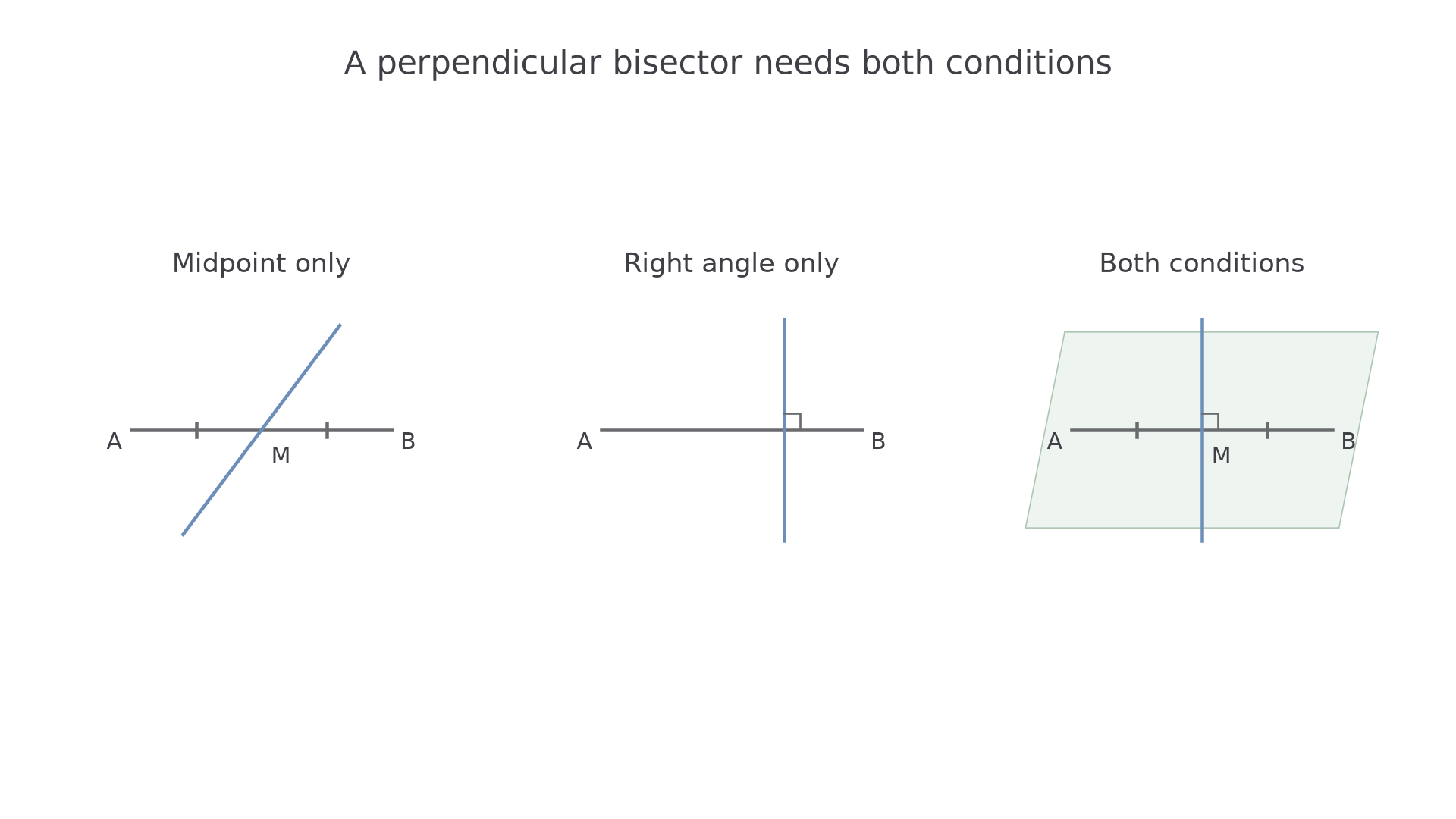
For example, if , its perpendicular bisector meets it at , with . A line through at bisects the segment but is not perpendicular. A line at through a point from is perpendicular but does not bisect it. You need to recognise and describe these properties; the name itself does not tell you to perform a compass construction.
Key idea
A plane is a flat two-dimensional surface in space. A perpendicular bisector in that plane is a line satisfying two exact conditions, not simply a line that looks central.
Check both conditions rather than just one.
Hemispheres and frustums
Imagine cutting a ball exactly through its centre. Each solid half has a curved outside and a flat circular base. Cutting elsewhere makes an unequal cap, not half the sphere.
Hemisphere and frustum
A hemisphere is half a sphere, obtained by a plane cut through the sphere's centre. Its boundary consists of one curved surface and one flat circular face.
A frustum of a cone or pyramid is the part between its base and a plane cut parallel to the base, after the smaller top cone or pyramid is removed.
[DIAGRAM: asset_name: Hemispheres and parallel cuts; asset_slug: hemisphere_and_frustums; caption: A central cut halves a sphere; a parallel cut removes the top of a cone or pyramid.; description: Three labelled perspective drawings show a hemisphere with circular flat base and curved surface, a right circular cone with a horizontal parallel cut and the upper small cone shown dashed above the retained frustum, and a square pyramid with a parallel square cut leaving a pyramidal frustum. Corresponding cut and base planes are indicated as parallel.]
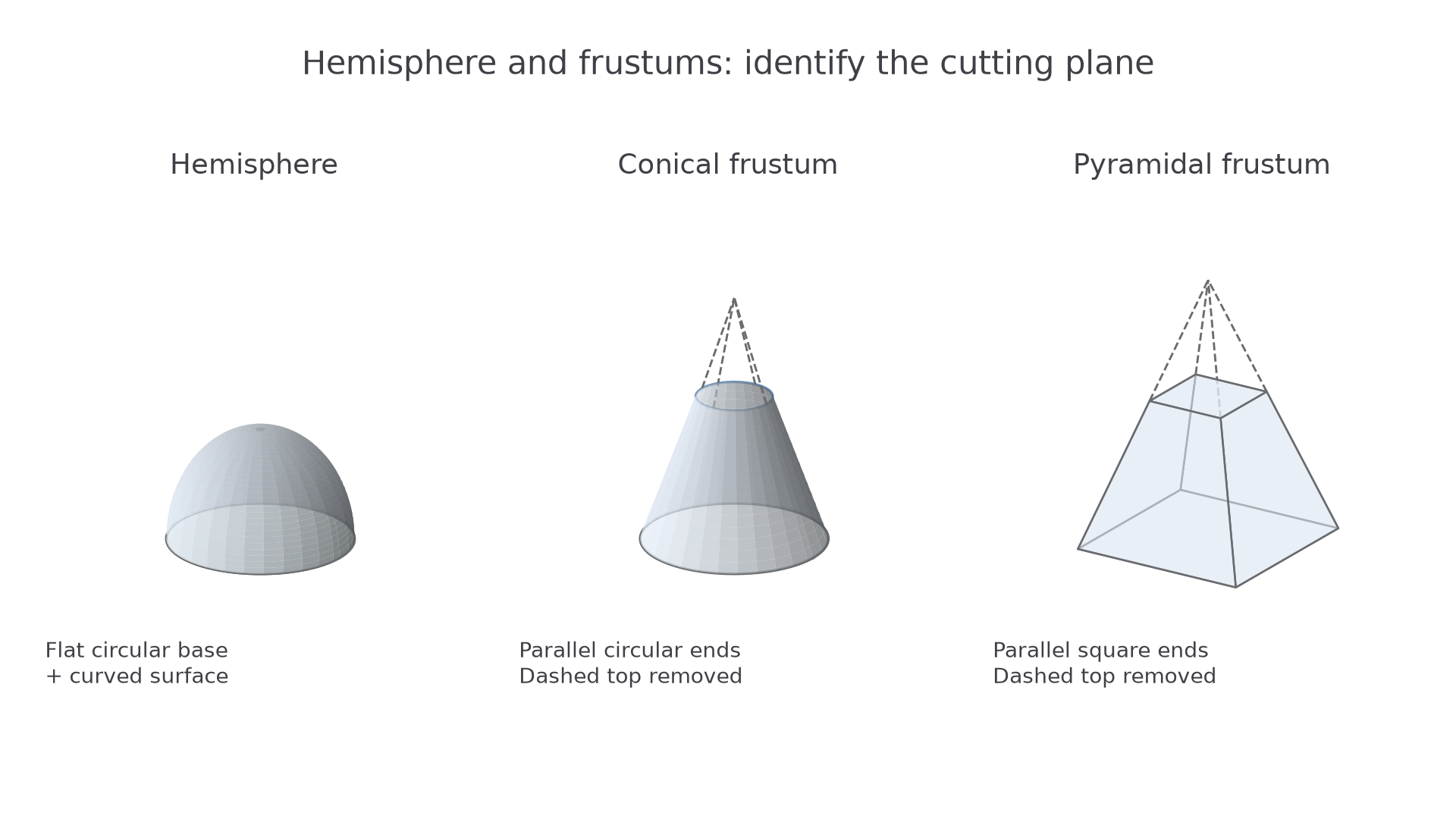
A semicircle is a flat half-disc; a hemisphere occupies space. A right circular cone cut parallel to its base leaves a frustum with two circular flat faces of different radii and one curved surface. A square-based pyramid cut parallel to its base leaves two square parallel faces and four trapezium-shaped side faces. Its edges are straight; the conical frustum's side surface is curved.
A sloping cut through a cone does not generally make the frustum described here, because the cut is not parallel to the base. Nor is an ordinary cylinder a conical frustum: removing the top of a non-degenerate cone leaves two unequal circular ends.
Watch out
“Every piece cut from a sphere is a hemisphere” overlooks the centre condition. Only a plane through the centre divides the sphere into two equal solid halves.
Use the shape of the faces as well as the cut direction.
Planes and axes of symmetry
For a solid, imagine a whole mirror plane passing through it. Reflecting the entire solid in that plane must reproduce the solid. Merely cutting it into two pieces of equal volume is not enough: the pieces must be mirror images.
Symmetry plane and rotation axis
A plane of symmetry reflects a solid onto itself. An axis of rotational symmetry is a line about which a turn smaller than a full turn can rotate the solid onto itself.
For a finite order, count matches in one full turn as in two dimensions. A circular solid may instead match through every angle about an axis.
Continue this lesson.
You’re previewing NovaLearn without an account. Create a free account to read the rest.
Create free account