E4.6 - Reasoning with irregular polygons
Irregular polygons keep the angle-sum rules without having equal angles. You will calculate missing interior and exterior angles, handle an inward-pointing corner carefully, and combine a polygon sum with angles in a smaller triangle.
Angle sums without equal angles
Can a six-sided polygon have a interior angle while its other corners are all right angles? An inward corner makes that possible. The total depends on the side count, not on all the angles being equal.
Convex and concave polygons
A simple polygon has a boundary that does not cross itself. It is convex if every interior angle is less than . It is concave if at least one interior angle is reflex, greater than .
An irregular polygon does not have both all sides equal and all angles equal. It may still have some equal sides or angles.
The interior sum also holds for irregular simple polygons. For a convex one, the fan from one vertex works exactly as before. A concave polygon can also be divided into triangles, but you must choose diagonals that remain inside: an arbitrary vertex fan may run outside the shape. At an inward corner, count the full reflex interior angle, not the small angle in the notch.
[DIAGRAM: asset_name: Convex and concave interior angles; asset_slug: irregular_interior_sums; caption: The inward corner contributes its reflex interior angle.; description: Three exact polygon panels show an irregular convex hexagon with interior angles 90, 135, 135, 90 and 135 degrees known and its sixth angle x; an L-shaped concave hexagon with five right angles and its reflex inward angle y; and a concave pentagon with two 90 degree corners, two 60 degree corners and a reflex inward angle z. The reflex arcs run inside the polygon, around the outside of the notch.]
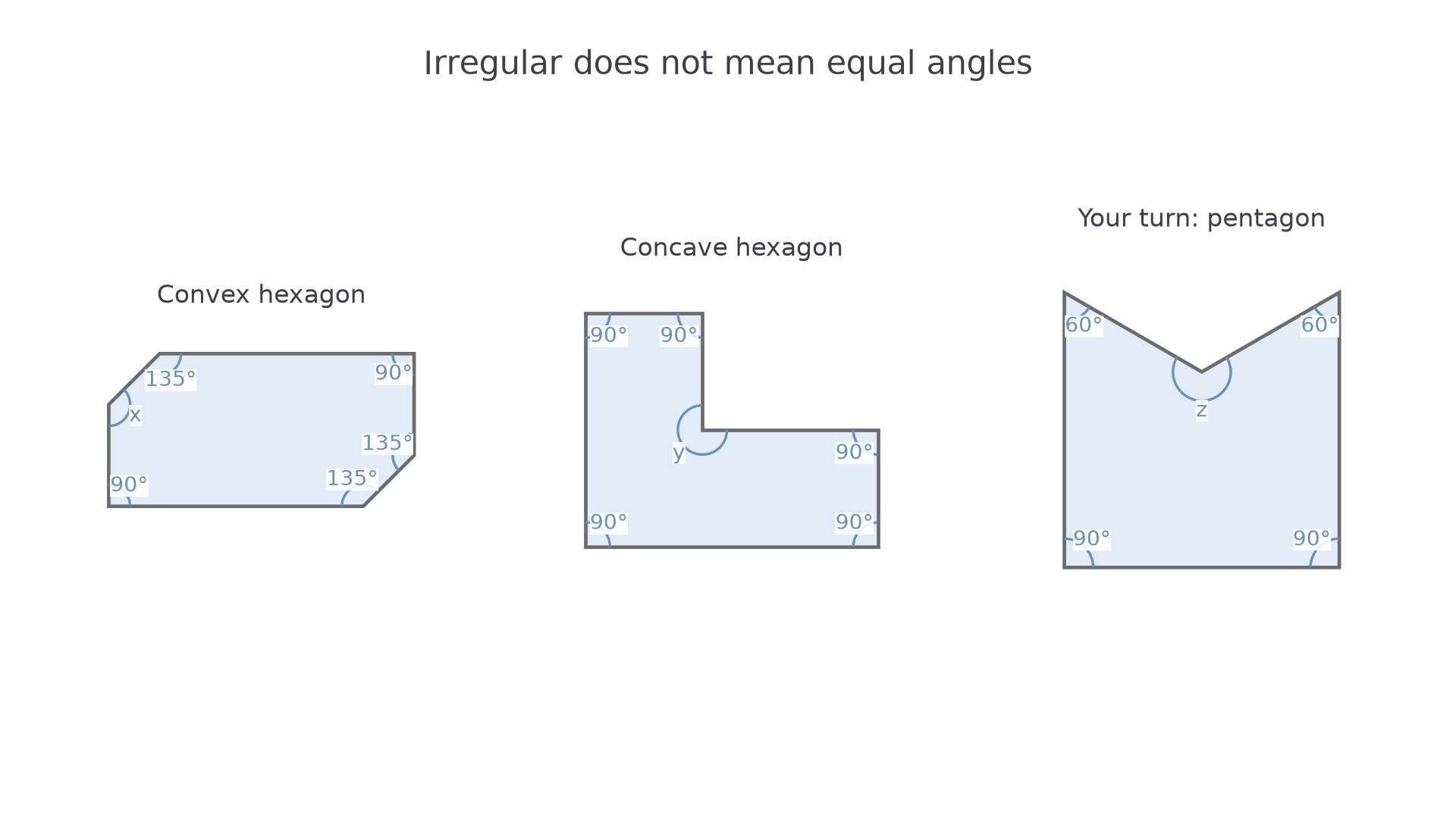
Worked example 1: unequal angles in a hexagon
Question. The convex hexagon in the first panel has five interior angles . Find its sixth interior angle .
Plan. Find the total for six sides, then subtract the five stated angles.
Answer. .
Check. There are two right angles and four angles: . Some angles are equal, but they are not all equal.
Keep six sides but change the shape to a concave one. The total stays ; the inward angle must be counted reflex.
Worked example 2: the L-shaped hexagon
Question. A simple L-shaped hexagon has five interior right angles. Find its sixth, inward-pointing interior angle .
Plan. Subtract the five right angles from the same hexagon total.
Answer. , a reflex angle.
Check. Around that vertex, the small notch is ; the polygon occupies the remaining . This agrees with the angle-sum result.
Watch out
“Every hexagon angle is ” requires equal angles. An irregular hexagon can contain , or reflex angles. Use the total, then the actual given information.
Count the sides before deciding the total in the new concave shape.
Interior and exterior relationships
Exterior angles need a consistent convention. For a convex polygon, walking anticlockwise round the boundary makes a left turn at every corner. Those positive turns total , even when they are unequal.
At a concave corner you turn the other way. If anticlockwise left turns are positive, a right turn is negative. Using these signed exterior turns keeps the total for a simple polygon walked anticlockwise. Adding the positive magnitudes of every small outside angle would lose the directions and generally give the wrong total.
Signed turning angle
For anticlockwise travel round a simple polygon, let be the interior angle and the signed exterior turn at a vertex. Then
A convex corner has . A reflex corner has . These formulas use turns with their signs, rather than unsigned outside-angle magnitudes.
Not given in the List of formulas: keep the direction with the turn.
[DIAGRAM: asset_name: Unequal and negative exterior turns; asset_slug: irregular_exterior_turns; caption: A right turn at a concave vertex subtracts from the total left turn.; description: Three anticlockwise pentagon walks show exterior turns outside the vertices. The convex example has 80, 50, 95 and 75 degrees plus unknown e. A concave example has turns 90, 90, 135, unknown e at its inward corner, and 135 degrees. A fresh concave example has turns 90, 90, 110, unknown e at the inward corner, and 110 degrees. Positive left-turn arcs and negative right-turn arcs have distinct pale blue and clay colours; arrowheads indicate the travel direction.]
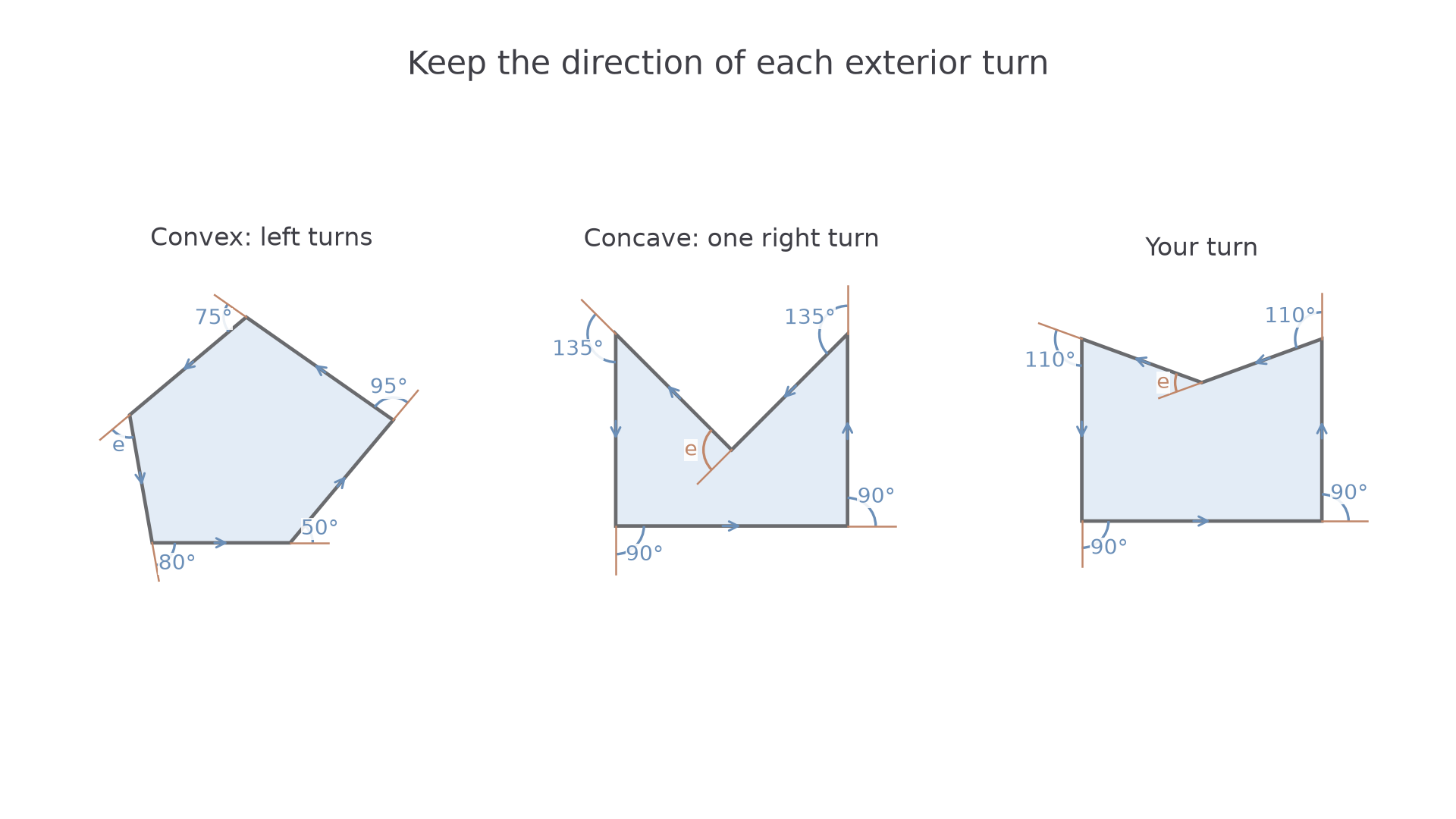
Worked example 3: unequal positive turns
Question. A convex pentagon's successive exterior turns are . Find and its adjacent interior angle.
Plan. Complete the full-turn sum, then subtract the exterior angle from a straight angle.
Answer. Exterior angle ; interior angle .
Check. The five interior angles are . Their sum is , the pentagon total.
Continue this lesson.
You’re previewing NovaLearn without an account. Create a free account to read the rest.
Create free account