C4.6; E4.6 - Angles at points and in triangles
An angle can be forced by the lines around it without being measured. You will calculate angles at points, at crossing lines, and inside triangles and quadrilaterals, giving a geometric reason for each step.
Angles at a point and on a line
Two lines cross and one angle is . Why can you find all four angles without a protractor? Begin with the amount of turning available around their common vertex.
Three-letter notation identifies an angle precisely. In , the middle letter is the vertex; the arms point towards and . Reversing the outside letters names the same marked angle: . An arc distinguishes the intended angle when a reflex turn is possible.
Angles at a point and on a straight line
Angles that fill one complete turn around a point, without gaps or overlaps, sum to . Adjacent angles filling one side of a straight line sum to .
Not given in the List of formulas: learn these angle facts.
A straight line provides a half-turn because its two rays point in opposite directions. Around a point you need the full turn, including any reflex sector. Do not select two angles merely because they share a vertex; together they must fill the relevant half-turn or full turn.
[DIAGRAM: asset_name: Completing a half-turn or full turn; asset_slug: line_and_point_angle_sums; caption: Identify the whole turn before subtracting the known sectors.; description: Three exact panels show A O B on a straight line with angle AOC 124 degrees and COB unknown; three rays around O partitioning the full turn into 124 degrees, 91 degrees and an unknown sector; and a fresh three-ray full turn partitioned into 137 degrees, 86 degrees and an unknown sector. Every marked arc follows its stated sector.]
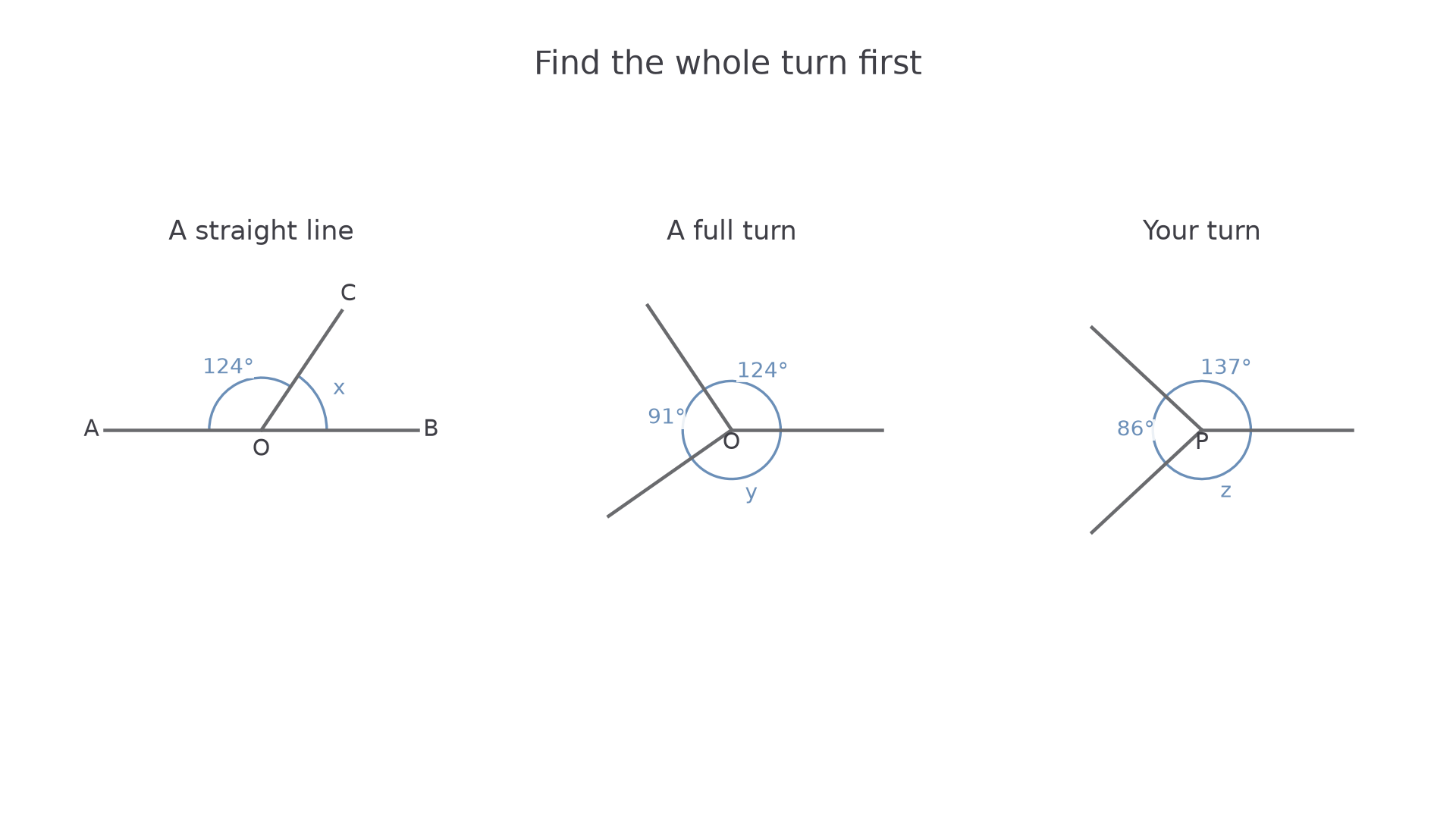
Worked example 1: one side of a line
Question. lie on a straight line. Ray divides one side into and . Find and give a reason.
Plan. Subtract the known angle from the half-turn on that side of the line.
Answer. , because angles on a straight line sum to .
Check. ; an obtuse sector and an acute sector together fill the half-turn.
Now the sectors fill the whole point rather than one side of a straight line. The total changes, not the subtraction strategy.
Worked example 2: the whole point
Question. Three adjacent sectors fill the full turn around . Their angles are , and . Find and give a reason.
Plan. Subtract both known sectors from one full turn.
Answer. , because angles at a point sum to .
Check. . Using would give a negative result, warning that a half-turn is the wrong whole.
Watch out
“Angles next to one another add to ” needs a straight-line condition. Adjacent angles can total other amounts; use the given straight line or the complete turn.
The fresh check specifies exactly which sectors fill the turn.
Vertically opposite angles
When two straight lines cross, they form two pairs of opposite angles. “Vertically” here means opposite at a vertex; the lines do not need to be vertical on the page.
Vertically opposite angles
Vertically opposite angles are the non-adjacent angles formed by two intersecting straight lines. Each opposite pair is equal.
Why? Each angle in an opposite pair adds to the same neighbouring angle to make . Subtracting that common neighbour leaves equal remainders. This explains the equality without relying on how accurately the picture is drawn.
[DIAGRAM: asset_name: Opposite and neighbouring angles at a crossing; asset_slug: vertically_opposite_crossings; caption: Opposite sectors are equal; neighbouring sectors on a line are supplementary.; description: Three pairs of straight lines AOB and COD cross at O. In the first angle BOC is 68 degrees, in the second 113 degrees and in the third 47 degrees. Angle AOD is labelled x and AOC is labelled y in each. The rays and arcs have exact coordinates consistent with each stated angle.]
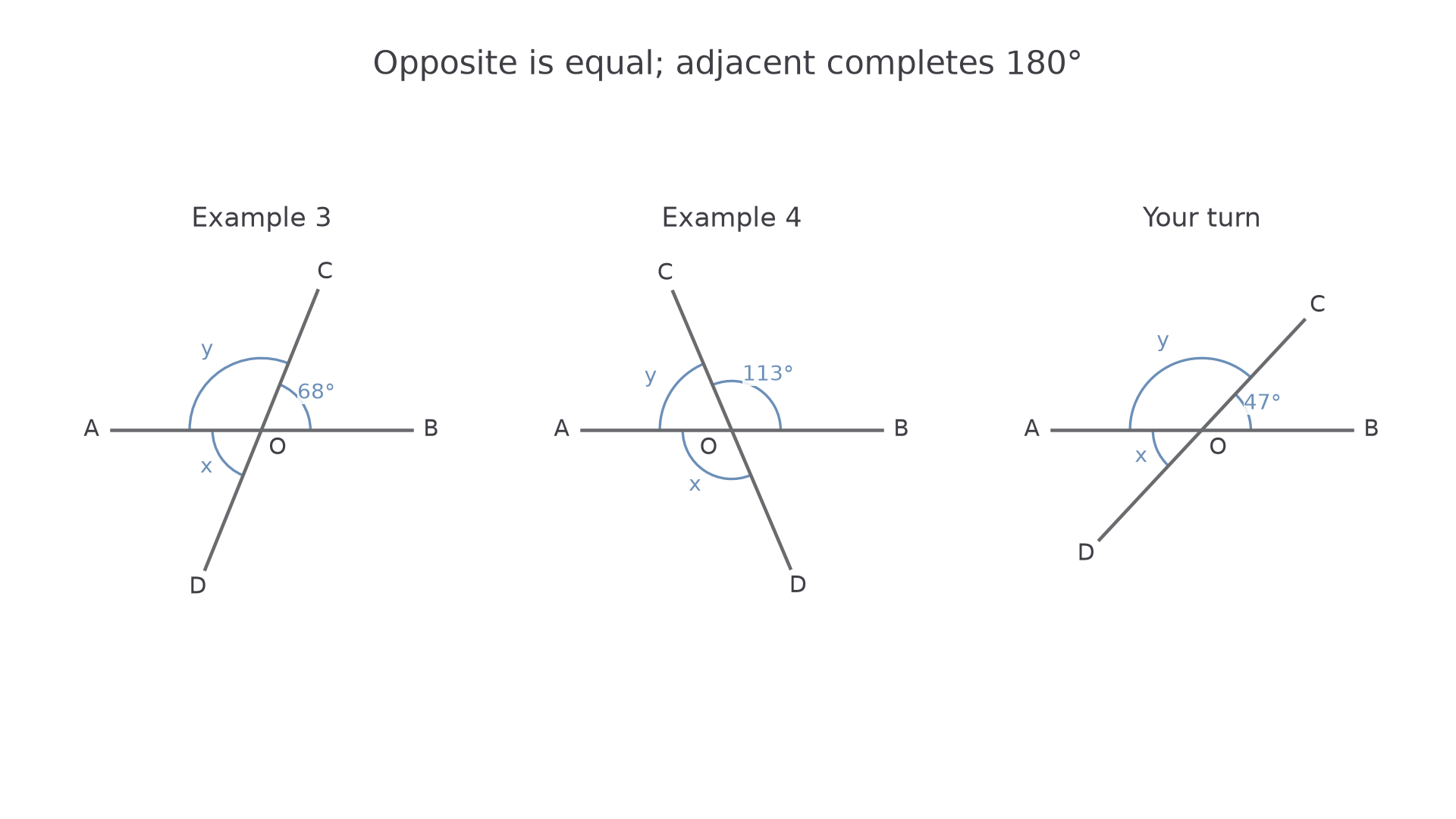
Worked example 3: acute opposite angles
Question. Straight lines and intersect at . Given , find and , giving reasons.
Plan. Copy the angle across the vertex, then complete a straight angle beside it.
Answer. and .
Check. The other opposite sector is also . Around the point, .
Continue this lesson.
You’re previewing NovaLearn without an account. Create a free account to read the rest.
Create free account